

330
J. DIAMOND
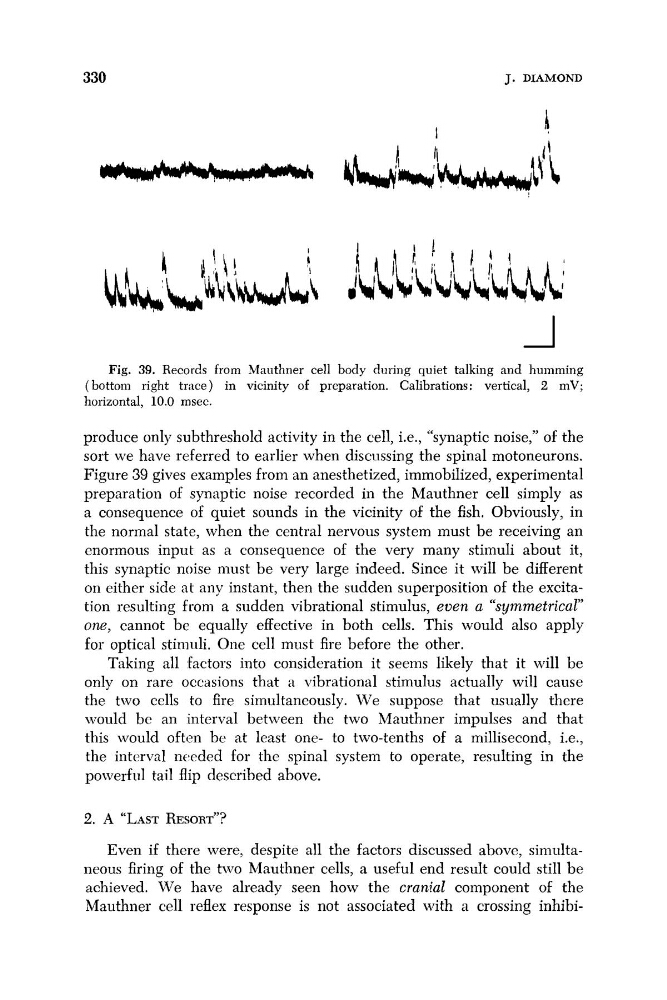
Fig. 39. Records from Mauthner cell body during quiet talking and humming
(bottom right trace) in vicinity of preparation. Calibrations: vertical, 2 mV;
horizontal, 10.0 msec.
produce only subthreshold activity in the cell, i.e., “synaptic noise,” of the
sort we have referred to earlier when discussing the spinal motoneurons.
Figure 39 gives examples from an anesthetized, immobilized, experimental
preparation of synaptic noise recorded in the Mauthner cell simply as
a consequence of quiet sounds in the vicinity of the fish. Obviously, in
the normal state, when the central nervous system must be receiving an
enormous input as a consequence of the very many stimuli about it,
this synaptic noise must be very large indeed. Since it will be different
on either side at any instant, then the sudden superposition of the excitation resulting from a sudden vibrational stimulus, even a “symmetrical”
one, cannot be equally effective in both cells. This would also apply
for optical stimuli. One cell must fire before the other.
Taking all Factors into consideration it seems likely that it will be
only on rare occasions that a vibrational stimulus actually will cause
the two cells to fire simultaneously. We suppose that usually there
would be an interval between the two Mauthner impulses and that
this would often be at least one- to two-tenths of a millisecond, i.e.,
the interval necded for the spinal system to operate, resulting in the
powerful tail flip described above.
2. A “LAST RESORT”?
Even if there were, despite all the factors discussed above, simultaneous firing of the two Mauthner cells, a useful end result could still be
achieved. We have already seen how the cranial component of the
Mauthner cell reflex response is not associated with a crossing inhibi-
J. DIAMOND
Fig. 39. Records from Mauthner cell body during quiet talking and humming
(bottom right trace) in vicinity of preparation. Calibrations: vertical, 2 mV;
horizontal, 10.0 msec.
produce only subthreshold activity in the cell, i.e., “synaptic noise,” of the
sort we have referred to earlier when discussing the spinal motoneurons.
Figure 39 gives examples from an anesthetized, immobilized, experimental
preparation of synaptic noise recorded in the Mauthner cell simply as
a consequence of quiet sounds in the vicinity of the fish. Obviously, in
the normal state, when the central nervous system must be receiving an
enormous input as a consequence of the very many stimuli about it,
this synaptic noise must be very large indeed. Since it will be different
on either side at any instant, then the sudden superposition of the excitation resulting from a sudden vibrational stimulus, even a “symmetrical”
one, cannot be equally effective in both cells. This would also apply
for optical stimuli. One cell must fire before the other.
Taking all Factors into consideration it seems likely that it will be
only on rare occasions that a vibrational stimulus actually will cause
the two cells to fire simultaneously. We suppose that usually there
would be an interval between the two Mauthner impulses and that
this would often be at least one- to two-tenths of a millisecond, i.e.,
the interval necded for the spinal system to operate, resulting in the
powerful tail flip described above.
2. A “LAST RESORT”?
Even if there were, despite all the factors discussed above, simultaneous firing of the two Mauthner cells, a useful end result could still be
achieved. We have already seen how the cranial component of the
Mauthner cell reflex response is not associated with a crossing inhibi-