

9. THE MAUTHNER CELL
0
b
C
e
323
- ' /
.*
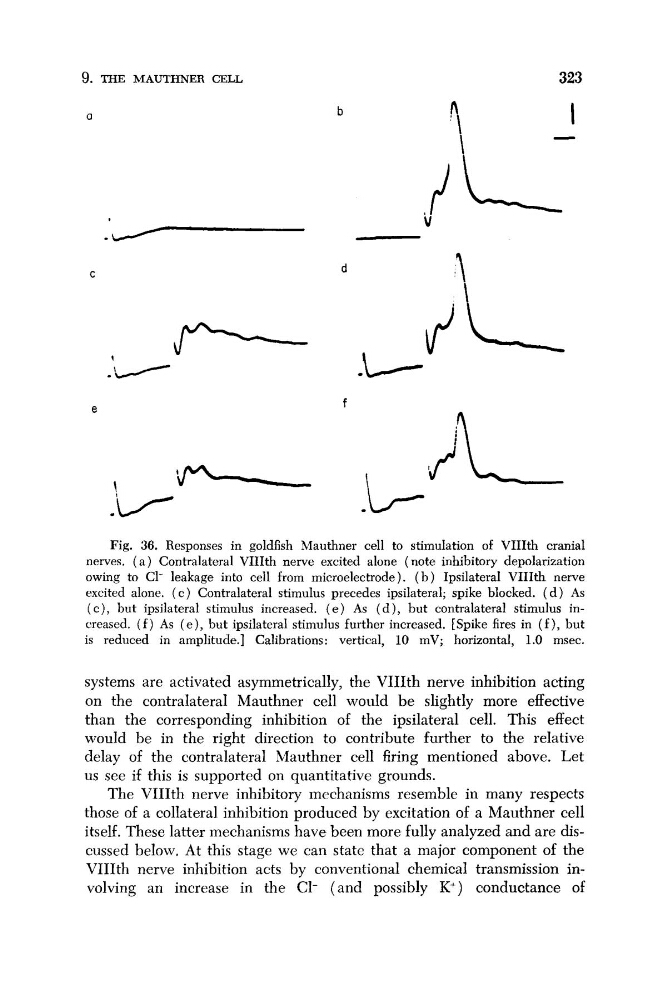
Fig. 36. Responses in goldfish Mauthner cell to stimulation of VIIIth cranial
nerves. ( a ) Contralateral VIIIth nerve excited alone (note inhibitory depolarization
owing to C1- leakage into cell from microelectrode). ( b ) Ipsilateral VIIIth nerve
excited alone. ( c ) Contralateral stimulus precedes ipsilateral; spike blocked. ( d ) As
( c ) , but ipsilateral stimulus increased. ( e ) As ( d ) , but contralateral stimulus increased. ( f ) As ( e ) , but ipsilateral stimulus further increased. [Spike fires in ( f ), but
is reduced in amplitude.] Calibrations: vertical, 10 mV; horizontal, 1.0 msec.
systems are activated asymmetrically, the VIIIth nerve inhibition acting
on the contralatera1 Mauthner cell would be slightly more effective
than the corresponding inhibition of the ipsilateral cell. This effect
would be in the right direction to contribute further to the relative
delay of the contralateral Mauthner cell firing mentioned above. Let
us see if this is supported on quantitative grounds.
The VIIIth nerve inhibitory mechanisms resemble in many respects
those of a collateral inhibition produced by excitation of a Mauthner cell
itself. These latter mechanisms have been more fully analyzed and are discussed below, At this stage we can state that a major component of the
VIIIth nerve inhibition acts by conventional chemical transmission involving an increase in the C1- (and possibly K' ) conductance of
0
b
C
e
323
- ' /
.*
Fig. 36. Responses in goldfish Mauthner cell to stimulation of VIIIth cranial
nerves. ( a ) Contralateral VIIIth nerve excited alone (note inhibitory depolarization
owing to C1- leakage into cell from microelectrode). ( b ) Ipsilateral VIIIth nerve
excited alone. ( c ) Contralateral stimulus precedes ipsilateral; spike blocked. ( d ) As
( c ) , but ipsilateral stimulus increased. ( e ) As ( d ) , but contralateral stimulus increased. ( f ) As ( e ) , but ipsilateral stimulus further increased. [Spike fires in ( f ), but
is reduced in amplitude.] Calibrations: vertical, 10 mV; horizontal, 1.0 msec.
systems are activated asymmetrically, the VIIIth nerve inhibition acting
on the contralatera1 Mauthner cell would be slightly more effective
than the corresponding inhibition of the ipsilateral cell. This effect
would be in the right direction to contribute further to the relative
delay of the contralateral Mauthner cell firing mentioned above. Let
us see if this is supported on quantitative grounds.
The VIIIth nerve inhibitory mechanisms resemble in many respects
those of a collateral inhibition produced by excitation of a Mauthner cell
itself. These latter mechanisms have been more fully analyzed and are discussed below, At this stage we can state that a major component of the
VIIIth nerve inhibition acts by conventional chemical transmission involving an increase in the C1- (and possibly K' ) conductance of