

9. THE MAUTHNER CELL
301
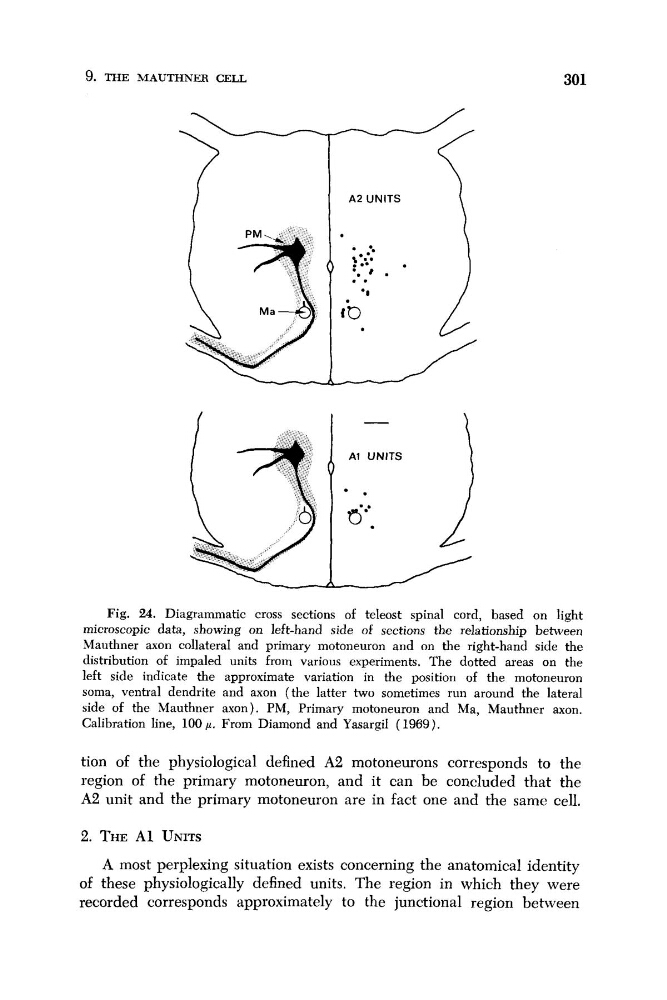
Fig. 24. Diagrammatic cross sections of teleost spinal cord, based on light
microscopic data, showing on left-hand side of sections the relationship between
Mauthner axon collateral and primary motoneuron and on the right-hand side the
distribution of impaled units from various experiments. The dotted areas on the
left side indicate the approximate variation in the position of the motoneuron
soma, ventral dendrite and axon (the latter two sometimes run around the lateral
side of the Mauthner axon). PM, Primary motoneuron and Ma, Mauthner axon.
Calibration line, 100 p . From Diamond and Yasargil (1969).
tion of the physiological defined A2 motoneurons corresponds to the
region of the primary motoneuron, and it can be concluded that the
A2 unit and the primary motoneuron are in fact one and the same cell.
2. THE A1 UNITS
A most perplexing situation exists concerning the anatomical identity
of these physiologically defined units. The region in which they were
recorded corresponds approximately to the junctional region between
301
Fig. 24. Diagrammatic cross sections of teleost spinal cord, based on light
microscopic data, showing on left-hand side of sections the relationship between
Mauthner axon collateral and primary motoneuron and on the right-hand side the
distribution of impaled units from various experiments. The dotted areas on the
left side indicate the approximate variation in the position of the motoneuron
soma, ventral dendrite and axon (the latter two sometimes run around the lateral
side of the Mauthner axon). PM, Primary motoneuron and Ma, Mauthner axon.
Calibration line, 100 p . From Diamond and Yasargil (1969).
tion of the physiological defined A2 motoneurons corresponds to the
region of the primary motoneuron, and it can be concluded that the
A2 unit and the primary motoneuron are in fact one and the same cell.
2. THE A1 UNITS
A most perplexing situation exists concerning the anatomical identity
of these physiologically defined units. The region in which they were
recorded corresponds approximately to the junctional region between