

252
kCF, FLOCK
of stimulus direction: A hair cell which is depolarized by cranial displacement is hyperpolarized by caudal displacement whereas displacement perpendicular to the axis of the canal gives little or no output. Different hair
cells have responses of opposite polarities as seen in Fig. 10 which shows
recordings from two hair cells 180” out of phase.
In the lateral line, as in the inner ear, microphonic potentials can be
recorded with gross extracellular electrodes. The hair cells have been
suggested as the responsible generators, a theory which now seems to be
confirmed. It should then represent the summed output of all hair cells
“seen” by the electrode. Such summation of extracellular current may
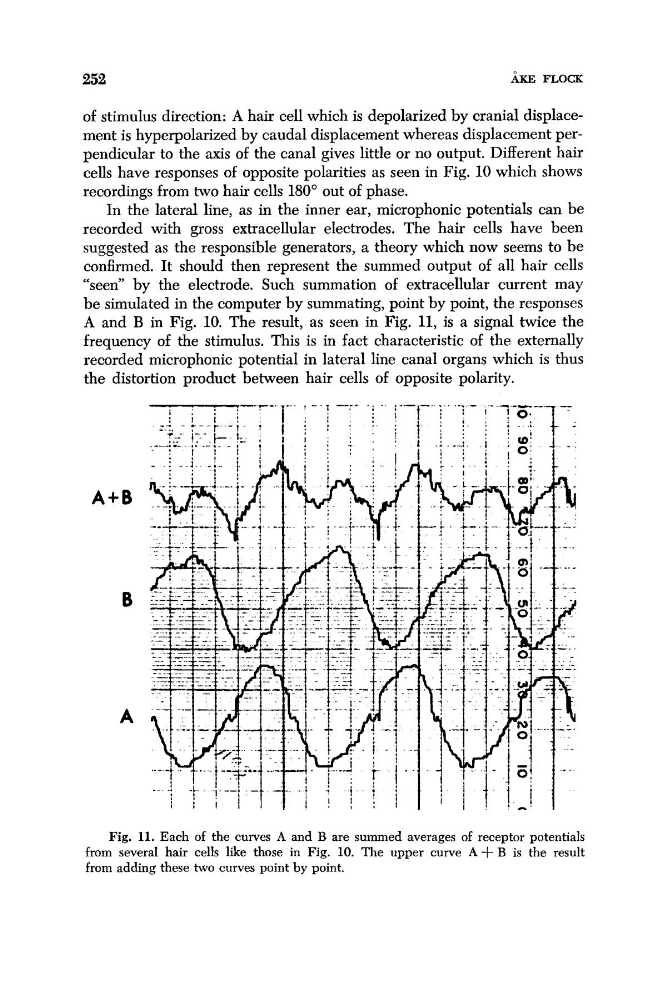
be simulated in the computer by summating, point by point, the responses
A and B in Fig. 10. The result, as seen in Fig. 11, is a signal twice the
frequency of the stimulus. This is in fact characteristic of the externally
recorded microphonic potential in lateral line canal organs which is thus
the distortion product between hair cells of opposite polarity.
A+B
B
A
Fig. 11. Each of the curves A and B are summed averages of receptor potentials
from several hair cells like those in Fig. 10. The upper curve A f B is the result
from adding these two curves point by point.
kCF, FLOCK
of stimulus direction: A hair cell which is depolarized by cranial displacement is hyperpolarized by caudal displacement whereas displacement perpendicular to the axis of the canal gives little or no output. Different hair
cells have responses of opposite polarities as seen in Fig. 10 which shows
recordings from two hair cells 180” out of phase.
In the lateral line, as in the inner ear, microphonic potentials can be
recorded with gross extracellular electrodes. The hair cells have been
suggested as the responsible generators, a theory which now seems to be
confirmed. It should then represent the summed output of all hair cells
“seen” by the electrode. Such summation of extracellular current may
be simulated in the computer by summating, point by point, the responses
A and B in Fig. 10. The result, as seen in Fig. 11, is a signal twice the
frequency of the stimulus. This is in fact characteristic of the externally
recorded microphonic potential in lateral line canal organs which is thus
the distortion product between hair cells of opposite polarity.
A+B
B
A
Fig. 11. Each of the curves A and B are summed averages of receptor potentials
from several hair cells like those in Fig. 10. The upper curve A f B is the result
from adding these two curves point by point.