

178
WILLIAM N. TAVOLGA
and probably do not represent true thresholds or audiograms, since it is
quite probable that under conditions of low ambient noise the shape and
level of the sensitivity curves would be very different.
In other studies on the hearing of sharks, Wisby et al. (1964) and
D. R. Nelson (1967b) obtained heart-rate responses to sound pressures
of about +30 to +40 dB pb in the lemon shark, Negaprion brevirostris,
at frequencies up to 1000 Hz. Dijkgraaf (196313) obtained similar values
at 180 Hz in the dogfish, Scyliorhinus caniculu, using classic conditioning.
Neither of these studies showed thresholds as low as those reported by
Kritzler and Wood (1961).
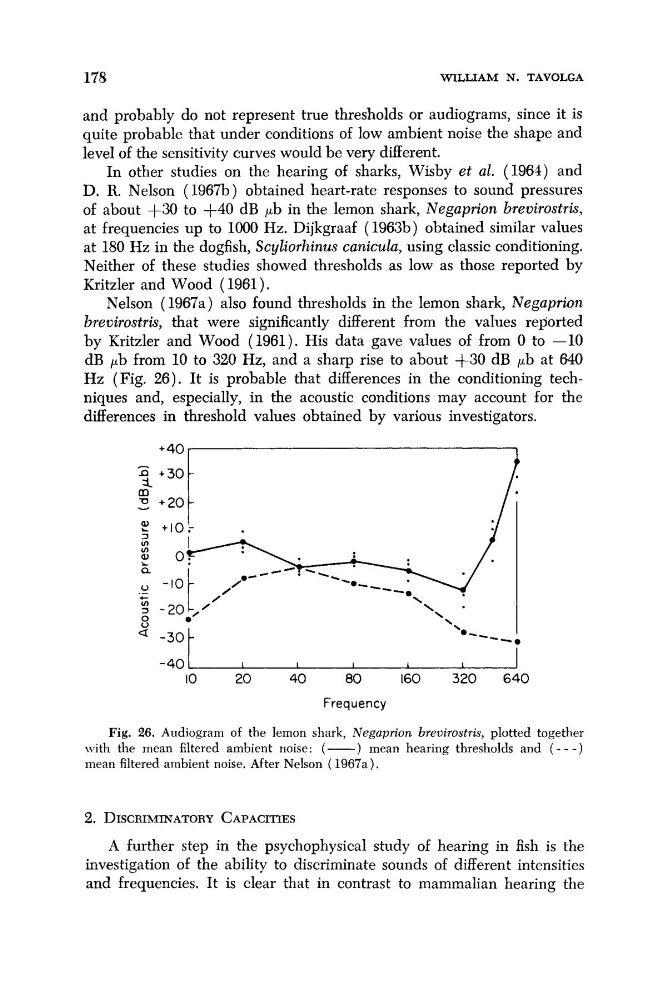
Nelson (1967a) also found thresholds in the lemon shark, Negaprion
breuirostris, that were significantly different from the values reported
by Kritzler and Wood (1961). His data gave values of from 0 to -10
dB pb from 10 to 320 Hz, and a sharp rise to about +30 dB pb at 640
Hz (Fig. 26). It is probable that differences in the conditioning techniques and, especially, in the acoustic conditions may account for the
differences in threshold values obtained by various investigators.
% +30
m
- I
2 +20
I
- 40
1 0
20
40
80
160
320
640
Frequency
Fig. 26. Audiogram of the lemon shark, Negaprion breuirostris, plotted together
with the mean filtered ambient noise: (-)
mean hearing thresholds and ( - - - )
mean filtered ambient noise. After Nelson ( 1967a).
2. DISCRIMINATORY CAPACITIES
A further step in the psychophysical study of hearing in fish is the
investigation of the ability to discriminate sounds of different intensities
and frequencies. It is clear that in contrast to mammalian hearing the
WILLIAM N. TAVOLGA
and probably do not represent true thresholds or audiograms, since it is
quite probable that under conditions of low ambient noise the shape and
level of the sensitivity curves would be very different.
In other studies on the hearing of sharks, Wisby et al. (1964) and
D. R. Nelson (1967b) obtained heart-rate responses to sound pressures
of about +30 to +40 dB pb in the lemon shark, Negaprion brevirostris,
at frequencies up to 1000 Hz. Dijkgraaf (196313) obtained similar values
at 180 Hz in the dogfish, Scyliorhinus caniculu, using classic conditioning.
Neither of these studies showed thresholds as low as those reported by
Kritzler and Wood (1961).
Nelson (1967a) also found thresholds in the lemon shark, Negaprion
breuirostris, that were significantly different from the values reported
by Kritzler and Wood (1961). His data gave values of from 0 to -10
dB pb from 10 to 320 Hz, and a sharp rise to about +30 dB pb at 640
Hz (Fig. 26). It is probable that differences in the conditioning techniques and, especially, in the acoustic conditions may account for the
differences in threshold values obtained by various investigators.
% +30
m
- I
2 +20
I
- 40
1 0
20
40
80
160
320
640
Frequency
Fig. 26. Audiogram of the lemon shark, Negaprion breuirostris, plotted together
with the mean filtered ambient noise: (-)
mean hearing thresholds and ( - - - )
mean filtered ambient noise. After Nelson ( 1967a).
2. DISCRIMINATORY CAPACITIES
A further step in the psychophysical study of hearing in fish is the
investigation of the ability to discriminate sounds of different intensities
and frequencies. It is clear that in contrast to mammalian hearing the