

6. SOUND PRODUCTION AND DETECTION
169
Axis of sensitivity
-
Kinocilium
Stereoci I io
Cuticle
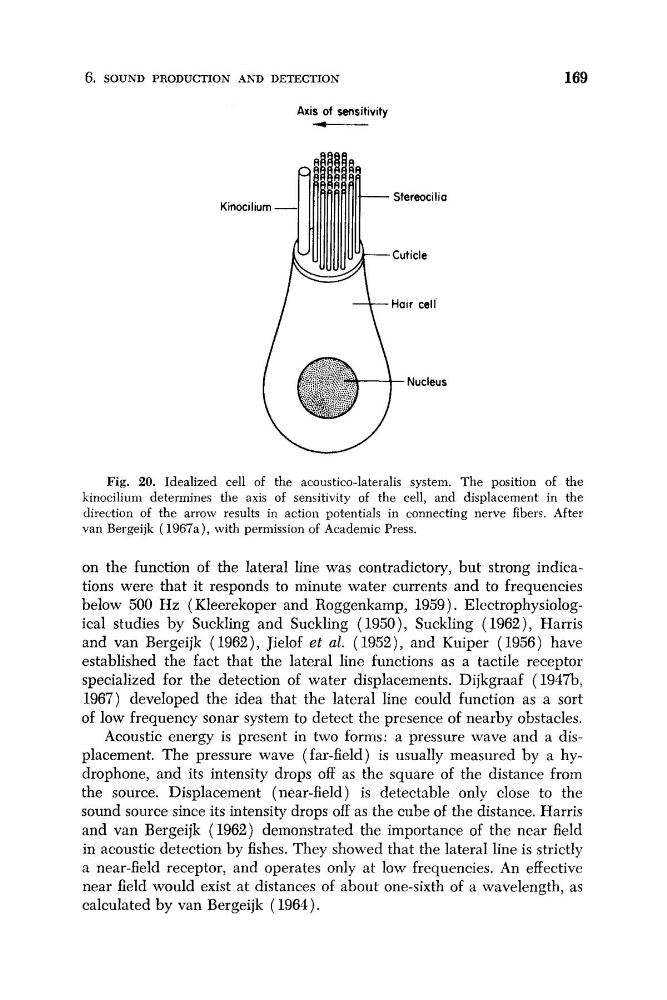
Fig. 20. Idealized cell of the acoustico-lateralis system. The position of the
kinocilium determines the axis of sensitivity of the cell, and displacement in the
direction of the arrow results in action potentials in connecting nerve fibers. After
van Bergeijk (1967a), with permission of Academic Press.
on the function of the lateral line was contradictory, but strong indications were that it responds to minute water currents and to frequencies
below 500 Hz (Kleerekoper and Roggenkamp, 1959). Elcctrophysiological studies by Suckling and Suckling (1950), Suckling (1962), Harris
and van Bergeijk (1962), Jielof et al. ( 1952), and Kuiper (1956) have
established the fact that the lateral line functions as a tactile receptor
specialized for the detection of water displacements. Dijkgraaf ( 194713,
1967) developed the idea that the lateral line could function as a sort
of low frequency sonar system to detect the presence of nearby obstacles.
Acoustic energy is present in two forms: a pressure wave and a displacement. The pressure wave (far-field) is usually measured by a hydrophone, and its intensity drops off as the square of the distance from
the source. Displacement (near-field) is detectable only close to the
sound source since its intensity drops off as the cube of the distance. Harris
and van Bergeijk (1962) demonstrated the importance of the near field
in acoustic detection by fishes. They showed that the lateral line is strictly
a near-field receptor, and operates only at low frequencies. An effective
near field would exist at distances of about one-sixth of a wavelength, as
calculated by van Bergeijk (1964).
169
Axis of sensitivity
-
Kinocilium
Stereoci I io
Cuticle
Fig. 20. Idealized cell of the acoustico-lateralis system. The position of the
kinocilium determines the axis of sensitivity of the cell, and displacement in the
direction of the arrow results in action potentials in connecting nerve fibers. After
van Bergeijk (1967a), with permission of Academic Press.
on the function of the lateral line was contradictory, but strong indications were that it responds to minute water currents and to frequencies
below 500 Hz (Kleerekoper and Roggenkamp, 1959). Elcctrophysiological studies by Suckling and Suckling (1950), Suckling (1962), Harris
and van Bergeijk (1962), Jielof et al. ( 1952), and Kuiper (1956) have
established the fact that the lateral line functions as a tactile receptor
specialized for the detection of water displacements. Dijkgraaf ( 194713,
1967) developed the idea that the lateral line could function as a sort
of low frequency sonar system to detect the presence of nearby obstacles.
Acoustic energy is present in two forms: a pressure wave and a displacement. The pressure wave (far-field) is usually measured by a hydrophone, and its intensity drops off as the square of the distance from
the source. Displacement (near-field) is detectable only close to the
sound source since its intensity drops off as the cube of the distance. Harris
and van Bergeijk (1962) demonstrated the importance of the near field
in acoustic detection by fishes. They showed that the lateral line is strictly
a near-field receptor, and operates only at low frequencies. An effective
near field would exist at distances of about one-sixth of a wavelength, as
calculated by van Bergeijk (1964).