

6. SOUND PRODUCTION AND DETECTION
161
I
I
0.2
0.4
0.6
0.8
I .o
sec
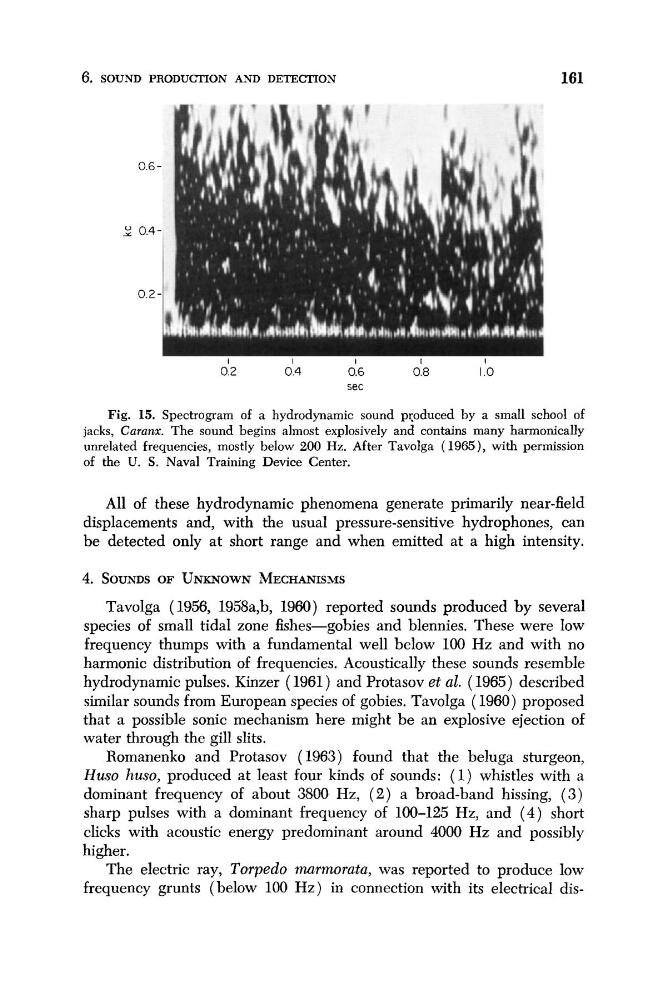
Fig. 15. Spectrogram of a hydrodynamic sound prpduced by a small school of
jacks, Caranx. The sound begins almost explosively and contains many harmonically
unrelated frequencies, mostly below 200 Hz. After Tavolga (196Fi), with permission
of the U. S . Naval Training Device Center.
All of these hydrodynamic phenomena generate primarily near-field
displacements and, with the usual pressure-sensitive hydrophones, can
be detected only at short range and when emitted at a high intensity.
4. SOUNDS OF UNKNOWN MECHANISMS
Tavolga (1956, 1958a,b, 1960) reported sounds produced by several
species of small tidal zone fishes-gobies and blennies. These were low
frequency thumps with a fundamental well below 100 Hz and with no
harmonic distribution of frequencies. Acoustically these sounds resemble
hydrodynamic pulses. Kinzer (1961) and Protasov et al. (1965) described
similar sounds from European species of gobies. Tavolga (1960) proposed
that a possible sonic mechanism here might be an explosive ejection of
water through the gill slits.
Romanenko and Protasov (1963) found that the beluga sturgeon,
Huso huso, produced at least four kinds of sounds: (1) whistles with a
dominant frequency of about 3800 Hz, ( 2 ) a broad-band hissing, ( 3 )
sharp pulses with a dominant frequency of 100-125 Hz, and ( 4 ) short
clicks with acoustic energy predominant around 4000 Hz and possibly
higher.
The electric ray, Torpedo marmorata, was reported to produce low
frequency grunts (below 100 Hz) in connection with its electrical dis-
161
I
I
0.2
0.4
0.6
0.8
I .o
sec
Fig. 15. Spectrogram of a hydrodynamic sound prpduced by a small school of
jacks, Caranx. The sound begins almost explosively and contains many harmonically
unrelated frequencies, mostly below 200 Hz. After Tavolga (196Fi), with permission
of the U. S . Naval Training Device Center.
All of these hydrodynamic phenomena generate primarily near-field
displacements and, with the usual pressure-sensitive hydrophones, can
be detected only at short range and when emitted at a high intensity.
4. SOUNDS OF UNKNOWN MECHANISMS
Tavolga (1956, 1958a,b, 1960) reported sounds produced by several
species of small tidal zone fishes-gobies and blennies. These were low
frequency thumps with a fundamental well below 100 Hz and with no
harmonic distribution of frequencies. Acoustically these sounds resemble
hydrodynamic pulses. Kinzer (1961) and Protasov et al. (1965) described
similar sounds from European species of gobies. Tavolga (1960) proposed
that a possible sonic mechanism here might be an explosive ejection of
water through the gill slits.
Romanenko and Protasov (1963) found that the beluga sturgeon,
Huso huso, produced at least four kinds of sounds: (1) whistles with a
dominant frequency of about 3800 Hz, ( 2 ) a broad-band hissing, ( 3 )
sharp pulses with a dominant frequency of 100-125 Hz, and ( 4 ) short
clicks with acoustic energy predominant around 4000 Hz and possibly
higher.
The electric ray, Torpedo marmorata, was reported to produce low
frequency grunts (below 100 Hz) in connection with its electrical dis-