

158
WLLLIAM N. TAVOLCA
0.2
0.4 t 0.6
sec
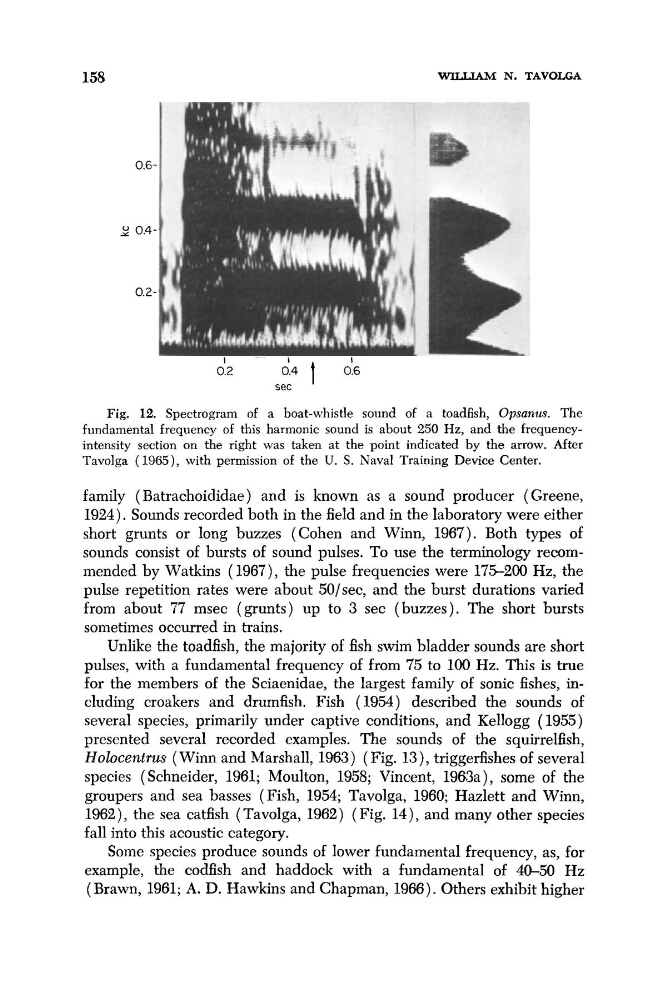
Fig. 12. Spectrogram of a boat-whistle sound of a toadfish, Opsanzls. The
fundamental frequency of this harmonic sound is about 250 Hz, and the frequencyintensity section on the right was taken at the point indicated by the arrow. After
Tavolga (1965), with permission of the U. S. Naval Training Device Center.
family (Batrachoididae) and is known as a sound producer (Greene,
1924). Sounds recorded both in the field and in the laboratory were either
short grunts or long buzzes (Cohen and Winn, 1967). Both types of
sounds consist of bursts of sound pulses. To use the terminology recommended by Watkins (1967), the pulse frequencies were 175-200 Hz, the
pulse repetition rates were about 50/sec, and the burst durations varied
from about 77 msec (grunts) up to 3 sec (buzzes). The short bursts
sometimes occurred in trains.
Unlike the toadfish, the majority of fish swim bladder sounds are short
pulses, with a fundamental frequency of from 75 to 100 Hz. This is true
for the members of the Sciaenidae, the largest family of sonic fishes, including croakers and drumfish. Fish (1954) described the sounds of
several species, primarily under captive conditions, and Kellogg ( 1955)
presented several recorded examples. The sounds of the squirrelfish,
Holocentrus ( Winn and Marshall, 1963) (Fig. 13), triggerfishes of several
species (Schneider, 1961; Moulton, 1958; Vincent, 1963a), some of the
groupers and sea basses (Fish, 1954; Tavolga, 1960; Hazlett and Winn,
1962), the sea catfish (Tavolga, 1962) (Fig. 14), and many other species
fall into this acoustic category.
Some species produce sounds of lower fundamental frequency, as, for
example, the codfish and haddock with a fundamental of 40-50 Hz
( Brawn, 1961; A. D. Hawkins and Chapman, 1966). Others exhibit higher
WLLLIAM N. TAVOLCA
0.2
0.4 t 0.6
sec
Fig. 12. Spectrogram of a boat-whistle sound of a toadfish, Opsanzls. The
fundamental frequency of this harmonic sound is about 250 Hz, and the frequencyintensity section on the right was taken at the point indicated by the arrow. After
Tavolga (1965), with permission of the U. S. Naval Training Device Center.
family (Batrachoididae) and is known as a sound producer (Greene,
1924). Sounds recorded both in the field and in the laboratory were either
short grunts or long buzzes (Cohen and Winn, 1967). Both types of
sounds consist of bursts of sound pulses. To use the terminology recommended by Watkins (1967), the pulse frequencies were 175-200 Hz, the
pulse repetition rates were about 50/sec, and the burst durations varied
from about 77 msec (grunts) up to 3 sec (buzzes). The short bursts
sometimes occurred in trains.
Unlike the toadfish, the majority of fish swim bladder sounds are short
pulses, with a fundamental frequency of from 75 to 100 Hz. This is true
for the members of the Sciaenidae, the largest family of sonic fishes, including croakers and drumfish. Fish (1954) described the sounds of
several species, primarily under captive conditions, and Kellogg ( 1955)
presented several recorded examples. The sounds of the squirrelfish,
Holocentrus ( Winn and Marshall, 1963) (Fig. 13), triggerfishes of several
species (Schneider, 1961; Moulton, 1958; Vincent, 1963a), some of the
groupers and sea basses (Fish, 1954; Tavolga, 1960; Hazlett and Winn,
1962), the sea catfish (Tavolga, 1962) (Fig. 14), and many other species
fall into this acoustic category.
Some species produce sounds of lower fundamental frequency, as, for
example, the codfish and haddock with a fundamental of 40-50 Hz
( Brawn, 1961; A. D. Hawkins and Chapman, 1966). Others exhibit higher