

6. SOUND PRODUCTION AND DETECTION
141
Wand -dependent bubble and spmy m s e
Heavy precipitation
+Oceanic
traffic
L"
I
1 0
10'
lo3
lo4
lo5
Frequency (Hz)
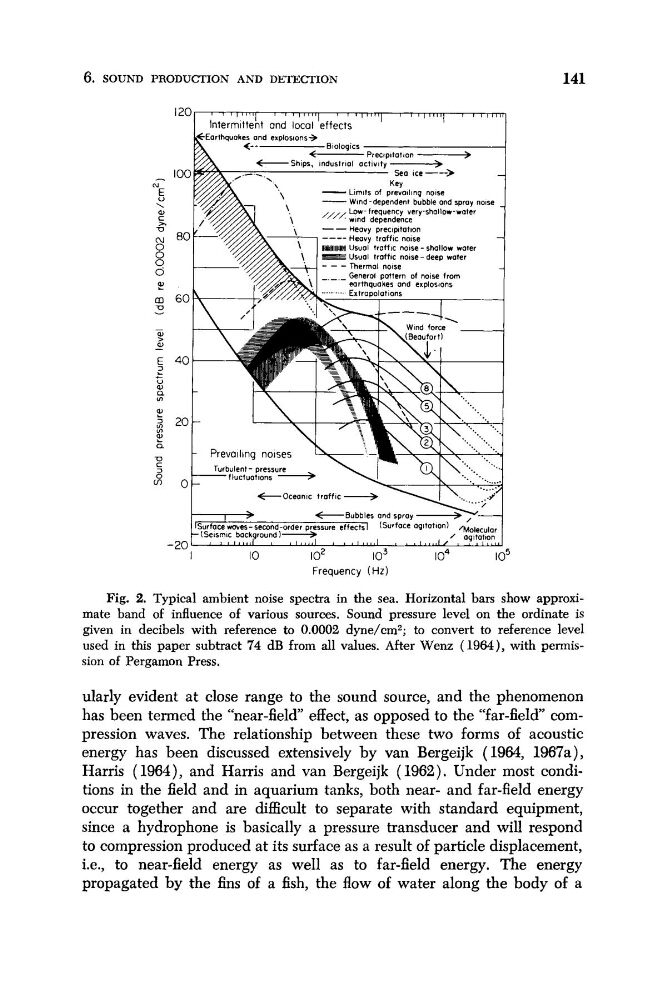
Fig. 2. Typical ambient noise spectra in the sea. Horizontal bars show approximate band of influence of various sources. Sound pressure level on the ordinate is
given in decibels with reference to 0.0002 dyne/cmZ; to convert to reference level
used in this paper subtract 74 dB from all values. After Wenz (1964), with permission of Pergamon Press.
ularly evident at close range to the sound source, and the phenomenon
has been termed the "near-field effect, as opposed to the "far-field" compression waves. The relationship between these two forms of acoustic
energy has been discussed extensively by van Bergeijk (1964, 1967a),
Harris (1964), and Harris and van Bergeijk (1962). Under most conditions in the field and in aquarium tanks, both near- and far-field energy
occur together and are difficult to separate with standard equipment,
since a hydrophone is basically a pressure transducer and will respond
to compression produced at its surface as a result of particle displacement,
i.e., to near-field energy as well as to far-field energy. The energy
propagated by the fins of a fish, the flow of water along the body of a
141
Wand -dependent bubble and spmy m s e
Heavy precipitation
+Oceanic
traffic
L"
I
1 0
10'
lo3
lo4
lo5
Frequency (Hz)
Fig. 2. Typical ambient noise spectra in the sea. Horizontal bars show approximate band of influence of various sources. Sound pressure level on the ordinate is
given in decibels with reference to 0.0002 dyne/cmZ; to convert to reference level
used in this paper subtract 74 dB from all values. After Wenz (1964), with permission of Pergamon Press.
ularly evident at close range to the sound source, and the phenomenon
has been termed the "near-field effect, as opposed to the "far-field" compression waves. The relationship between these two forms of acoustic
energy has been discussed extensively by van Bergeijk (1964, 1967a),
Harris (1964), and Harris and van Bergeijk (1962). Under most conditions in the field and in aquarium tanks, both near- and far-field energy
occur together and are difficult to separate with standard equipment,
since a hydrophone is basically a pressure transducer and will respond
to compression produced at its surface as a result of particle displacement,
i.e., to near-field energy as well as to far-field energy. The energy
propagated by the fins of a fish, the flow of water along the body of a