

5. TEMPERATURE RECEPTORS
131
response to repeated mechanical stimulation was inhibited by warming
the skin from 20" to 20.8"C but returned when the temperature stayed
steadily at 20.8"C.
V. THERMAL RESPONSES OF OTHER SENSE ORGANS
A number of other sense organs in fishes exhibit either phasic responses
to temperature changes or tonic effects of steady temperatures. The chief
examples are the lateral line organs in teleosts and elasmobranchs and
the ampullae of Lorenzini in the latter. The ampullae, in fact, are so
sensitive that Sand (1938) was forced to attribute a thermoreceptive
function to them, but there is no evidence that they are so used in the life
of the fish, and on anatomical and physiological grounds it now seems
most unlikely. For example, it is hard to account for the ramification of
the tube system in rays, and the deep location of the ampullae themselves which are the temperature-sensitive regions, if thermoreception
was their function. Moreover, there is no evidence of any special thermal
conductivity in the jelly (Murray, 1960). It is, of course, possible that
the tonic increase in the resting discharge at high temperatures in the
ampullae and lateral line organs could have a nonspecific stimulatory
effect on the CNS (especially if the latter were still not warmed), but
there is no good evidence even for this function. [See chapters by
Flock and Bennett, this volume, for a discussion of the function of the
ampullae, and also Murray ( 1967) .]
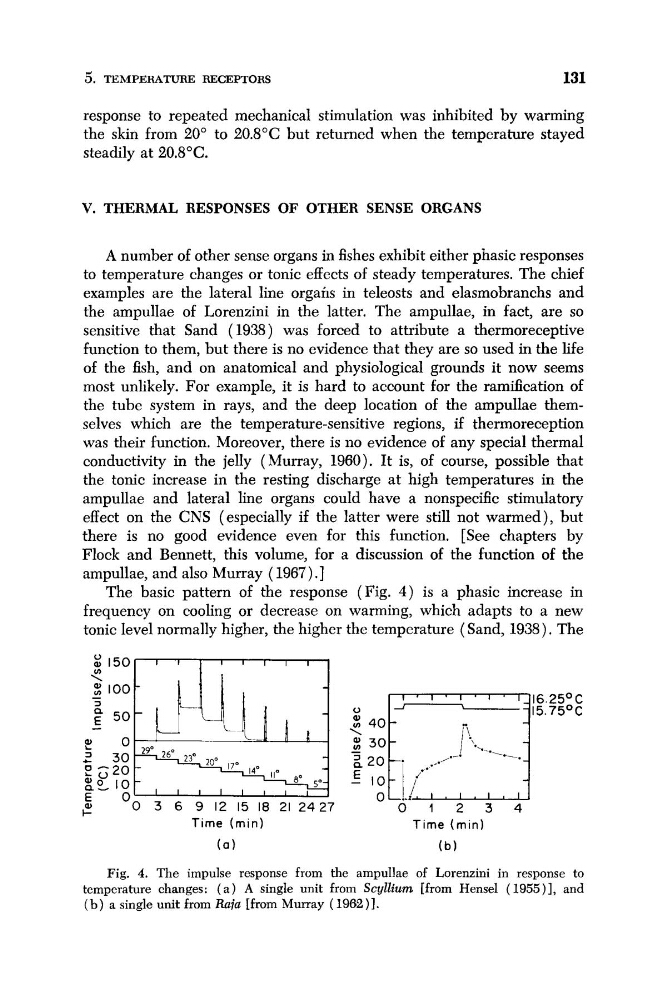
The basic pattern of the response (Fig. 4 ) is a phasic increase in
frequency on cooling or decrease on warming, which adapts to a new
tonic level normally higher, the higher the temperature (Sand, 1938). The
i 150
\
z 100
2
16.25OC
-
15.75OC
\
3 ?
O
- 3 0
5 0
- 2 i
4
o
E
I
2 20 3 0
. -* , . -.
'
.
.
.
& 10
e G20
g: 10
0 .-2
t - 6 ' 0 3 6 9 12 15 18 21 2 4 2 7
0
1
2
3
4
Time (min)
Time (min)
( 0 )
(b)
Fig. 4. The impulse response from the ampullae of Lorenzini in response to
temperature changes: ( a ) A single unit from Scyllium [from Hensel (1955)], and
( b ) a single unit from RU~U [from Murray (1962)l.
131
response to repeated mechanical stimulation was inhibited by warming
the skin from 20" to 20.8"C but returned when the temperature stayed
steadily at 20.8"C.
V. THERMAL RESPONSES OF OTHER SENSE ORGANS
A number of other sense organs in fishes exhibit either phasic responses
to temperature changes or tonic effects of steady temperatures. The chief
examples are the lateral line organs in teleosts and elasmobranchs and
the ampullae of Lorenzini in the latter. The ampullae, in fact, are so
sensitive that Sand (1938) was forced to attribute a thermoreceptive
function to them, but there is no evidence that they are so used in the life
of the fish, and on anatomical and physiological grounds it now seems
most unlikely. For example, it is hard to account for the ramification of
the tube system in rays, and the deep location of the ampullae themselves which are the temperature-sensitive regions, if thermoreception
was their function. Moreover, there is no evidence of any special thermal
conductivity in the jelly (Murray, 1960). It is, of course, possible that
the tonic increase in the resting discharge at high temperatures in the
ampullae and lateral line organs could have a nonspecific stimulatory
effect on the CNS (especially if the latter were still not warmed), but
there is no good evidence even for this function. [See chapters by
Flock and Bennett, this volume, for a discussion of the function of the
ampullae, and also Murray ( 1967) .]
The basic pattern of the response (Fig. 4 ) is a phasic increase in
frequency on cooling or decrease on warming, which adapts to a new
tonic level normally higher, the higher the temperature (Sand, 1938). The
i 150
\
z 100
2
16.25OC
-
15.75OC
\
3 ?
O
- 3 0
5 0
- 2 i
4
o
E
I
2 20 3 0
. -* , . -.
'
.
.
.
& 10
e G20
g: 10
0 .-2
t - 6 ' 0 3 6 9 12 15 18 21 2 4 2 7
0
1
2
3
4
Time (min)
Time (min)
( 0 )
(b)
Fig. 4. The impulse response from the ampullae of Lorenzini in response to
temperature changes: ( a ) A single unit from Scyllium [from Hensel (1955)], and
( b ) a single unit from RU~U [from Murray (1962)l.