

128
R. W. MURRAY
Seconds
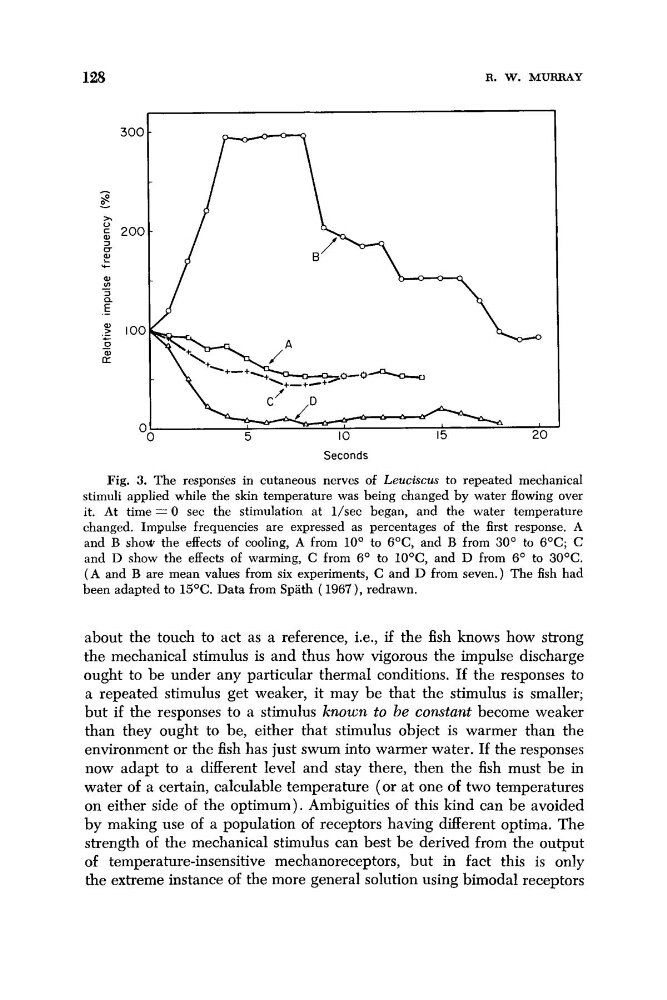
Fig. 3. The responses in cutaneous nerves of Leuciscus to repeated mechanical
stimuli applied while the skin temperature was being changed by water flowing over
it. At time = 0 sec the stimulation at l/sec began, and the water temperature
changed. Impulse frequencies are expressed as percentages of the first response. A
and B show the effects of cooling, A from 10' to 6'C, and B from 30' to 6'C; C
and D show the effects of warming, C from 6' to 10°C, and D from 6' to 30'C.
( A and B are mean values from six experiments, C and D from seven.) The fish had
been adapted to 15'C. Data from Spath (1967), redrawn.
about the touch to act as a reference, i.e., if the fish knows how strong
the mechanical stimulus is and thus how vigorous the impulse discharge
ought to be under any particular thermal conditions. If the responses to
a repeated stimulus get weaker, it may be that the stimulus is smaller;
but if the responses to a stimulus known to be constant become weaker
than they ought to be, either that stimulus object is warmer than the
environment or the fish has just swum into warmer water. If the responses
now adapt to a different level and stay there, then the fish must be in
water of a certain, calculable temperature (or at one of two temperatures
on either side of the optimum). Ambiguities of this kind can be avoided
by making use of a population of receptors having different optima. The
strength of the mechanical stimulus can best be derived from the output
of temperature-insensitive mechanoreceptors, but in fact this is only
the extreme instance of the more general solution using bimodal receptors
R. W. MURRAY
Seconds
Fig. 3. The responses in cutaneous nerves of Leuciscus to repeated mechanical
stimuli applied while the skin temperature was being changed by water flowing over
it. At time = 0 sec the stimulation at l/sec began, and the water temperature
changed. Impulse frequencies are expressed as percentages of the first response. A
and B show the effects of cooling, A from 10' to 6'C, and B from 30' to 6'C; C
and D show the effects of warming, C from 6' to 10°C, and D from 6' to 30'C.
( A and B are mean values from six experiments, C and D from seven.) The fish had
been adapted to 15'C. Data from Spath (1967), redrawn.
about the touch to act as a reference, i.e., if the fish knows how strong
the mechanical stimulus is and thus how vigorous the impulse discharge
ought to be under any particular thermal conditions. If the responses to
a repeated stimulus get weaker, it may be that the stimulus is smaller;
but if the responses to a stimulus known to be constant become weaker
than they ought to be, either that stimulus object is warmer than the
environment or the fish has just swum into warmer water. If the responses
now adapt to a different level and stay there, then the fish must be in
water of a certain, calculable temperature (or at one of two temperatures
on either side of the optimum). Ambiguities of this kind can be avoided
by making use of a population of receptors having different optima. The
strength of the mechanical stimulus can best be derived from the output
of temperature-insensitive mechanoreceptors, but in fact this is only
the extreme instance of the more general solution using bimodal receptors