

122
R. W. MURRAY
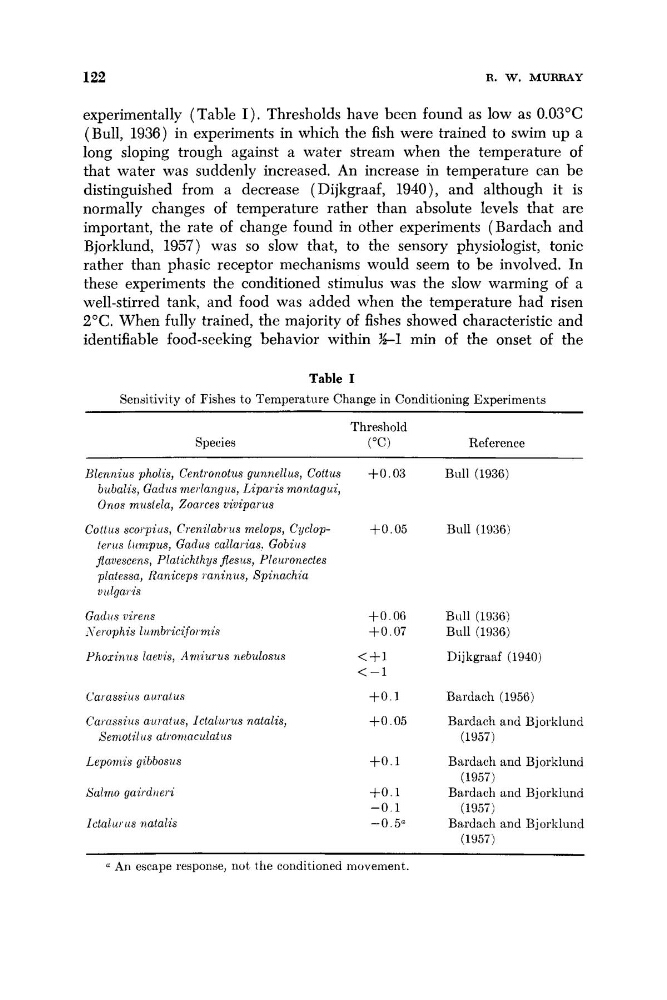
experimentally (Table I). Thresholds have been found as low as 0.03"C
(Bull, 1936) in experiments in which the fish were trained to swim up a
long sloping trough against a water stream when the temperature of
that water was suddenly increased. An increase in temperature can be
distinguished from a decrease (Dijkgraaf, 1940), and although it is
normally changes of temperature rather than absolute levels that are
important, the rate of change found in other experiments (Bardach and
Bjorklund, 1957) was so slow that, to the sensory physiologist, tonic
rather than phasic receptor mechanisms would seem to be involved. In
these experiments the conditioned stimulus was the slow warming of a
well-stirred tank, and food was added when the temperature had risen
2°C. When fully trained, the majority of fishes showed characteristic and
identifiable food-seeking behavior within %l min of the onset of the
Table I
Sensitivity of Fishes to Temperatiire Change in Conditioning Experiments
Species
Threshold
("C)
Reference
Ulennius pholis, Centronotus gunnellus, Cottus
bubalis, Gadus mei,langus, Liparis montagui,
Onos muslela, Zoarces viviparus
Colt us scorpius, Crenilabws melops, Cyclopterus lumpus, Gadus callarias. Gobius
jiavescens, Platichthys jlesiis, Pleiironectes
platessa, Raniceps ranintis, Spinachia
v ulgaris
Gadus virens
.Yer.ophis 1 umbricifot m i s
Phozinus laevis, Awiiurus nebulosus
('arassaus auiatus
Caiassaus auiatus, Ictaluius natalis,
Seiiiotzlus at, oniaculatus
Lepomas gibbosus
Ictalurus natalis
+0.03
+0.05
+O.OG
+0.07
< + I
< -1
+0.1
+0.05
+ 0 . l
+ 0 . 1
-0.1
-0.5'
Bull (1936)
Bull (1936)
Bull (1936)
Bull (1036)
Dijkgraaf (1940)
Bardach (1956)
Bardach and Bjorklund
(1957)
Bardach and Bjorklund
Bardach and Bjorklund
Ba.rdach and Bjorklund
(1957)
(1957)
(1957)
An escape response, not the conditioned movement.
R. W. MURRAY
experimentally (Table I). Thresholds have been found as low as 0.03"C
(Bull, 1936) in experiments in which the fish were trained to swim up a
long sloping trough against a water stream when the temperature of
that water was suddenly increased. An increase in temperature can be
distinguished from a decrease (Dijkgraaf, 1940), and although it is
normally changes of temperature rather than absolute levels that are
important, the rate of change found in other experiments (Bardach and
Bjorklund, 1957) was so slow that, to the sensory physiologist, tonic
rather than phasic receptor mechanisms would seem to be involved. In
these experiments the conditioned stimulus was the slow warming of a
well-stirred tank, and food was added when the temperature had risen
2°C. When fully trained, the majority of fishes showed characteristic and
identifiable food-seeking behavior within %l min of the onset of the
Table I
Sensitivity of Fishes to Temperatiire Change in Conditioning Experiments
Species
Threshold
("C)
Reference
Ulennius pholis, Centronotus gunnellus, Cottus
bubalis, Gadus mei,langus, Liparis montagui,
Onos muslela, Zoarces viviparus
Colt us scorpius, Crenilabws melops, Cyclopterus lumpus, Gadus callarias. Gobius
jiavescens, Platichthys jlesiis, Pleiironectes
platessa, Raniceps ranintis, Spinachia
v ulgaris
Gadus virens
.Yer.ophis 1 umbricifot m i s
Phozinus laevis, Awiiurus nebulosus
('arassaus auiatus
Caiassaus auiatus, Ictaluius natalis,
Seiiiotzlus at, oniaculatus
Lepomas gibbosus
Ictalurus natalis
+0.03
+0.05
+O.OG
+0.07
< + I
< -1
+0.1
+0.05
+ 0 . l
+ 0 . 1
-0.1
-0.5'
Bull (1936)
Bull (1936)
Bull (1936)
Bull (1036)
Dijkgraaf (1940)
Bardach (1956)
Bardach and Bjorklund
(1957)
Bardach and Bjorklund
Bardach and Bjorklund
Ba.rdach and Bjorklund
(1957)
(1957)
(1957)
An escape response, not the conditioned movement.