

4. CHEMORECEPTION
95
0
1 200pv
I
b
I 200pv
I
d
I 2 0 0 p v
, 200pv
e
I
I_
-
0.5 sec
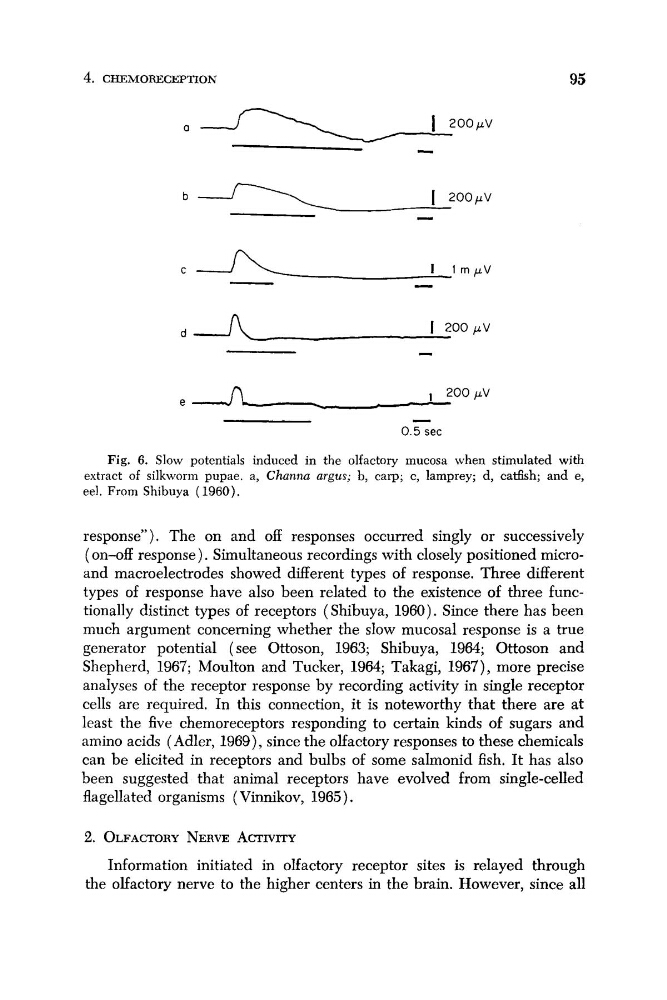
Fig. 6. Slow potentials induced in the olfactory mucosa when stimulated with
extract of silkworm pupae. a, Channa argus; b, carp; c, lamprey; d, catfish; and e,
eel. From Shibuya (1960).
response”). The on and off responses occurred singly or successively
( on-off response). Simultaneous recordings with closely positioned microand macroelectrodes showed different types of response. Three different
types of response have also been related to the existence of three functionally distinct types of receptors (Shibuya, 1960). Since there has been
much argument concerning whether the slow mucosal response is a true
generator potential (see Ottoson, 1963; Shibuya, 1964; Ottoson and
Shepherd, 1967; Moulton and Tucker, 1964; Takagi, 1967), more precise
analyses of the receptor response by recording activity in single receptor
cells are required. In this connection, it is noteworthy that there are at
least the five chemoreceptors responding to certain kinds of sugars and
amino acids ( Adler, 1969), since the olfactory responses to these chemicals
can be elicited in receptors and bulbs of some salmonid fish. It has also
been suggested that animal receptors have evolved from single-celled
flagellated organisms ( Vinnikov, 1965).
2. OLFACTORY NERVE ACTIVITY
Information initiated in olfactory receptor sites is relayed through
the olfactory nerve to the higher centers in the brain. However, since all
95
0
1 200pv
I
b
I 200pv
I
d
I 2 0 0 p v
, 200pv
e
I
I_
-
0.5 sec
Fig. 6. Slow potentials induced in the olfactory mucosa when stimulated with
extract of silkworm pupae. a, Channa argus; b, carp; c, lamprey; d, catfish; and e,
eel. From Shibuya (1960).
response”). The on and off responses occurred singly or successively
( on-off response). Simultaneous recordings with closely positioned microand macroelectrodes showed different types of response. Three different
types of response have also been related to the existence of three functionally distinct types of receptors (Shibuya, 1960). Since there has been
much argument concerning whether the slow mucosal response is a true
generator potential (see Ottoson, 1963; Shibuya, 1964; Ottoson and
Shepherd, 1967; Moulton and Tucker, 1964; Takagi, 1967), more precise
analyses of the receptor response by recording activity in single receptor
cells are required. In this connection, it is noteworthy that there are at
least the five chemoreceptors responding to certain kinds of sugars and
amino acids ( Adler, 1969), since the olfactory responses to these chemicals
can be elicited in receptors and bulbs of some salmonid fish. It has also
been suggested that animal receptors have evolved from single-celled
flagellated organisms ( Vinnikov, 1965).
2. OLFACTORY NERVE ACTIVITY
Information initiated in olfactory receptor sites is relayed through
the olfactory nerve to the higher centers in the brain. However, since all