

Table I I I
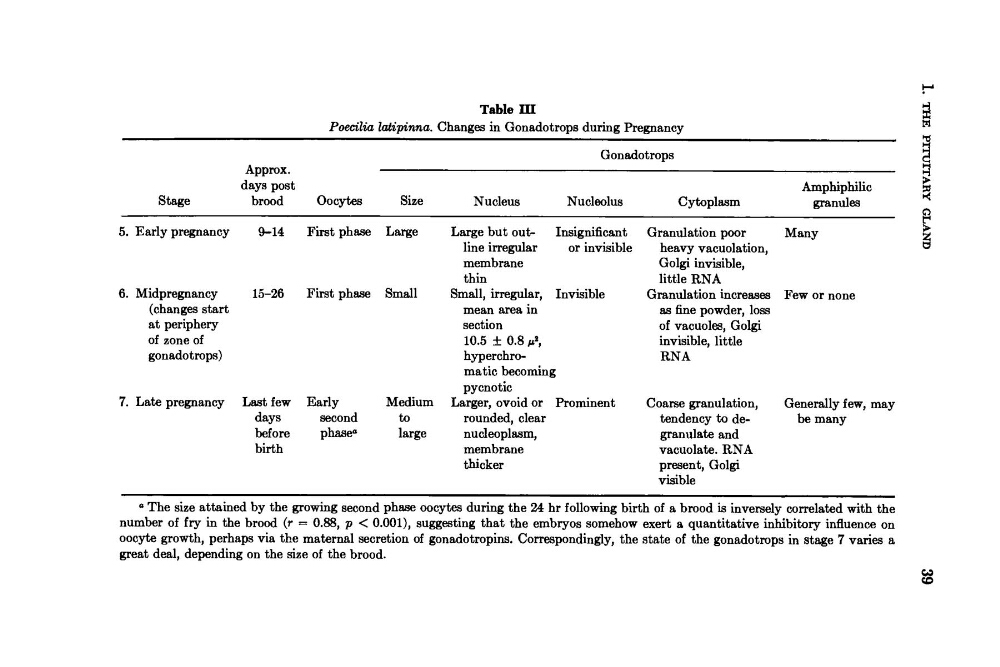
Poeeilia latipinna. Changes in Gonadotrops during Pregnancy
Gonadotrops
Approx.
days post
Amphiphilic
Stage
brood
Oocytes
Size
Nucleus
Nucleolus
Cytoplasm
granules
5. Early pregnancy
9-14
First phase Large
6. Midpregnancy
15-26
First phase Small
(changes start
at periphery
of zone of
gonadotrops)
7. Late pregnancy Last few Early
Medium
days
second
to
before
phase'
large
birth
Large but outr Insignificant
h e irregular
or invisible
membrane
thin
mean area in
section
10.5 f 0.8 1.4,
hyperchrmatic becoming
pycnotic
rounded, clear
nucleoplasm,
membrane
thicker
Small, irregular, Invisible
Larger, ovoid or Prominent
Granulation poor
Many
heavy vacuolation,
Golgi invisible,
little RNA
as fine powder, loss
of vacuoles, Golgi
invisible, little
RNA
Granulation increases Few or none
Coarse granulation,
Generally few, may
tendency to debe many
granulate and
vacuolate. RNA
present, Golgi
visible
The size attained by the growing second phase oocytes during the 24 hr following birth of a brood is inversely correlated with the
number of fry in the brood (r = 0.88, p < 0.001), suggesting that the embryos somehow exert a quantitative inhibitory influence on
oocyte growth, perhaps via the maternal secretion of gonadotropins. Correspondingly, the state of the gonadotrops in stage 7 varies a
great deal, depending on the size of the brood.
Poeeilia latipinna. Changes in Gonadotrops during Pregnancy
Gonadotrops
Approx.
days post
Amphiphilic
Stage
brood
Oocytes
Size
Nucleus
Nucleolus
Cytoplasm
granules
5. Early pregnancy
9-14
First phase Large
6. Midpregnancy
15-26
First phase Small
(changes start
at periphery
of zone of
gonadotrops)
7. Late pregnancy Last few Early
Medium
days
second
to
before
phase'
large
birth
Large but outr Insignificant
h e irregular
or invisible
membrane
thin
mean area in
section
10.5 f 0.8 1.4,
hyperchrmatic becoming
pycnotic
rounded, clear
nucleoplasm,
membrane
thicker
Small, irregular, Invisible
Larger, ovoid or Prominent
Granulation poor
Many
heavy vacuolation,
Golgi invisible,
little RNA
as fine powder, loss
of vacuoles, Golgi
invisible, little
RNA
Granulation increases Few or none
Coarse granulation,
Generally few, may
tendency to debe many
granulate and
vacuolate. RNA
present, Golgi
visible
The size attained by the growing second phase oocytes during the 24 hr following birth of a brood is inversely correlated with the
number of fry in the brood (r = 0.88, p < 0.001), suggesting that the embryos somehow exert a quantitative inhibitory influence on
oocyte growth, perhaps via the maternal secretion of gonadotropins. Correspondingly, the state of the gonadotrops in stage 7 varies a
great deal, depending on the size of the brood.