

8. UROPHYSIS AND CAUDAL NEUROSECRETORY SYSTEM
413
the “fine adjustment” to minor changes in environmental salinity, in contrast to the contribution of hypophysial prolactin and interrenal corticoids,
which seem to be involved in the adaptation of euryhaline fishes to more
drastic changes in their aqueous environment (Bern, 1967). It is of interest that other activities of urophysial extracts, vasopressor (see Bern et al.,
1967), antidiuretic and hydrosmotic (Sterba et al., 1965; Bern et al., 1967;
Lacanilao, 1969), again suggest an analogy with certain neurohypophysial
factors.
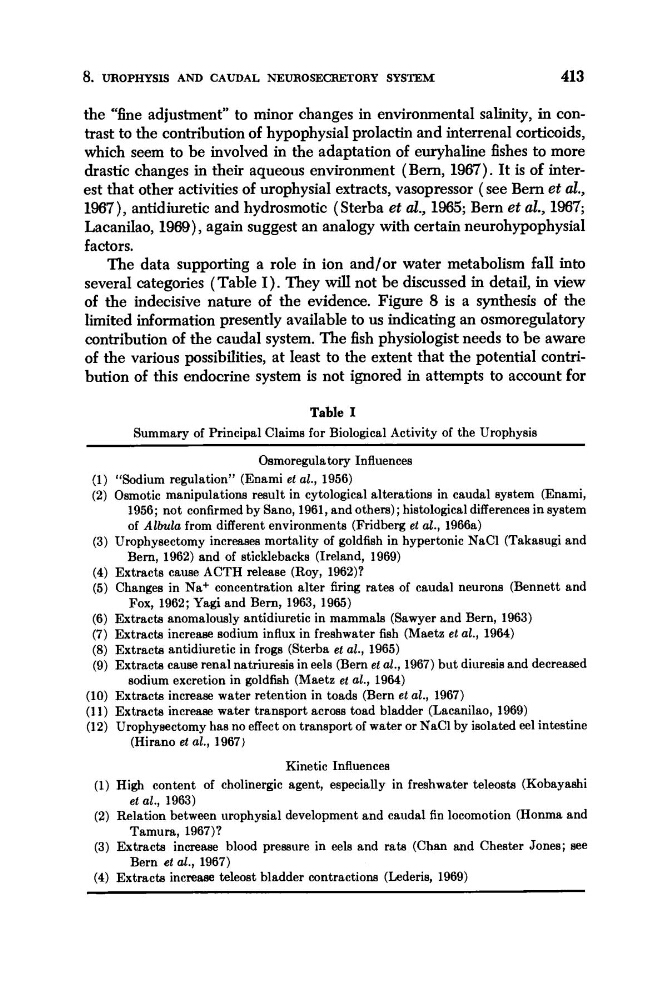
The data supporting a role in ion and/or water metabolism fall into
several categories (Table I). They will not be discussed in detail, in view
of the indecisive nature of the evidence. Figure 8 is a synthesis of the
limited information presently available to us indicating an osmoregulatory
contribution of the caudal system. The fish physiologist needs to be aware
of the various possibilities, at least to the extent that the potential contribution of this endocrine system is not ignored in attempts to account for
Table I
Summary of Principal Claims for Biological Activity of the Urophysis
Osmoregulatory Influences
(1) “Sodium regulation” (Enami et al., 1956)
(2) Osmotic manipulations result in cytological alterations in caudal system (Enami,
1956; not confirmed by Seno, 1961, and others); histological differences in system
of Albula from different environments (Fridberg et al., 1966a)
(3) Urophysectomy increases mortality of goldfish in hypertonic NaCl (Takasug and
Bern, 1962) and of sticklebacks (Ireland, 1969)
(4) Extracts cause ACTH release (Roy, 1962)?
(5) Changes in Na+ concentration alter firing rates of caudal neurons (Bennett and
(6) Extracts anomalously antidiuretic in mammals (Sawyer and Bern, 1963)
(7) Extracts increase sodium influx in freshwater fish (Maeta et al., 1964)
(8) Extracts antidiuretic in frogs (Sterba et al., 1965)
(9) Extracts cause renal natriuresis in eels (Bern et al., 1967) but diuresis and decreased
Fox, 1962; Yagi and Bern, 1963, 1965)
sodium excretion in goldfish (Maetz et al., 1964)
(10) Extracts increase water retention in toads (Bern el al., 1967)
(1 1) Extracts increase water transport across toad bladder (Lacanilao, 1969)
(12) Urophysectomy has no effect on transport of water or NaCl by isolated eel intestine
(Hirano et al., 1967)
Kinetic Influences
(I) High content of cholinergic agent, especially in freshwater teleosts (Kobayashi
(2) Relation between urophysial development and caudal fin locomotion (Honma and
(3) Extracts increase blood pressure in eels and rats (Chan and Chester Jones; see
(4) Extracts increase teleost bladder contractions (Lederis, 1969)
et al., 1963)
Tamura, 1967)?
Bern et al., 1967)
413
the “fine adjustment” to minor changes in environmental salinity, in contrast to the contribution of hypophysial prolactin and interrenal corticoids,
which seem to be involved in the adaptation of euryhaline fishes to more
drastic changes in their aqueous environment (Bern, 1967). It is of interest that other activities of urophysial extracts, vasopressor (see Bern et al.,
1967), antidiuretic and hydrosmotic (Sterba et al., 1965; Bern et al., 1967;
Lacanilao, 1969), again suggest an analogy with certain neurohypophysial
factors.
The data supporting a role in ion and/or water metabolism fall into
several categories (Table I). They will not be discussed in detail, in view
of the indecisive nature of the evidence. Figure 8 is a synthesis of the
limited information presently available to us indicating an osmoregulatory
contribution of the caudal system. The fish physiologist needs to be aware
of the various possibilities, at least to the extent that the potential contribution of this endocrine system is not ignored in attempts to account for
Table I
Summary of Principal Claims for Biological Activity of the Urophysis
Osmoregulatory Influences
(1) “Sodium regulation” (Enami et al., 1956)
(2) Osmotic manipulations result in cytological alterations in caudal system (Enami,
1956; not confirmed by Seno, 1961, and others); histological differences in system
of Albula from different environments (Fridberg et al., 1966a)
(3) Urophysectomy increases mortality of goldfish in hypertonic NaCl (Takasug and
Bern, 1962) and of sticklebacks (Ireland, 1969)
(4) Extracts cause ACTH release (Roy, 1962)?
(5) Changes in Na+ concentration alter firing rates of caudal neurons (Bennett and
(6) Extracts anomalously antidiuretic in mammals (Sawyer and Bern, 1963)
(7) Extracts increase sodium influx in freshwater fish (Maeta et al., 1964)
(8) Extracts antidiuretic in frogs (Sterba et al., 1965)
(9) Extracts cause renal natriuresis in eels (Bern et al., 1967) but diuresis and decreased
Fox, 1962; Yagi and Bern, 1963, 1965)
sodium excretion in goldfish (Maetz et al., 1964)
(10) Extracts increase water retention in toads (Bern el al., 1967)
(1 1) Extracts increase water transport across toad bladder (Lacanilao, 1969)
(12) Urophysectomy has no effect on transport of water or NaCl by isolated eel intestine
(Hirano et al., 1967)
Kinetic Influences
(I) High content of cholinergic agent, especially in freshwater teleosts (Kobayashi
(2) Relation between urophysial development and caudal fin locomotion (Honma and
(3) Extracts increase blood pressure in eels and rats (Chan and Chester Jones; see
(4) Extracts increase teleost bladder contractions (Lederis, 1969)
et al., 1963)
Tamura, 1967)?
Bern et al., 1967)