

6. ADRENAL STEROIDS AND ACTH
353
variation in response to the operation and subsequent replacement therapy is probably related to relative predominance of sodium efflux or
sodium influx ( Maetz et al., 1%7b),
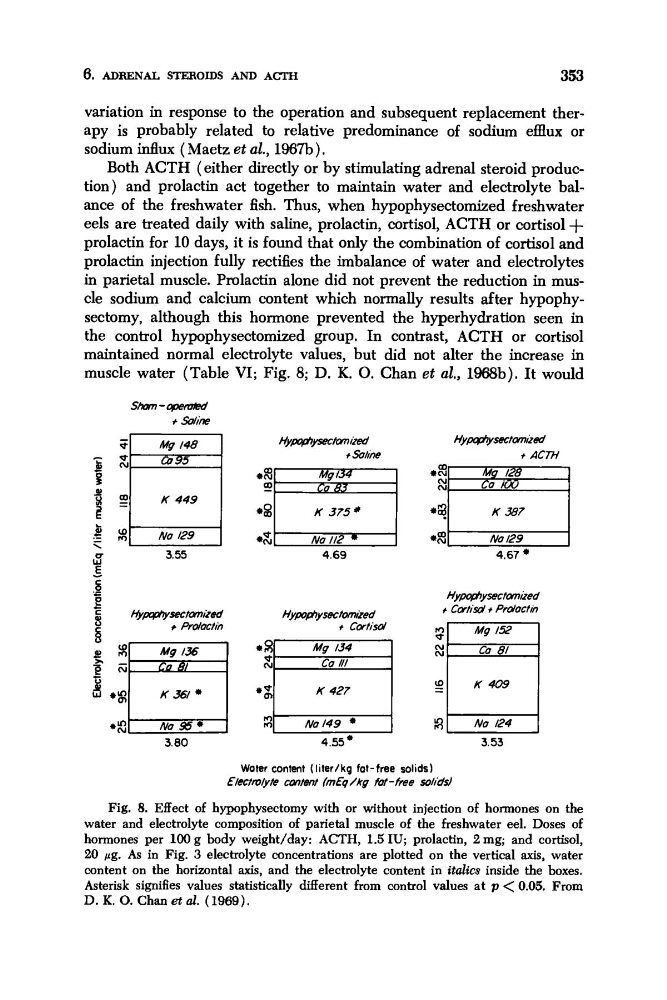
Both ACTH (either directly or by stimulating adrenal steroid production) and prolactin act together to maintain water and electrolyte balance of the freshwater fish. Thus, when hypophysectomized freshwater
eels are treated daily with saline, prolactin, cortisol, ACTH or cortisol +
prolactin for 10 days, it is found that only the combination of cortisol and
prolactin injection fully rectifies the imbalance of water and electrolytes
in parietal muscle. Prolactin alone did not prevent the reduction in muscle sodium and calcium content which normally results after hypophysectomy, although this hormone prevented the hyperhydration seen in
the control hypophysectomized group. In contrast, ACTH or cortisol
maintained normal electrolyte values, but did not alter the increase in
muscle water (Table VI; Fig. 8; D. K. 0. Chan et aZ., 196813). It would
Naf/2 *
1
4.69
ca 111
4.554
Hypqthysectmlkd
t ACrn
Na 129
4.67 *
(I,
K 409
-
R H Na 124
3.53
Water content (liter/kg fot-free solids)
E lectm lye cmtent lmEg /kg fat -kee solids)
Fig. 8. Effect of hypophysectomy with or without injection of hormones on the
water and electrolyte composition of parietal muscle of the freshwater eel. Doses of
hormones per 100 g body weight/day: ACTH, 1.5 IU; prolactin, 2 mg; and cortisol,
20 fig. As in Fig. 3 electrolyte concentrations are plotted on the vertical axis, water
content on the horizontal axis, and the electrolyte content in itaZics inside the boxes.
Asterisk signifies values statistically different from control values at p < 0.05. From
D. K. 0. Chan et d. (1969).
353
variation in response to the operation and subsequent replacement therapy is probably related to relative predominance of sodium efflux or
sodium influx ( Maetz et al., 1%7b),
Both ACTH (either directly or by stimulating adrenal steroid production) and prolactin act together to maintain water and electrolyte balance of the freshwater fish. Thus, when hypophysectomized freshwater
eels are treated daily with saline, prolactin, cortisol, ACTH or cortisol +
prolactin for 10 days, it is found that only the combination of cortisol and
prolactin injection fully rectifies the imbalance of water and electrolytes
in parietal muscle. Prolactin alone did not prevent the reduction in muscle sodium and calcium content which normally results after hypophysectomy, although this hormone prevented the hyperhydration seen in
the control hypophysectomized group. In contrast, ACTH or cortisol
maintained normal electrolyte values, but did not alter the increase in
muscle water (Table VI; Fig. 8; D. K. 0. Chan et aZ., 196813). It would
Naf/2 *
1
4.69
ca 111
4.554
Hypqthysectmlkd
t ACrn
Na 129
4.67 *
(I,
K 409
-
R H Na 124
3.53
Water content (liter/kg fot-free solids)
E lectm lye cmtent lmEg /kg fat -kee solids)
Fig. 8. Effect of hypophysectomy with or without injection of hormones on the
water and electrolyte composition of parietal muscle of the freshwater eel. Doses of
hormones per 100 g body weight/day: ACTH, 1.5 IU; prolactin, 2 mg; and cortisol,
20 fig. As in Fig. 3 electrolyte concentrations are plotted on the vertical axis, water
content on the horizontal axis, and the electrolyte content in itaZics inside the boxes.
Asterisk signifies values statistically different from control values at p < 0.05. From
D. K. 0. Chan et d. (1969).