

336
CHESTER JONES, CHAN, HENDERSON, AND BALL
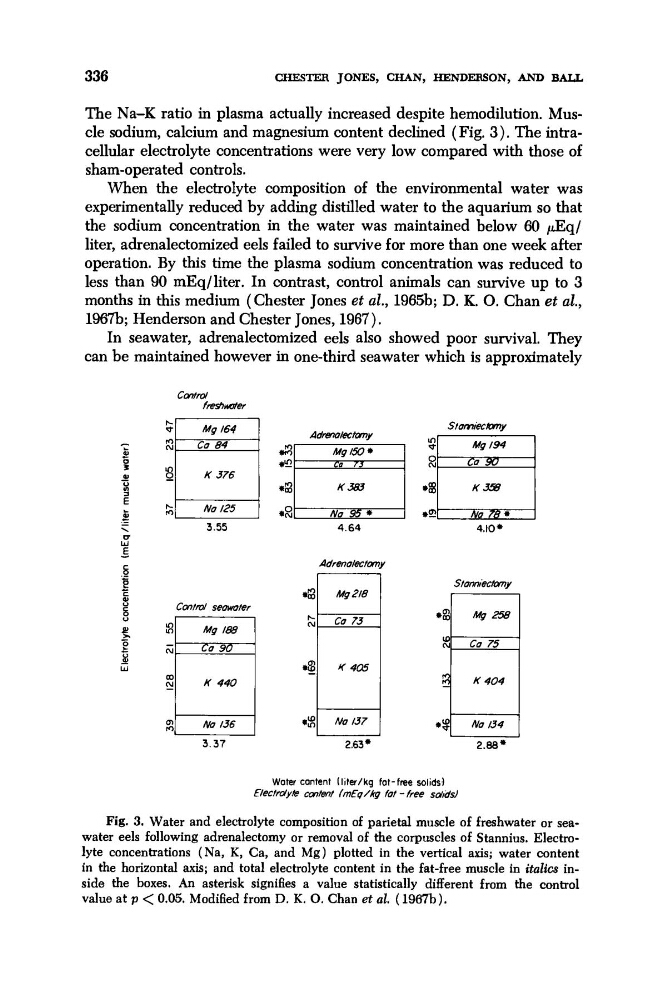
The Na-K ratio in plasma actually increased despite hemodilution. Muscle sodium, calcium and magnesium content declined (Fig. 3). The intracellular electrolyte concentrations were very low compared with those of
sham-operated controls.
When the electrolyte composition of the environmental water was
experimentally reduced by adding distilled water to the aquarium so that
the sodium concentration in the water was maintained below 60 $q/
liter, adrenalectomized eels failed to survive for more than one week after
operation. By this time the plasma sodium concentration was reduced to
less than 90 mEq/liter. In contrast, control animals can survive up to 3
months in this medium (Chester Jones et al., 1965b; D. K. 0. Chan et al.,
1967b; Henderson and Chester Jones, 1967).
In seawater, adrenalectomized eels also showed poor survival. They
can be maintained however in one-third seawater which is approximately
B I K376 I
$ - - z q
3.55
Cmtd semter
:w 81 K 440 1
3.37
s t o m i u m y
Adrwluhanv
* g 1 2 1
*w
:l-zzJ
4.64
4.10*
Adrenolectmy
Stonmechany
m
* ‘ I K405 1 K 4 0 4 1
*% MI37
No 134
2.63*
2.88*
Water content Lliterlkg fot-free solids)
Electrdy& cwtent fm€q/kg fat -free sdids)
Fig. 3. Water and electrolyte composition of parietal muscle of freshwater or seawater eels following adrenalectomy or removal of the corpuscles of Stannius. Electrolyte concentrations (Na, K, Ca, and Mg) plotted in the vertical axis; water content
in the horizontal axis; and total electrolyte content in the fat-free muscle in italics inside the boxes. An asterisk signifies a value statistically different from the control
value at p < 0.05. Modified from D. K. 0. Chan et al. (1967b).
CHESTER JONES, CHAN, HENDERSON, AND BALL
The Na-K ratio in plasma actually increased despite hemodilution. Muscle sodium, calcium and magnesium content declined (Fig. 3). The intracellular electrolyte concentrations were very low compared with those of
sham-operated controls.
When the electrolyte composition of the environmental water was
experimentally reduced by adding distilled water to the aquarium so that
the sodium concentration in the water was maintained below 60 $q/
liter, adrenalectomized eels failed to survive for more than one week after
operation. By this time the plasma sodium concentration was reduced to
less than 90 mEq/liter. In contrast, control animals can survive up to 3
months in this medium (Chester Jones et al., 1965b; D. K. 0. Chan et al.,
1967b; Henderson and Chester Jones, 1967).
In seawater, adrenalectomized eels also showed poor survival. They
can be maintained however in one-third seawater which is approximately
B I K376 I
$ - - z q
3.55
Cmtd semter
:w 81 K 440 1
3.37
s t o m i u m y
Adrwluhanv
* g 1 2 1
*w
:l-zzJ
4.64
4.10*
Adrenolectmy
Stonmechany
m
* ‘ I K405 1 K 4 0 4 1
*% MI37
No 134
2.63*
2.88*
Water content Lliterlkg fot-free solids)
Electrdy& cwtent fm€q/kg fat -free sdids)
Fig. 3. Water and electrolyte composition of parietal muscle of freshwater or seawater eels following adrenalectomy or removal of the corpuscles of Stannius. Electrolyte concentrations (Na, K, Ca, and Mg) plotted in the vertical axis; water content
in the horizontal axis; and total electrolyte content in the fat-free muscle in italics inside the boxes. An asterisk signifies a value statistically different from the control
value at p < 0.05. Modified from D. K. 0. Chan et al. (1967b).