

242
AUBREY GORBMAN
Exogenous
I. Brain
influences
of pituitary
Endogenous factors
I
w
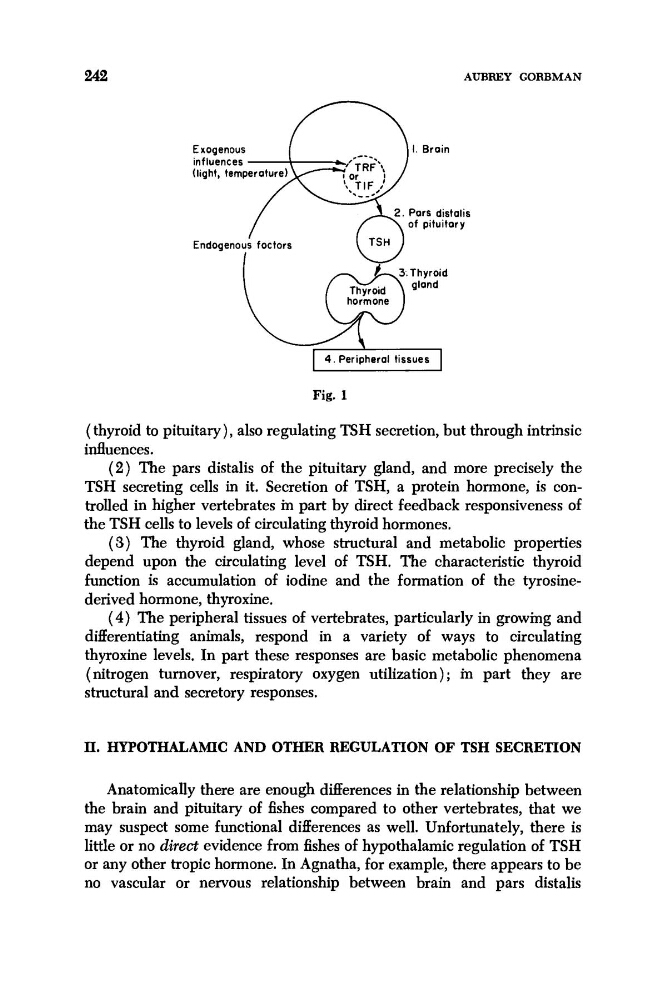
Fig. 1
(thyroid to pituitary) , also regulating TSH secretion, but through intrinsic
iduences.
( 2 ) The pars distalis of the pituitary gland, and more precisely the
TSH secreting cells in it. Secretion of TSH, a protein hormone, is controlled in higher vertebrates in part by direct feedback responsiveness of
the TSH cells to levels of circulating thyroid hormones.
(3) The thyroid gland, whose structural and metabolic properties
depend upon the circulating level of TSH. The characteristic thyroid
function is accumulation of iodine and the formation of the tyrosinederived hormone, thyroxine.
(4) The peripheral tissues of vertebrates, particularly in growing and
differentiating animals, respond in a variety of ways to circulating
thyroxine levels. In part these responses are basic metabolic phenomena
(nitrogen turnover, respiratory oxygen utilization) ; in part they are
structural and secretory responses.
11. HYPOTHALAMIC AND OTHER REGULATION OF TSH SECRETION
Anatomically there are enough differences in the relationship between
the brain and pituitary of fishes compared to other vertebrates, that we
may suspect some functional differences as well. Unfortunately, there is
little or no direct evidence from fishes of hypothalamic regulation of TSH
or any other tropic hormone. In Agnatha, for example, there appears to be
no vascular or nervous relationship between brain and pars distalis
AUBREY GORBMAN
Exogenous
I. Brain
influences
of pituitary
Endogenous factors
I
w
Fig. 1
(thyroid to pituitary) , also regulating TSH secretion, but through intrinsic
iduences.
( 2 ) The pars distalis of the pituitary gland, and more precisely the
TSH secreting cells in it. Secretion of TSH, a protein hormone, is controlled in higher vertebrates in part by direct feedback responsiveness of
the TSH cells to levels of circulating thyroid hormones.
(3) The thyroid gland, whose structural and metabolic properties
depend upon the circulating level of TSH. The characteristic thyroid
function is accumulation of iodine and the formation of the tyrosinederived hormone, thyroxine.
(4) The peripheral tissues of vertebrates, particularly in growing and
differentiating animals, respond in a variety of ways to circulating
thyroxine levels. In part these responses are basic metabolic phenomena
(nitrogen turnover, respiratory oxygen utilization) ; in part they are
structural and secretory responses.
11. HYPOTHALAMIC AND OTHER REGULATION OF TSH SECRETION
Anatomically there are enough differences in the relationship between
the brain and pituitary of fishes compared to other vertebrates, that we
may suspect some functional differences as well. Unfortunately, there is
little or no direct evidence from fishes of hypothalamic regulation of TSH
or any other tropic hormone. In Agnatha, for example, there appears to be
no vascular or nervous relationship between brain and pars distalis