

1. ANATOMY AND PHYSIOLOGY OF THE CENTRAL NERVOUS SYSTEM
55
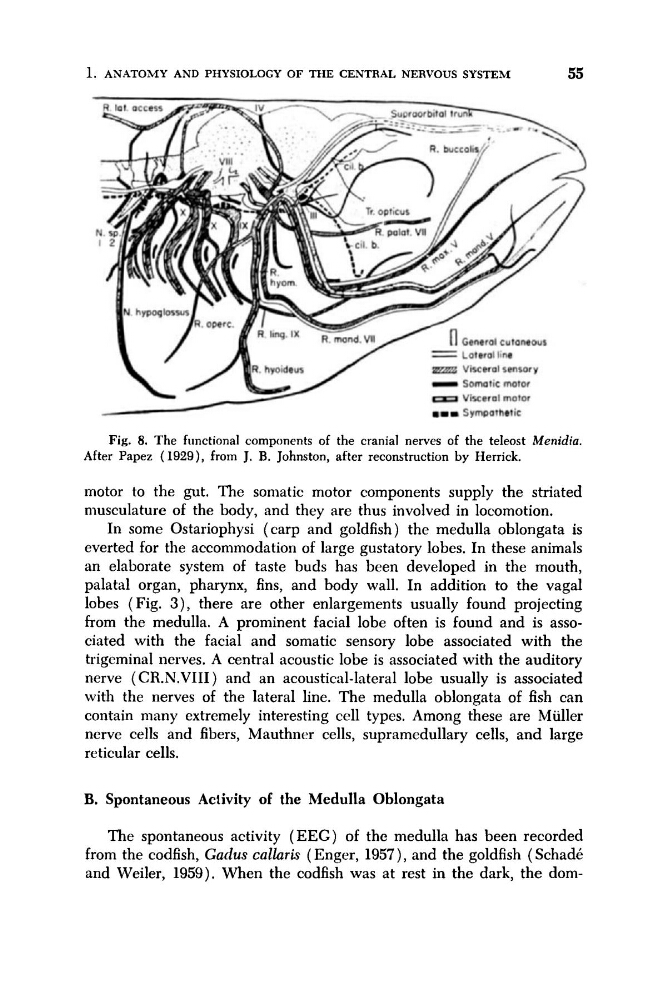
Fig. 8. The functional components of the cranial nerves of the teleost Menidia.
After Papez (1929), from J. B. Johnston, after reconstruction by Herrick.
motor to the gut. The somatic motor components supply the striated
niusculature of the body, and they are thus involved in locomotion.
In some Ostariophysi (carp and goldfish) the medulla oblongata is
everted for the accommodation of large gustatory lobes. In these animals
an elaborate system of taste buds has been developed in the mouth,
palatal organ, pharynx, fins, and body wall. In addition to the vagal
lobes ( Fig. 3 ) , there are other enlargements usually found projecting
from the medulla. A prominent facial lobe often is found and is associated with the facial and somatic sensory lobe associated with the
trigeminal nerves. A central acoustic lobe is associated with the auditory
nerve ( CR.N.VII1) and an acousticnl-lateral lobe usually is associated
with the nerves of the lateral line. The medulla oblongata of fish can
contain many extremely interesting cell types. Among these are Muller
nerve cells and fibers, Mauthner cells, supramedullary cells, and large
reticular cells.
B. Spontaneous Aclivity of the Medulla Oblongata
The spontaneous activity (EEG) of the medulla has been recorded
from the codfish, Gadus callaris (Engcr, 1957), and the goldfish (Schadh
and Weiler, 1959). When the codfish was at rest in the dark, the dom-
55
Fig. 8. The functional components of the cranial nerves of the teleost Menidia.
After Papez (1929), from J. B. Johnston, after reconstruction by Herrick.
motor to the gut. The somatic motor components supply the striated
niusculature of the body, and they are thus involved in locomotion.
In some Ostariophysi (carp and goldfish) the medulla oblongata is
everted for the accommodation of large gustatory lobes. In these animals
an elaborate system of taste buds has been developed in the mouth,
palatal organ, pharynx, fins, and body wall. In addition to the vagal
lobes ( Fig. 3 ) , there are other enlargements usually found projecting
from the medulla. A prominent facial lobe often is found and is associated with the facial and somatic sensory lobe associated with the
trigeminal nerves. A central acoustic lobe is associated with the auditory
nerve ( CR.N.VII1) and an acousticnl-lateral lobe usually is associated
with the nerves of the lateral line. The medulla oblongata of fish can
contain many extremely interesting cell types. Among these are Muller
nerve cells and fibers, Mauthner cells, supramedullary cells, and large
reticular cells.
B. Spontaneous Aclivity of the Medulla Oblongata
The spontaneous activity (EEG) of the medulla has been recorded
from the codfish, Gadus callaris (Engcr, 1957), and the goldfish (Schadh
and Weiler, 1959). When the codfish was at rest in the dark, the dom-