

12. IMMUNOLOGY OF FISH
471
variations termed “allotypes” which appear on both L and H chains
in addition to the subclass variations referred to above. The interrelations of the allotypes and the other ,G specificities are complex to the
point where further discussion is not warranted here, However, it
should be kept in mind that these specificities not only are proving
very useful in understanding the nature of the genetic control of yG
synthesis but also in providing data of value in subpopulation studies.
The reader is referred to the paper of Natvig et al. (Cold Spring Harbor
Symposium, 1968) for a lucid introduction to this phenomenon.
Allotype variation is not only found in humans but also is well known
in such diverse forms as the mouse and rabbit. It has yet to be demonstrated in fish; however, observations by Krauel and Ridgway (1963)
point in this general direction. Studies on the genetics of allotypes
strengthen the concept that the L chains are produced by two digerent
cistrons and the H chains by four other cistrons all present in every
individual with mutations giving rise to allotypic alleles in the various
cistrons. New allotypic variations continue to be discovered, and other
antigenic variations exist among uG molecules, but the above information
should be sufficient to show the complex nature of the variations in
antigenic specificities that occur in this class of molecule.
As Putnam (1969) shows in some detail, it is possible to “slice”
the ,G molecule in various ways, using appropriate enzymes and other
reagents, and to obtain fragments that include or exclude the combining
site areas and a carbohydrate moiety that is attached to the C-terminal
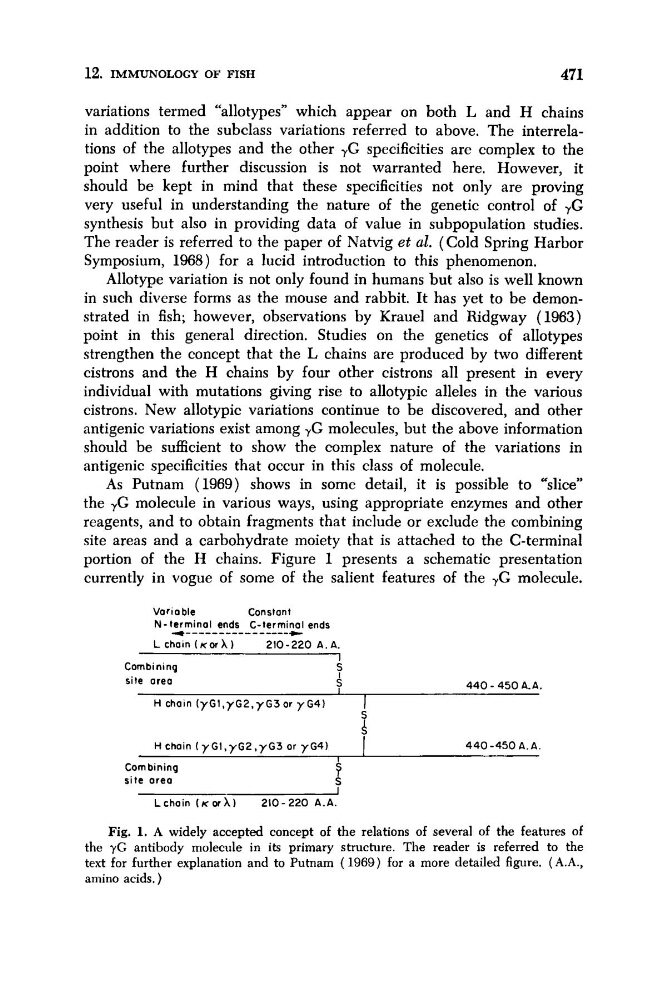
portion of the H chains. Figure 1 presents a schematic presentation
currently in vogue of some of the salient features of the ,G molecule.
Variable
Constant
N-terminal ends C-terminal ends
* ---------------- *
L chain ( K O r k )
2 1 0 - 2 2 0 A . A .
Combining
3
site area
4
440 - 450 A.A.
H chain ( y G l , y G 2 , y G 3 o r y G 4 )
I
4 4 0 - 4 5 0 A . A .
8
H chain ( y G l , y G 2 , y G 3 or y G 4 )
1
s
Combining
site area
S
I
Lchain ( K W ~ ) 2 1 0 - 2 2 0 A.A.
Fig. 1. A widely accepted concept of the relations of several of the features of
the yC antibody molecule in its primary structure. The reader is referred to the
text for further explanation and to Putnam ( 1969) for a more detailed figure. ( A.A.,
amino acids. )
471
variations termed “allotypes” which appear on both L and H chains
in addition to the subclass variations referred to above. The interrelations of the allotypes and the other ,G specificities are complex to the
point where further discussion is not warranted here, However, it
should be kept in mind that these specificities not only are proving
very useful in understanding the nature of the genetic control of yG
synthesis but also in providing data of value in subpopulation studies.
The reader is referred to the paper of Natvig et al. (Cold Spring Harbor
Symposium, 1968) for a lucid introduction to this phenomenon.
Allotype variation is not only found in humans but also is well known
in such diverse forms as the mouse and rabbit. It has yet to be demonstrated in fish; however, observations by Krauel and Ridgway (1963)
point in this general direction. Studies on the genetics of allotypes
strengthen the concept that the L chains are produced by two digerent
cistrons and the H chains by four other cistrons all present in every
individual with mutations giving rise to allotypic alleles in the various
cistrons. New allotypic variations continue to be discovered, and other
antigenic variations exist among uG molecules, but the above information
should be sufficient to show the complex nature of the variations in
antigenic specificities that occur in this class of molecule.
As Putnam (1969) shows in some detail, it is possible to “slice”
the ,G molecule in various ways, using appropriate enzymes and other
reagents, and to obtain fragments that include or exclude the combining
site areas and a carbohydrate moiety that is attached to the C-terminal
portion of the H chains. Figure 1 presents a schematic presentation
currently in vogue of some of the salient features of the ,G molecule.
Variable
Constant
N-terminal ends C-terminal ends
* ---------------- *
L chain ( K O r k )
2 1 0 - 2 2 0 A . A .
Combining
3
site area
4
440 - 450 A.A.
H chain ( y G l , y G 2 , y G 3 o r y G 4 )
I
4 4 0 - 4 5 0 A . A .
8
H chain ( y G l , y G 2 , y G 3 or y G 4 )
1
s
Combining
site area
S
I
Lchain ( K W ~ ) 2 1 0 - 2 2 0 A.A.
Fig. 1. A widely accepted concept of the relations of several of the features of
the yC antibody molecule in its primary structure. The reader is referred to the
text for further explanation and to Putnam ( 1969) for a more detailed figure. ( A.A.,
amino acids. )