

10. THE SWIM BLADDER AS A HYDROSTATIC ORGAN
439
stretch in the bladder wall, act as stimuli for the deflatory reflex. Thus
von Ledebur (1937) reports that reabsorption of gases can be provoked
by a decrease of the hydrostatic pressure of the surrounding water, by
attachment of air-filled balloons to the fish, or by injection of gases
into the swim bladder. It is also known that during asphyxiation oxygen
is reabsorbed from the bladder (Berg and Steen, 1966).
The swim bladder is innervated by branches from the vagi and from
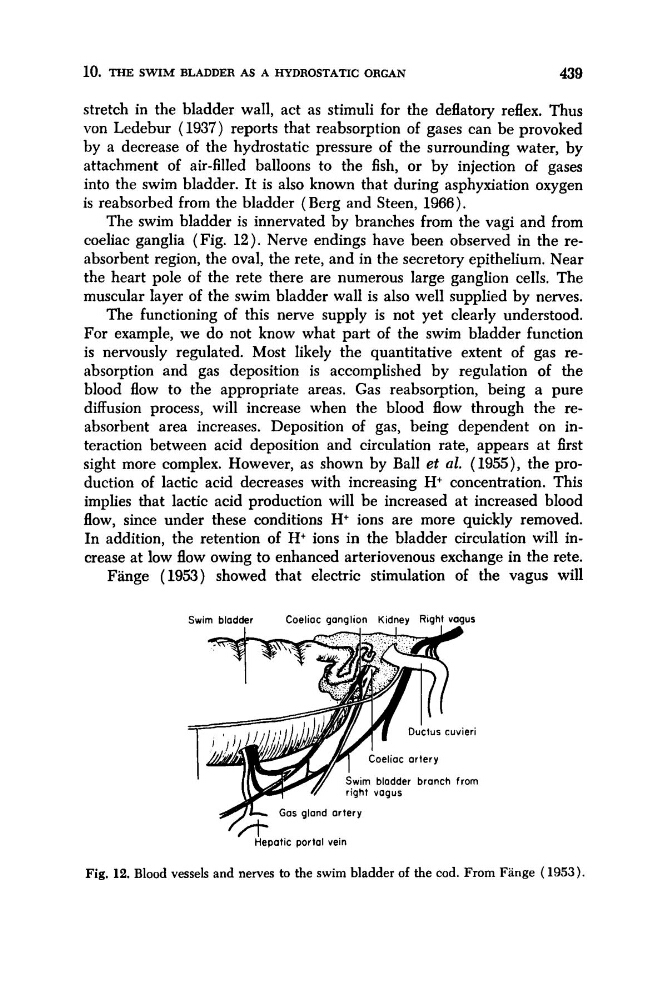
coeliac ganglia (Fig. 12). Nerve endings have been observed in the reabsorbent region, the oval, the rete, and in the secretory epithelium. Near
the heart pole of the rete there are numerous large ganglion cells. The
muscular layer of the swim bladder wall is also well supplied by nerves.
The functioning of this nerve supply is not yet clearly understood.
For example, we do not know what part of the swim bladder function
is nervously regulated. Most likely the quantitative extent of gas reabsorption and gas deposition is accomplished by regulation of the
blood flow to the appropriate areas. Gas reabsorption, being a pure
diffusion process, will increase when the blood flow through the reabsorbent area increases. Deposition of gas, being dependent on interaction between acid deposition and circulation rate, appears at first
sight more complex. However, as shown by Ball et uZ. (1955), the production of lactic acid decreases with increasing H+ concentration. This
implies that lactic acid production will be increased at increased blood
flow, since under these conditions H' ions are more quickly removed.
In addition, the retention of H+ ions in the bladder circulation will increase at low flow owing to enhanced arteriovenous exchange in the rete.
Fange (1953) showed that electric stimulation of the vagus will
Swim bladder
Coeliac ganglion Kidney Rlght vagus
im bladder branch from
Hepatic portal vein
Fig. 12. Blood vessels and nerves to the swim bladder of the cod. From Fange (1953).
439
stretch in the bladder wall, act as stimuli for the deflatory reflex. Thus
von Ledebur (1937) reports that reabsorption of gases can be provoked
by a decrease of the hydrostatic pressure of the surrounding water, by
attachment of air-filled balloons to the fish, or by injection of gases
into the swim bladder. It is also known that during asphyxiation oxygen
is reabsorbed from the bladder (Berg and Steen, 1966).
The swim bladder is innervated by branches from the vagi and from
coeliac ganglia (Fig. 12). Nerve endings have been observed in the reabsorbent region, the oval, the rete, and in the secretory epithelium. Near
the heart pole of the rete there are numerous large ganglion cells. The
muscular layer of the swim bladder wall is also well supplied by nerves.
The functioning of this nerve supply is not yet clearly understood.
For example, we do not know what part of the swim bladder function
is nervously regulated. Most likely the quantitative extent of gas reabsorption and gas deposition is accomplished by regulation of the
blood flow to the appropriate areas. Gas reabsorption, being a pure
diffusion process, will increase when the blood flow through the reabsorbent area increases. Deposition of gas, being dependent on interaction between acid deposition and circulation rate, appears at first
sight more complex. However, as shown by Ball et uZ. (1955), the production of lactic acid decreases with increasing H+ concentration. This
implies that lactic acid production will be increased at increased blood
flow, since under these conditions H' ions are more quickly removed.
In addition, the retention of H+ ions in the bladder circulation will increase at low flow owing to enhanced arteriovenous exchange in the rete.
Fange (1953) showed that electric stimulation of the vagus will
Swim bladder
Coeliac ganglion Kidney Rlght vagus
im bladder branch from
Hepatic portal vein
Fig. 12. Blood vessels and nerves to the swim bladder of the cod. From Fange (1953).