

10. THE SWIM BLADDER AS A HYDROSTATIC ORGAN
435
may be instrumental in a concentration mechanism based on salting out,
but hardly on one based on its acid effects. Steen (1963~) experimentally
showed that the rete is in fact permeable to acids. Thus a considerable
pH change is detectable in both arterial and venous blood during circulation of the rete.
It thus appeared that the experimental evidence on two of the three
crucial points clearly contradicted the requirements of the model. For
a while it appeared that we had in the swim bladder a system which
was perfectly engineered for gas concentration by ccm but that the
fishes did not use it that way.
The anomalous evidence was based on measurements done on blood
samples. Thus, transient changes in pH or Po, might have been overlooked. Manwell (1960) urged students of the swim bladder to be
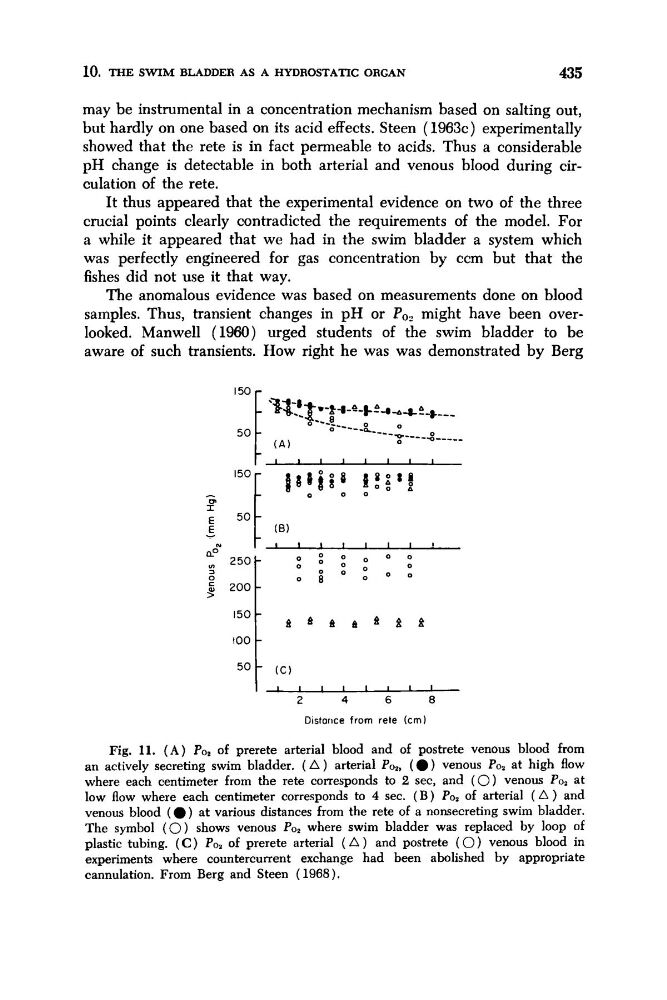
aware of such transients. How right he was was demonstrated by Berg
150 I -
2
4
6
8
Distorice from rete (cm)
Fig. 11. ( A ) PO, of prerete arterial blood and of postrete venous blood from
an actively secreting swim bladder. ( A ) arterial PO,, ( 0 ) venous Po, at high flow
where each centimeter from the rete corresponds to 2 sec, and (0) venous PO, at
low flow where each centimeter corresponds to 4 sec. ( B ) PO, of arterial ( A ) and
venous blood ( 0 ) at various distances from the rete of a nonsecreting swim bladder.
The symbol (0) shows venous PO, where swim bladder was replaced by loop of
plastic tubing. ( C ) Po, of prerete arterial ( A ) and postrete (0) venous blood in
experiments where countercurrent exchange had been abolished by appropriate
cannulation. From Berg and Steen ( 1968).
435
may be instrumental in a concentration mechanism based on salting out,
but hardly on one based on its acid effects. Steen (1963~) experimentally
showed that the rete is in fact permeable to acids. Thus a considerable
pH change is detectable in both arterial and venous blood during circulation of the rete.
It thus appeared that the experimental evidence on two of the three
crucial points clearly contradicted the requirements of the model. For
a while it appeared that we had in the swim bladder a system which
was perfectly engineered for gas concentration by ccm but that the
fishes did not use it that way.
The anomalous evidence was based on measurements done on blood
samples. Thus, transient changes in pH or Po, might have been overlooked. Manwell (1960) urged students of the swim bladder to be
aware of such transients. How right he was was demonstrated by Berg
150 I -
2
4
6
8
Distorice from rete (cm)
Fig. 11. ( A ) PO, of prerete arterial blood and of postrete venous blood from
an actively secreting swim bladder. ( A ) arterial PO,, ( 0 ) venous Po, at high flow
where each centimeter from the rete corresponds to 2 sec, and (0) venous PO, at
low flow where each centimeter corresponds to 4 sec. ( B ) PO, of arterial ( A ) and
venous blood ( 0 ) at various distances from the rete of a nonsecreting swim bladder.
The symbol (0) shows venous PO, where swim bladder was replaced by loop of
plastic tubing. ( C ) Po, of prerete arterial ( A ) and postrete (0) venous blood in
experiments where countercurrent exchange had been abolished by appropriate
cannulation. From Berg and Steen ( 1968).