

10. THE SWIM BLADDER AS A HYDROSTATIC ORGAN
423
ported by the observation that a high capacity to deposit gases is correlated with the presence of a rete system which gives the two bloodstreams a large, but thin, common exchange area. This aspect will be
discussed in quantitative term together with the functional aspects of
the rete.
IV. THE PERFORMANCE OF THE SWIM BLADDER
A. The Behavior of the Swim Bladder
during Vertical Displacements
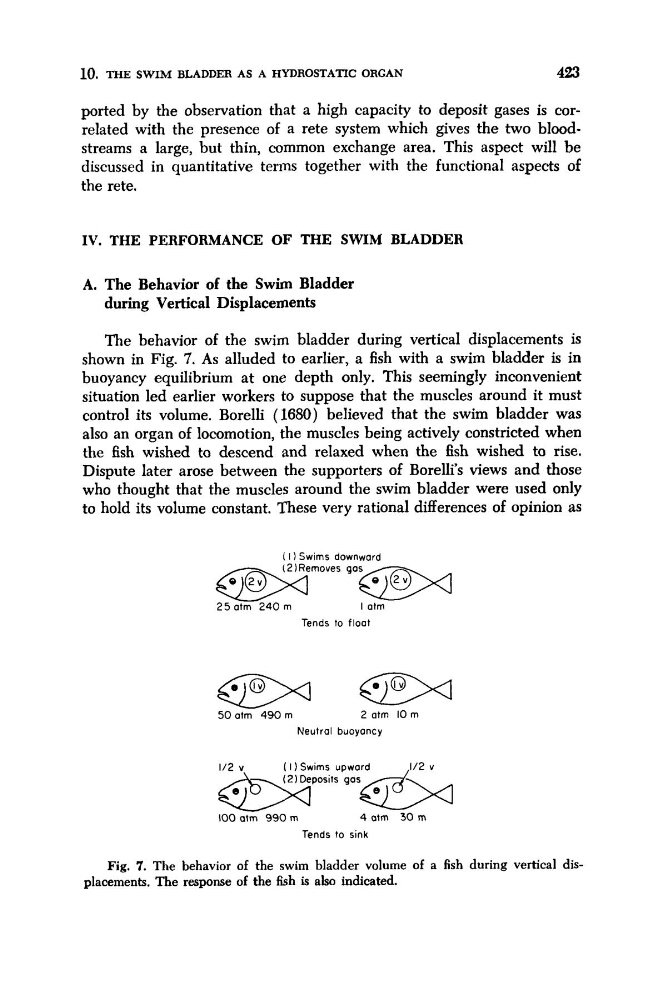
The behavior of the swim bladder during vertical displacements is
shown in Fig. 7. As alluded to earlier, a fish with a swim bladder is in
buoyancy equilibrium at one depth only, This seemingly inconvenient
situation led earlier workers to suppose that the muscles around it must
control its volume. Borelli (1680) believed that the swim bladder was
also an organ of locomotion, the muscles being actively constricted when
the fish wished to descend and relaxed when the fish wished to rise.
Dispute later arose between the supporters of Borelli’s views and those
who thought that the muscles around the swim bladder were used only
to hold its volume constant. These very rational differences of opinion as
( I ) Swims downward
2 5 a t m 2 4 0 m
I otm
Tends to float
2 otm 1 0 m
5 0 a t m 4 9 0 m
Neutral buoyancy
( I ) Swims upward
(2) Deposits gas
100 at ;
990 m
4 otm 30 m
Tends to sink
Fig. 7. The behavior of the swim bladder volume of a fish during vertical displacements. The response of the fish is also indicated.
423
ported by the observation that a high capacity to deposit gases is correlated with the presence of a rete system which gives the two bloodstreams a large, but thin, common exchange area. This aspect will be
discussed in quantitative term together with the functional aspects of
the rete.
IV. THE PERFORMANCE OF THE SWIM BLADDER
A. The Behavior of the Swim Bladder
during Vertical Displacements
The behavior of the swim bladder during vertical displacements is
shown in Fig. 7. As alluded to earlier, a fish with a swim bladder is in
buoyancy equilibrium at one depth only, This seemingly inconvenient
situation led earlier workers to suppose that the muscles around it must
control its volume. Borelli (1680) believed that the swim bladder was
also an organ of locomotion, the muscles being actively constricted when
the fish wished to descend and relaxed when the fish wished to rise.
Dispute later arose between the supporters of Borelli’s views and those
who thought that the muscles around the swim bladder were used only
to hold its volume constant. These very rational differences of opinion as
( I ) Swims downward
2 5 a t m 2 4 0 m
I otm
Tends to float
2 otm 1 0 m
5 0 a t m 4 9 0 m
Neutral buoyancy
( I ) Swims upward
(2) Deposits gas
100 at ;
990 m
4 otm 30 m
Tends to sink
Fig. 7. The behavior of the swim bladder volume of a fish during vertical displacements. The response of the fish is also indicated.