

404
K J E U JOHANSEN
It seems typical that fishes engaged in voluntary air exposure under
natural conditions promptly commence frequent ventilatory movements
and show no signs of distress and erratic behavior such as seen in purely
aquatic breathers when air-exposed in the laboratory (Berg and Steen,
1965; Johansen and Lenfant, 1968). Only in the South American teleost
Symbranchus and in the lungfishes have blood gas values been correlated with breathing behavior during air exposure (Johansen, 1966;
Lenfant and Johansen, 1968). In Symbranchus, arterial Po, and P,,,
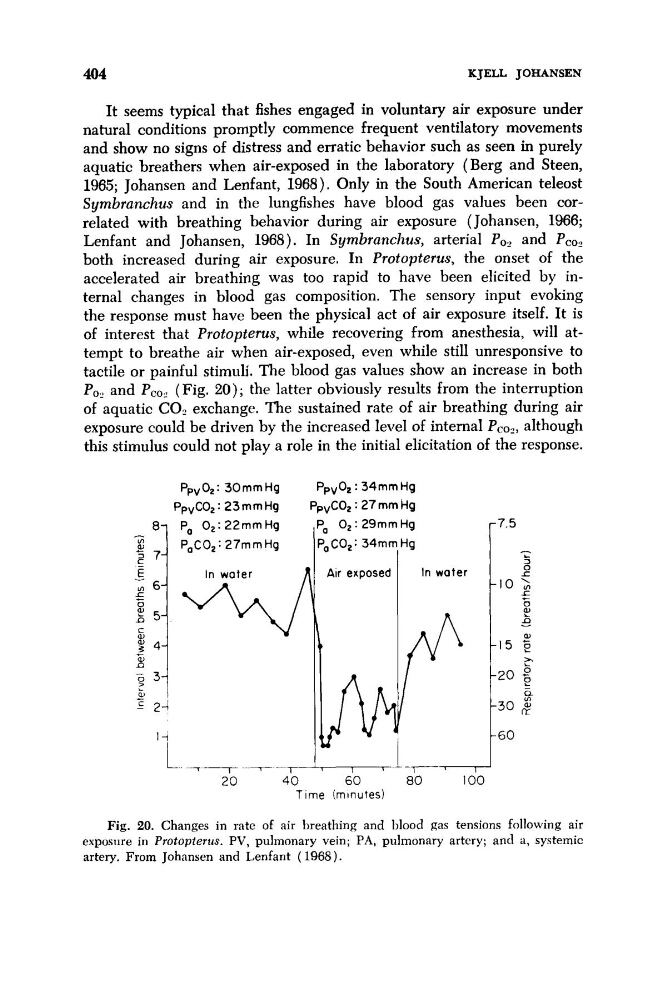
both increased during air exposure. In Protopterus, the onset of the
accelerated air breathing was too rapid to have been elicited by internal changes in blood gas composition. The sensory input evoking
the response must have been the physical act of air exposure itself. It is
of interest that Protopterus, while recovering from anesthesia, will attempt to breathe air when air-exposed, even while still unresponsive to
tactile or painful stimuli. The blood gas values show an increase in both
Po, and Pco, (Fig. 20); the latter obviously results from the interruption
of aquatic CO, exchange. The sustained rate of air breathing during air
exposure could be driven by the increased level of internal Pco2, although
this stimulus could not play a role in the initial elicitation of the response.
PpvOz: 30mmHg
Ppv0,:34mmHg
PpvCO, : 27 m m Hg
PpvCOz : 23mm Hg
'I
Po O2:22mmHg
,Po OZ:29mmHg
POCO,: 27mmHg
POCO,: 34mr
I
7.5
-
L
3
0
c
10 >
f
e
n
0
-
0,
15
t.
2 0 5
-
a u1
30 $
60
20
4 0
60
80
I 0 0
Time (minutes)
Fig. 20. Changes in rate of air breathing and blood gas tensions following air
exposure in Protopierris. PV, pulmonary vein; PA, pnlmonary artery; and a, systemic
artery. From Johansen and Lenfant ( 1968).
K J E U JOHANSEN
It seems typical that fishes engaged in voluntary air exposure under
natural conditions promptly commence frequent ventilatory movements
and show no signs of distress and erratic behavior such as seen in purely
aquatic breathers when air-exposed in the laboratory (Berg and Steen,
1965; Johansen and Lenfant, 1968). Only in the South American teleost
Symbranchus and in the lungfishes have blood gas values been correlated with breathing behavior during air exposure (Johansen, 1966;
Lenfant and Johansen, 1968). In Symbranchus, arterial Po, and P,,,
both increased during air exposure. In Protopterus, the onset of the
accelerated air breathing was too rapid to have been elicited by internal changes in blood gas composition. The sensory input evoking
the response must have been the physical act of air exposure itself. It is
of interest that Protopterus, while recovering from anesthesia, will attempt to breathe air when air-exposed, even while still unresponsive to
tactile or painful stimuli. The blood gas values show an increase in both
Po, and Pco, (Fig. 20); the latter obviously results from the interruption
of aquatic CO, exchange. The sustained rate of air breathing during air
exposure could be driven by the increased level of internal Pco2, although
this stimulus could not play a role in the initial elicitation of the response.
PpvOz: 30mmHg
Ppv0,:34mmHg
PpvCO, : 27 m m Hg
PpvCOz : 23mm Hg
'I
Po O2:22mmHg
,Po OZ:29mmHg
POCO,: 27mmHg
POCO,: 34mr
I
7.5
-
L
3
0
c
10 >
f
e
n
0
-
0,
15
t.
2 0 5
-
a u1
30 $
60
20
4 0
60
80
I 0 0
Time (minutes)
Fig. 20. Changes in rate of air breathing and blood gas tensions following air
exposure in Protopierris. PV, pulmonary vein; PA, pnlmonary artery; and a, systemic
artery. From Johansen and Lenfant ( 1968).