

380
KJELL JOHANSEN
353 0I
L
c
al
< 25al
-
E
E 208
-
n
I
5in fishes normally living in a C0,-rich habitat is an important adaptation
needed for adoption of air breathing since this change inevitably will
entail an elevated concentration of C 0 2 at the gas exchange surfaces because of the bidirectional airway of air breathers (Carter, 1951).
The CO, combining power of blood shows a clear increase with increased importance of air breathing in overall gas exchange. Figure 6
shows a comparison of CO, dissociation curves with normal values of
arterial Pco, indicated for representative air-breathing fishes.
The increase in C 0 2 combining power correlates with an increase in
the average level of arterial Pco.,, thus meeting the obvious need for
a higher capacity in CO, transport associated with the air-breathing
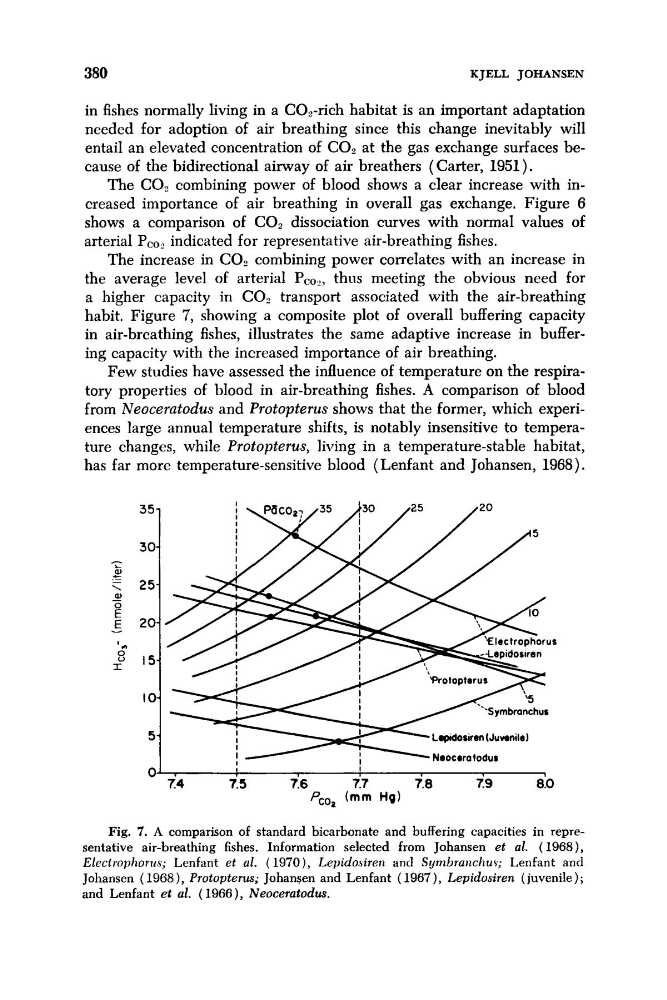
habit. Figure 7, showing a composite plot of overall buffering capacity
in air-breathing fishes, illustrates the same adaptive increase in buffering capacity with the increased importance of air breathing.
Few studies have assessed the influence of temperature on the respiratory properties of blood in air-breathing fishes. A comparison of blood
from Neoceratodus and Protopterus shows that the former, which experiences large annual temperature shifts, is notably insensitive to temperature changes, while Protopterus, living in a temperature-stable habitat,
has far more temperature-sensitive blood (Lenfant and Johansen, 1968).
; - Neocrratodus
0’ .
0
I
j
7.4
7.5
7.6
7.7
7.8
7.9
8.0
Pco, ( m m Hg)
Fig. 7. A comparison of standard bicarbonate and buffering capacities in representative air-breathing fishes. Information selected from Johansen et ul. ( 1968),
Elcclrophorus; Lenfant et al. ( 1970), Lepidosiren and Symbrunchu~; Lenfant and
Johansen ( 1968), Protopterus; Johansen and Lenfant ( 1967), Lepidosiren (juvenile);
and Lenfant et al. (1966), Neoceratodus.
KJELL JOHANSEN
353 0I
L
c
al
< 25al
-
E
E 208
-
n
I
5in fishes normally living in a C0,-rich habitat is an important adaptation
needed for adoption of air breathing since this change inevitably will
entail an elevated concentration of C 0 2 at the gas exchange surfaces because of the bidirectional airway of air breathers (Carter, 1951).
The CO, combining power of blood shows a clear increase with increased importance of air breathing in overall gas exchange. Figure 6
shows a comparison of CO, dissociation curves with normal values of
arterial Pco, indicated for representative air-breathing fishes.
The increase in C 0 2 combining power correlates with an increase in
the average level of arterial Pco.,, thus meeting the obvious need for
a higher capacity in CO, transport associated with the air-breathing
habit. Figure 7, showing a composite plot of overall buffering capacity
in air-breathing fishes, illustrates the same adaptive increase in buffering capacity with the increased importance of air breathing.
Few studies have assessed the influence of temperature on the respiratory properties of blood in air-breathing fishes. A comparison of blood
from Neoceratodus and Protopterus shows that the former, which experiences large annual temperature shifts, is notably insensitive to temperature changes, while Protopterus, living in a temperature-stable habitat,
has far more temperature-sensitive blood (Lenfant and Johansen, 1968).
; - Neocrratodus
0’ .
0
I
j
7.4
7.5
7.6
7.7
7.8
7.9
8.0
Pco, ( m m Hg)
Fig. 7. A comparison of standard bicarbonate and buffering capacities in representative air-breathing fishes. Information selected from Johansen et ul. ( 1968),
Elcclrophorus; Lenfant et al. ( 1970), Lepidosiren and Symbrunchu~; Lenfant and
Johansen ( 1968), Protopterus; Johansen and Lenfant ( 1967), Lepidosiren (juvenile);
and Lenfant et al. (1966), Neoceratodus.