

324
G. SHELTON
Motonewon
t
t
Proprioceptor
and
chemoreceptor
input
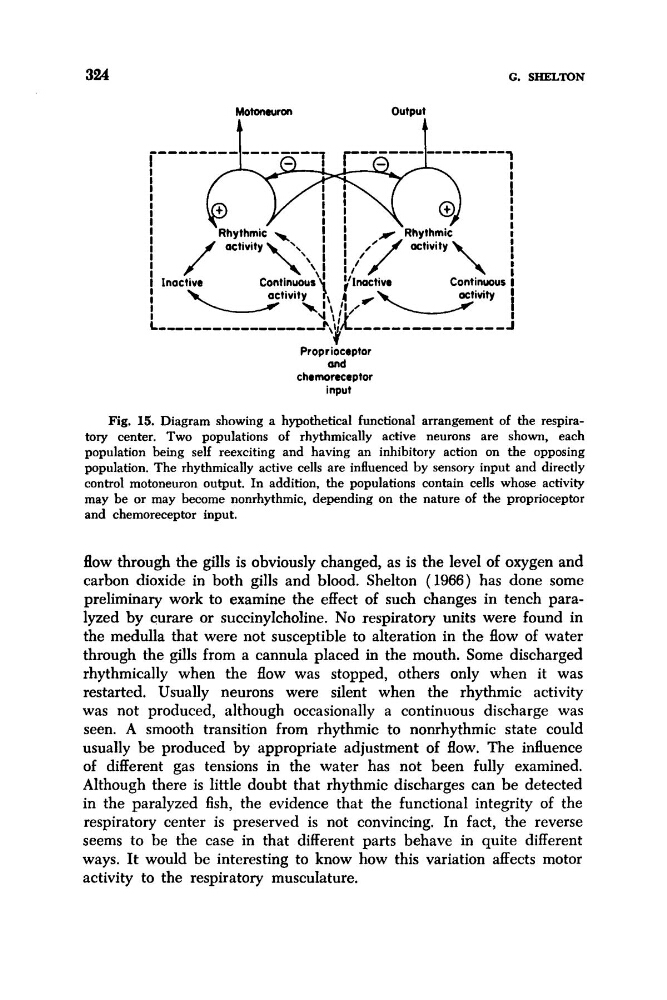
Fig. 15. Diagram showing a hypothetical functional arrangement of the respiratory center. Two populations of rhythmically active neurons are shown, each
population being self reexciting and having an inhibitory action on the opposing
population. The rhythmically active cells are influenced by sensory input and directly
control motoneuron output. In addition, the populations contain cells whose activity
may be or may become nonrhythmic, depending on the nature of the proprioceptor
and chemoreceptor input.
flow through the gills is obviously changed, as is the level of oxygen and
carbon dioxide in both gills and blood. Shelton (1966) has done some
preliminary work to examine the effect of such changes in tench paralyzed by curare or succinylcholine. No respiratory units were found in
the medulla that were not susceptible to alteration in the flow of water
through the gills from a cannula placed in the mouth. Some discharged
rhythmically when the flow was stopped, others only when it was
restarted. Usually neurons were silent when the rhythmic activity
was not produced, although occasionally a continuous discharge was
seen. A smooth transition from rhythmic to nonrhythmic state could
usually be produced by appropriate adjustment of flow. The influence
of different gas tensions in the water has not been fully examined.
Although there is little doubt that rhythmic discharges can be detected
in the paralyzed fish, the evidence that the functional integrity of the
respiratory center is preserved is not convincing. In fact, the reverse
seems to be the case in that different parts behave in quite different
ways. It would be interesting to know how this variation affects motor
activity to the respiratory musculature.
G. SHELTON
Motonewon
t
t
Proprioceptor
and
chemoreceptor
input
Fig. 15. Diagram showing a hypothetical functional arrangement of the respiratory center. Two populations of rhythmically active neurons are shown, each
population being self reexciting and having an inhibitory action on the opposing
population. The rhythmically active cells are influenced by sensory input and directly
control motoneuron output. In addition, the populations contain cells whose activity
may be or may become nonrhythmic, depending on the nature of the proprioceptor
and chemoreceptor input.
flow through the gills is obviously changed, as is the level of oxygen and
carbon dioxide in both gills and blood. Shelton (1966) has done some
preliminary work to examine the effect of such changes in tench paralyzed by curare or succinylcholine. No respiratory units were found in
the medulla that were not susceptible to alteration in the flow of water
through the gills from a cannula placed in the mouth. Some discharged
rhythmically when the flow was stopped, others only when it was
restarted. Usually neurons were silent when the rhythmic activity
was not produced, although occasionally a continuous discharge was
seen. A smooth transition from rhythmic to nonrhythmic state could
usually be produced by appropriate adjustment of flow. The influence
of different gas tensions in the water has not been fully examined.
Although there is little doubt that rhythmic discharges can be detected
in the paralyzed fish, the evidence that the functional integrity of the
respiratory center is preserved is not convincing. In fact, the reverse
seems to be the case in that different parts behave in quite different
ways. It would be interesting to know how this variation affects motor
activity to the respiratory musculature.