

8. THE REGULATION OF BREATHING
311
the mouth leaves through the last three slits. There is clearly not much
turbulence in the orobranchial cavity. The pattern is not so obvious
in the skate.
These problems and differences notwithstanding, the general picture
of gill ventilation in selachians as it emerges from studies of movement
and pressure does not appear to be radically different from that seen
in the teleosts (Hughes, 1960a). A pressure gradient from orobranchial
to parabranchial cavities exists for most of the respiratory cycle in
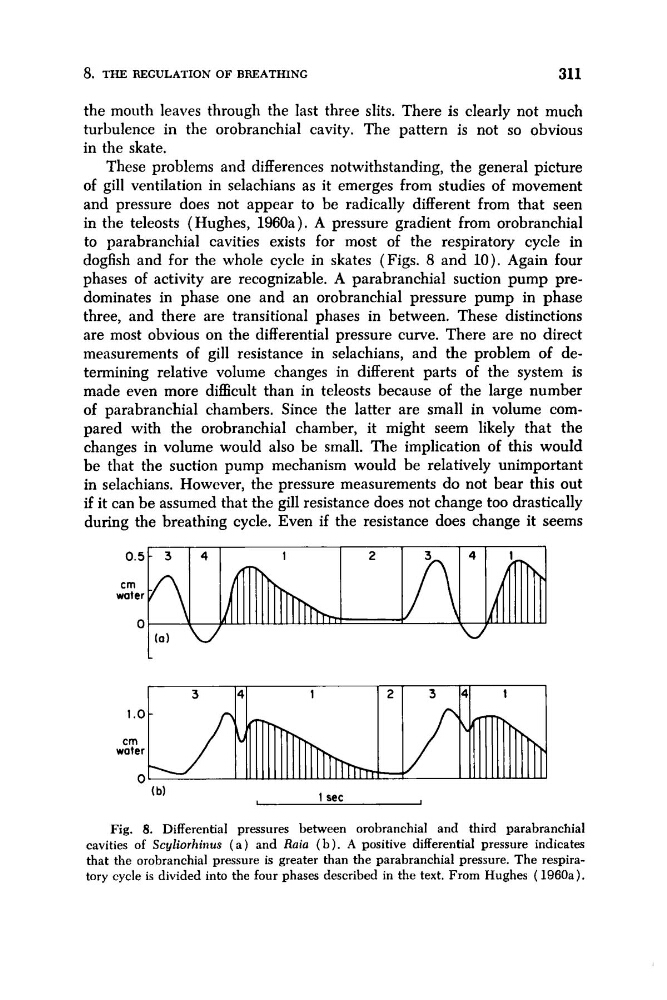
dogfish and for the whole cycle in skates (Figs. 8 and 10). Again four
phases of activity are recognizable. A parabranchial suction pump predominates in phase one and an orobranchial pressure pump in phase
three, and there are transitional phases in between. These distinctions
are most obvious on the differential pressure curve. There are no direct
measurements of gill resistance in selachians, and the problem of determining relative volume changes in different parts of the system is
made even more difficult than in teleosts because of the large number
of parabranchial chambers. Since the latter are small in volume compared with the orobranchial chamber, it might seem likely that the
changes in volume would also be small. The implication of this would
be that the suction pump mechanism would be relatively unimportant
in selachians. However, the pressure measurements do not bear this out
if it can be assumed that the gill resistance does not change too drastically
during the breathing cycle. Even if the resistance does change it seems
I
1 sec
I
Fig. 8. Differential pressures between orobranchial and third parabranchial
cavities of Scyliorhinus ( a ) and Raia ( b ) . A positive differential pressure indicates
that the orobranchial pressure is greater than the parabranchial pressure. The respiratory cycle is divided into the four phases described in the text. From Hughes (1960a).
311
the mouth leaves through the last three slits. There is clearly not much
turbulence in the orobranchial cavity. The pattern is not so obvious
in the skate.
These problems and differences notwithstanding, the general picture
of gill ventilation in selachians as it emerges from studies of movement
and pressure does not appear to be radically different from that seen
in the teleosts (Hughes, 1960a). A pressure gradient from orobranchial
to parabranchial cavities exists for most of the respiratory cycle in
dogfish and for the whole cycle in skates (Figs. 8 and 10). Again four
phases of activity are recognizable. A parabranchial suction pump predominates in phase one and an orobranchial pressure pump in phase
three, and there are transitional phases in between. These distinctions
are most obvious on the differential pressure curve. There are no direct
measurements of gill resistance in selachians, and the problem of determining relative volume changes in different parts of the system is
made even more difficult than in teleosts because of the large number
of parabranchial chambers. Since the latter are small in volume compared with the orobranchial chamber, it might seem likely that the
changes in volume would also be small. The implication of this would
be that the suction pump mechanism would be relatively unimportant
in selachians. However, the pressure measurements do not bear this out
if it can be assumed that the gill resistance does not change too drastically
during the breathing cycle. Even if the resistance does change it seems
I
1 sec
I
Fig. 8. Differential pressures between orobranchial and third parabranchial
cavities of Scyliorhinus ( a ) and Raia ( b ) . A positive differential pressure indicates
that the orobranchial pressure is greater than the parabranchial pressure. The respiratory cycle is divided into the four phases described in the text. From Hughes (1960a).