

8. THE REGULATION OF BREATHING
309
Add md
HY hY
p hY
St hy
Lev op
Do
Add op
Pressure
+
buccal
0
cav1ty
-
Close
Jow
movement 1
Pressure
+
operculor
0
cov1ty
-
Close
Opercular t
movement
1 second
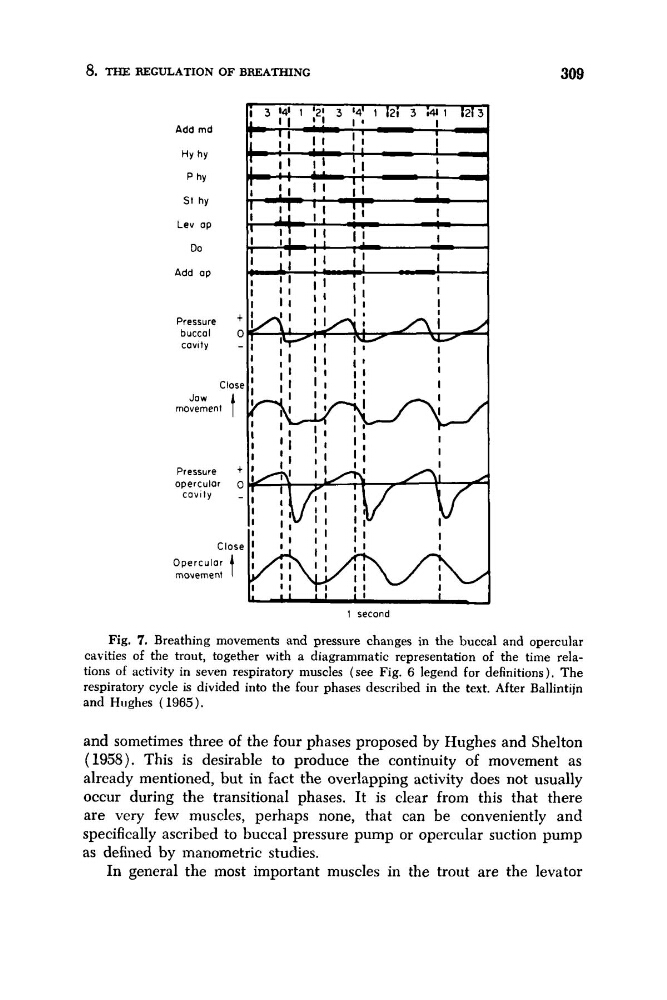
Fig. 7. Breathing movements and pressure changes in the buccal and opercular
cavities of the trout, together with a diagrammatic representation of the time relations of activity in seven respiratory muscles (see Fig. 6 legend for definitions). The
respiratory cycle is divided into the four phases described in the text. After Ballintijn
and Hughes (1965).
and sometimes three of the four phases proposed by Hughes and Shelton
(1958). This is desirable to produce the continuity of movement as
already mentioned, but in fact the overlapping activity does not usually
occur during the transitional phases. It is clear from this that there
are very few muscles, perhaps none, that can be conveniently and
specifically ascribed to buccal pressure pump or opercular suction pump
as defined by manometric studies.
In general the most important muscles in the trout are the levator
309
Add md
HY hY
p hY
St hy
Lev op
Do
Add op
Pressure
+
buccal
0
cav1ty
-
Close
Jow
movement 1
Pressure
+
operculor
0
cov1ty
-
Close
Opercular t
movement
1 second
Fig. 7. Breathing movements and pressure changes in the buccal and opercular
cavities of the trout, together with a diagrammatic representation of the time relations of activity in seven respiratory muscles (see Fig. 6 legend for definitions). The
respiratory cycle is divided into the four phases described in the text. After Ballintijn
and Hughes (1965).
and sometimes three of the four phases proposed by Hughes and Shelton
(1958). This is desirable to produce the continuity of movement as
already mentioned, but in fact the overlapping activity does not usually
occur during the transitional phases. It is clear from this that there
are very few muscles, perhaps none, that can be conveniently and
specifically ascribed to buccal pressure pump or opercular suction pump
as defined by manometric studies.
In general the most important muscles in the trout are the levator