

8. THE REGULATION OF BREATHING
305
uptake at resting ventilation volumes and 44-69% at ventilation volumes
three times resting were used by the respiratory musculature.
Unfortunately, calculations on the mechanical work of breathing
give somewhat different answers. In fact, simultaneous pressure and
volume measurements have not been made. The separate determination
of volume changes in buccal and opercular cavities is a difficult proposition, and, although volume changes of the whole system could be more
easily measured (from cine films, for example), no data are available.
However, making some simplifications, it is possible to use the ventilation volume as a measure of the latter as Alexander (1967) has pointed
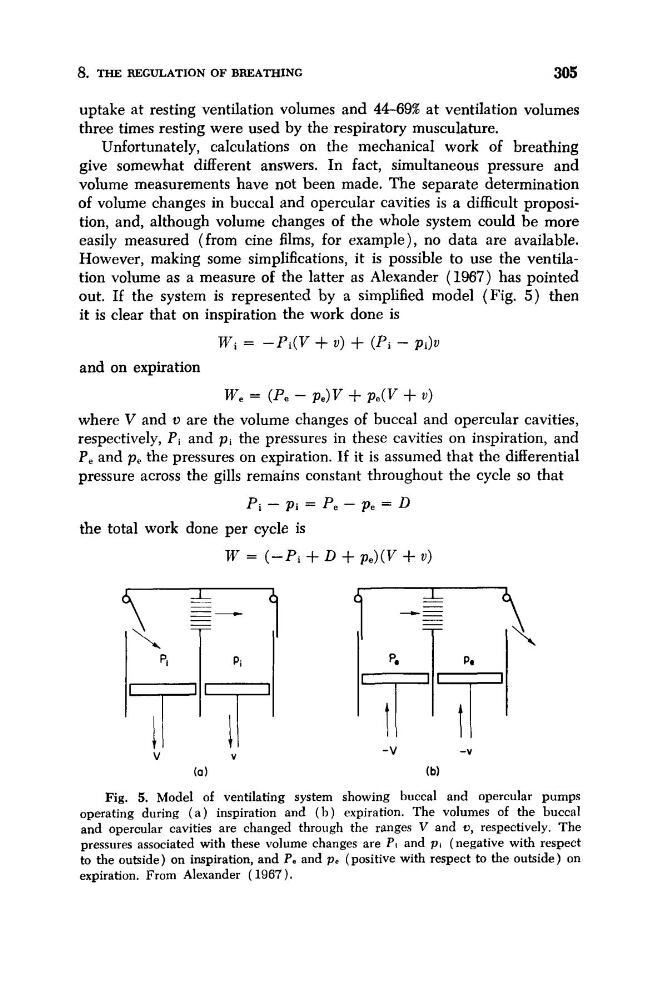
out. If the system is represented by a simplified model (Fig. 5 ) then
it is clear that on inspiration the work done is
wi = -Pi(V + v) + (Pi - pi)v
We = (Pe - pe)V + pe(V + v)
and on expiration
where V and o are the volume changes of buccal and opercular cavities,
respectively, Pi and pi the pressures in these cavities on inspiration, and
P , and p , the pressures on expiration. If it is assumed that the differential
pressure across the gills remains constant throughout the cycle so that
Pi - pi = Pe - pe = D
the total work done per cycle is
= (--Pi + D + pe)(V + v)
- V
-V
(b)
V
(a 1
Fig. 5. Model of ventilating system showing buccal and opercular pumps
operating during ( a ) inspiration and ( b ) expiration. The volumes of the buccal
and opercular cavities are changed through the ranges V and u, respectively. The
pressures associated with these volume changes are Pi and pi (negative with respect
to the outside) on inspiration, and P. and p , (positive with respect to the outside) on
expiration. From Alexander ( 1967).
305
uptake at resting ventilation volumes and 44-69% at ventilation volumes
three times resting were used by the respiratory musculature.
Unfortunately, calculations on the mechanical work of breathing
give somewhat different answers. In fact, simultaneous pressure and
volume measurements have not been made. The separate determination
of volume changes in buccal and opercular cavities is a difficult proposition, and, although volume changes of the whole system could be more
easily measured (from cine films, for example), no data are available.
However, making some simplifications, it is possible to use the ventilation volume as a measure of the latter as Alexander (1967) has pointed
out. If the system is represented by a simplified model (Fig. 5 ) then
it is clear that on inspiration the work done is
wi = -Pi(V + v) + (Pi - pi)v
We = (Pe - pe)V + pe(V + v)
and on expiration
where V and o are the volume changes of buccal and opercular cavities,
respectively, Pi and pi the pressures in these cavities on inspiration, and
P , and p , the pressures on expiration. If it is assumed that the differential
pressure across the gills remains constant throughout the cycle so that
Pi - pi = Pe - pe = D
the total work done per cycle is
= (--Pi + D + pe)(V + v)
- V
-V
(b)
V
(a 1
Fig. 5. Model of ventilating system showing buccal and opercular pumps
operating during ( a ) inspiration and ( b ) expiration. The volumes of the buccal
and opercular cavities are changed through the ranges V and u, respectively. The
pressures associated with these volume changes are Pi and pi (negative with respect
to the outside) on inspiration, and P. and p , (positive with respect to the outside) on
expiration. From Alexander ( 1967).