

7. GAS EXCHANGE IN FISH
269
observations led Lenfant and Johansen (1966) to question the presence
of a countercurrent system in elasmobranchs. Robin and Murdaugh
(1967) discussed the effects of various arrangements of the flows of
blood and water on gas exchange and concluded that a countercurrent
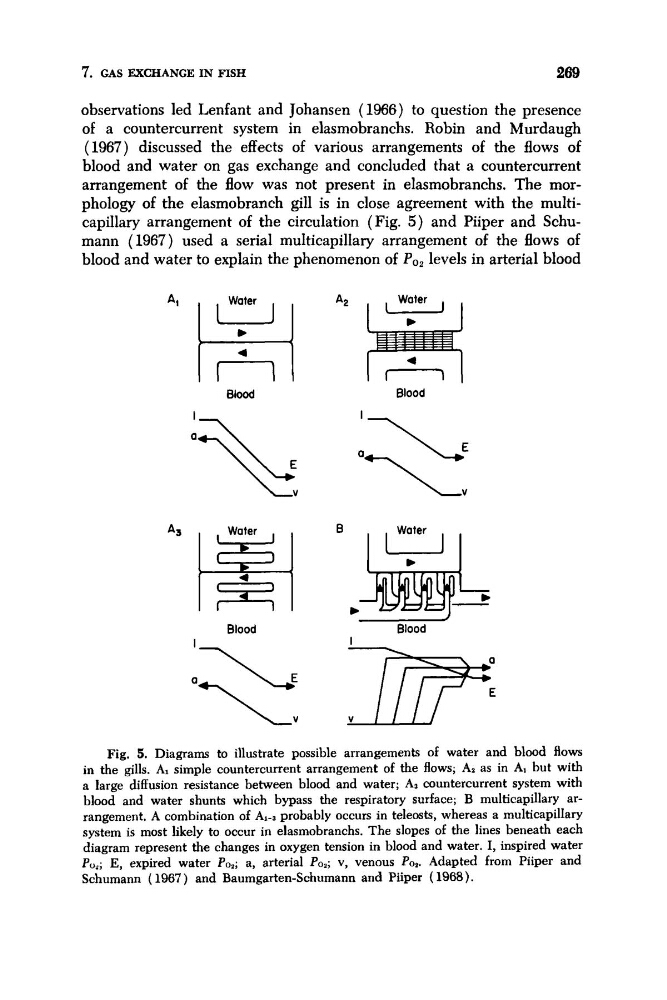
arrangement of the 00w was not present in elasmobranchs. The morphology of the elasmobranch gill is in close agreement with the multicapillary arrangement of the circulation (Fig. 5 ) and Piiper and Schumann (1967) used a serial multicapillary arrangement of the flows of
blood and water to explain the phenomenon of Po, levels in arterial blood
Blood
" t
Water
3 Blood
Water
* ' I L S J I
Blood
Blood
IFE
Fig. 5. Diagrams to illustrate possible arrangements of water and blood flows
in the gills. A1 simple countercurrent arrangement of the flows; A2 as in A1 but with
a large diffusion resistance between blood and water; Al countercurrent system with
blood and water shunts which bypass the respiratory surface; B multicapillary arrangement. A combination of A1-3 probably occurs in teleosts, whereas a multicapillary
system is most likely to occur in elasmobranchs. The slopes of the lines beneath each
diagram represent the changes in oxygen tension in blood and water. I, inspired water
Po,; E, expired water PO,; a, arterial PO,; v, venous Po,. Adapted from Piiper and
Schumann ( 1967 ) and Baumgarten-Schumann and Piiper ( 1968).
269
observations led Lenfant and Johansen (1966) to question the presence
of a countercurrent system in elasmobranchs. Robin and Murdaugh
(1967) discussed the effects of various arrangements of the flows of
blood and water on gas exchange and concluded that a countercurrent
arrangement of the 00w was not present in elasmobranchs. The morphology of the elasmobranch gill is in close agreement with the multicapillary arrangement of the circulation (Fig. 5 ) and Piiper and Schumann (1967) used a serial multicapillary arrangement of the flows of
blood and water to explain the phenomenon of Po, levels in arterial blood
Blood
" t
Water
3 Blood
Water
* ' I L S J I
Blood
Blood
IFE
Fig. 5. Diagrams to illustrate possible arrangements of water and blood flows
in the gills. A1 simple countercurrent arrangement of the flows; A2 as in A1 but with
a large diffusion resistance between blood and water; Al countercurrent system with
blood and water shunts which bypass the respiratory surface; B multicapillary arrangement. A combination of A1-3 probably occurs in teleosts, whereas a multicapillary
system is most likely to occur in elasmobranchs. The slopes of the lines beneath each
diagram represent the changes in oxygen tension in blood and water. I, inspired water
Po,; E, expired water PO,; a, arterial PO,; v, venous Po,. Adapted from Piiper and
Schumann ( 1967 ) and Baumgarten-Schumann and Piiper ( 1968).