

6. PROPERTIES OF FISH HEMOGLOBINS
241
depend strongly on temperature: the P,, rises about 1 mm for each
degree centrigrade the temperature rises, but the oxygen equilibrium
of tuna hemoglobin is almost completely independent of temperature.
This peculiarity is discussed in an earlier section. Generally, marine
teleosts live in a more uniform environment than their freshwater relatives: the po, is usually high and the pco, low (often less than 1 mm).
Nevertheless, their hemoglobins show just as much variation in oxygen
affinity as those of freshwater fish, which suggests the importance of
metabolic variations. Rather than catalog these variations, it will, perhaps, be more instructive to examine the hemoglobins of certain fishes
in detail.
Salmon hemoglobins have been studied more extensively than almost
any other fish hemoglobin. The oxygen equilibrium of the whole hemolyzate near pH 7.0 often appears “unduatory,” and claculations of n at
50% oxygenation show evidence for reduced cooperativity or apparent
“negative heme-heme interaction.” Hashimoto et al. ( 1960) show that
this is only apparent and that the departure is wholly owing to the
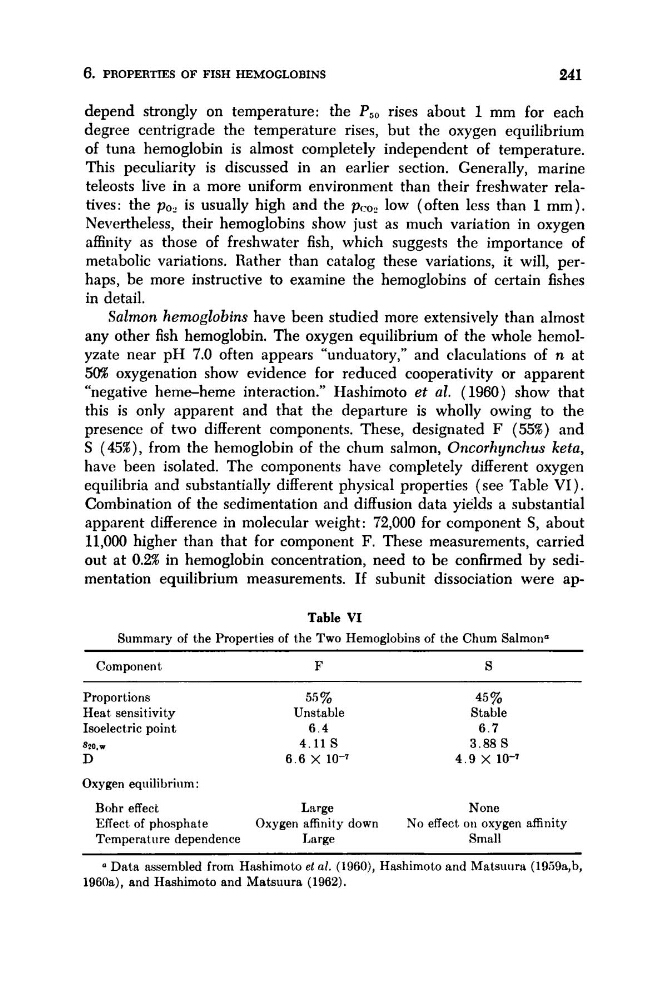
presence of two different components. These, designated F (55%) and
S (45X), from the hemoglobin of the chum salmon, Oncorhynclzus keta,
have been isolated. The components have completely different oxygen
equilibria and substantially different physical properties (see Table VI).
Combination of the sedimentation and diffusion data yields a substantial
apparent difference in molecular weight: 72,000 for component S, about
11,000 higher than that for component F. These measurements, carried
out at 0.2% in hemoglobin concentration, need to be confirmed by sedimentation equilibrium measurements. If subunit dissociation were apTable VI
Summary of the Properties of the Two Hemoglobins of the Chum Salmona
Component
F
S
Proportions
5.5 %
45 %
Heat sensitivity
Unstable
Stable
Isoelectric point
6 . 4
6 . 7
s2o.w
4 . 1 1 S
3.88 S
D
6 . 6 X
4 . 9 x 10⁻⁷
Oxygen equilibrium :
Bohr effect
Large
None
Effect of phosphate
Temperature dependence
Large
Small
Oxygen affinity down
No effect on oxygen affinity
0 Data assembled from Hashimoto el al. (1960), Hashimoto and Matsuura (1959a,b,
1960a), and Hashimoto and Matsuura (1962).
241
depend strongly on temperature: the P,, rises about 1 mm for each
degree centrigrade the temperature rises, but the oxygen equilibrium
of tuna hemoglobin is almost completely independent of temperature.
This peculiarity is discussed in an earlier section. Generally, marine
teleosts live in a more uniform environment than their freshwater relatives: the po, is usually high and the pco, low (often less than 1 mm).
Nevertheless, their hemoglobins show just as much variation in oxygen
affinity as those of freshwater fish, which suggests the importance of
metabolic variations. Rather than catalog these variations, it will, perhaps, be more instructive to examine the hemoglobins of certain fishes
in detail.
Salmon hemoglobins have been studied more extensively than almost
any other fish hemoglobin. The oxygen equilibrium of the whole hemolyzate near pH 7.0 often appears “unduatory,” and claculations of n at
50% oxygenation show evidence for reduced cooperativity or apparent
“negative heme-heme interaction.” Hashimoto et al. ( 1960) show that
this is only apparent and that the departure is wholly owing to the
presence of two different components. These, designated F (55%) and
S (45X), from the hemoglobin of the chum salmon, Oncorhynclzus keta,
have been isolated. The components have completely different oxygen
equilibria and substantially different physical properties (see Table VI).
Combination of the sedimentation and diffusion data yields a substantial
apparent difference in molecular weight: 72,000 for component S, about
11,000 higher than that for component F. These measurements, carried
out at 0.2% in hemoglobin concentration, need to be confirmed by sedimentation equilibrium measurements. If subunit dissociation were apTable VI
Summary of the Properties of the Two Hemoglobins of the Chum Salmona
Component
F
S
Proportions
5.5 %
45 %
Heat sensitivity
Unstable
Stable
Isoelectric point
6 . 4
6 . 7
s2o.w
4 . 1 1 S
3.88 S
D
6 . 6 X
4 . 9 x 10⁻⁷
Oxygen equilibrium :
Bohr effect
Large
None
Effect of phosphate
Temperature dependence
Large
Small
Oxygen affinity down
No effect on oxygen affinity
0 Data assembled from Hashimoto el al. (1960), Hashimoto and Matsuura (1959a,b,
1960a), and Hashimoto and Matsuura (1962).