

6. PROPERTIES OF FISH HEMOGLOBINS
229
0
I
2
3
LOSP
- 4
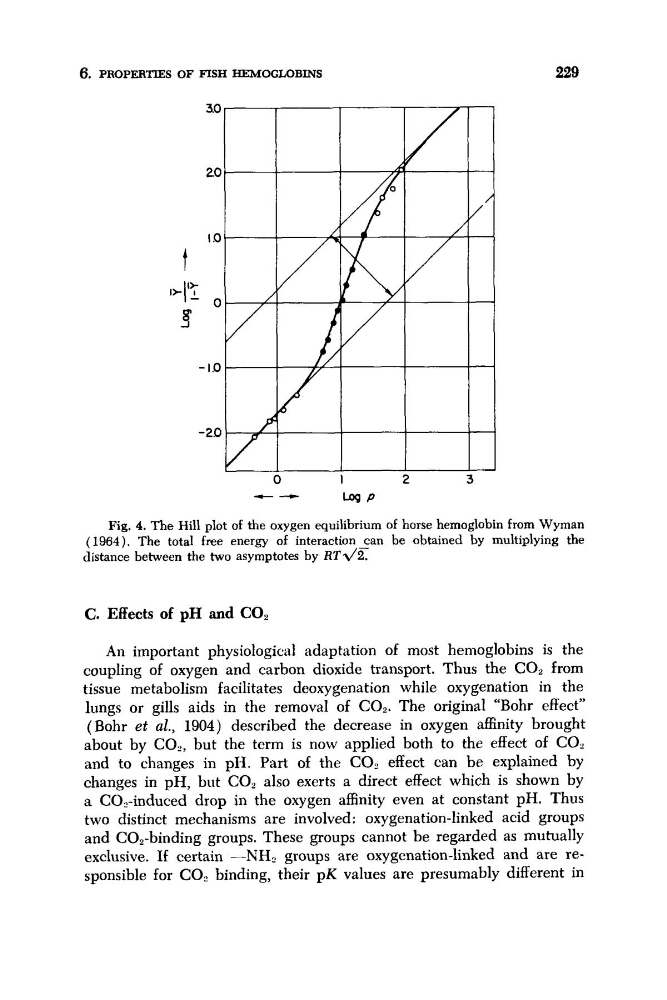
Fig, 4. The Hill plot of the oxygen equilibrium of horse hemoglobin from Wyman
(1964). The total free energy of interactionsan be obtained by multiplying the
distance between the two asymptotes by R T d 2 .
C. Effects of pH and CO,
An important physiological adaptation of most hemoglobins is the
coupling of oxygen and carbon dioxide transport. Thus the CO, from
tissue metabolism facilitates deoxygenation while oxygenation in the
lungs or gills aids in the removal of CO,. The original “Bohr effect”
(Bohr et al., 1904) described the decrease in oxygen affinity brought
about by CO., but the term is now applied both to the effect of CO,
and to changes in pH. Part of the CO, effect can be explained by
changes in pH, but CO, also exerts a direct effect which is shown by
a C0,-induced drop in the oxygen affinity even at constant pH. Thus
two distinct mechanisms are involved: oxygenation-linked acid groups
and C0,-binding groups. These groups cannot be regarded as mutually
exclusive. If certain -NH, groups are oxygenation-linked and are responsible for CO, binding, their pK values are presumably different in
229
0
I
2
3
LOSP
- 4
Fig, 4. The Hill plot of the oxygen equilibrium of horse hemoglobin from Wyman
(1964). The total free energy of interactionsan be obtained by multiplying the
distance between the two asymptotes by R T d 2 .
C. Effects of pH and CO,
An important physiological adaptation of most hemoglobins is the
coupling of oxygen and carbon dioxide transport. Thus the CO, from
tissue metabolism facilitates deoxygenation while oxygenation in the
lungs or gills aids in the removal of CO,. The original “Bohr effect”
(Bohr et al., 1904) described the decrease in oxygen affinity brought
about by CO., but the term is now applied both to the effect of CO,
and to changes in pH. Part of the CO, effect can be explained by
changes in pH, but CO, also exerts a direct effect which is shown by
a C0,-induced drop in the oxygen affinity even at constant pH. Thus
two distinct mechanisms are involved: oxygenation-linked acid groups
and C0,-binding groups. These groups cannot be regarded as mutually
exclusive. If certain -NH, groups are oxygenation-linked and are responsible for CO, binding, their pK values are presumably different in