

214
AUSTEN RIGGS
- - - - - - - - - 0
Length:13.3 14.2 16.0 1 6 . 7 18.7 24.1 25.1
30.4
Age (years): I
2-4-5
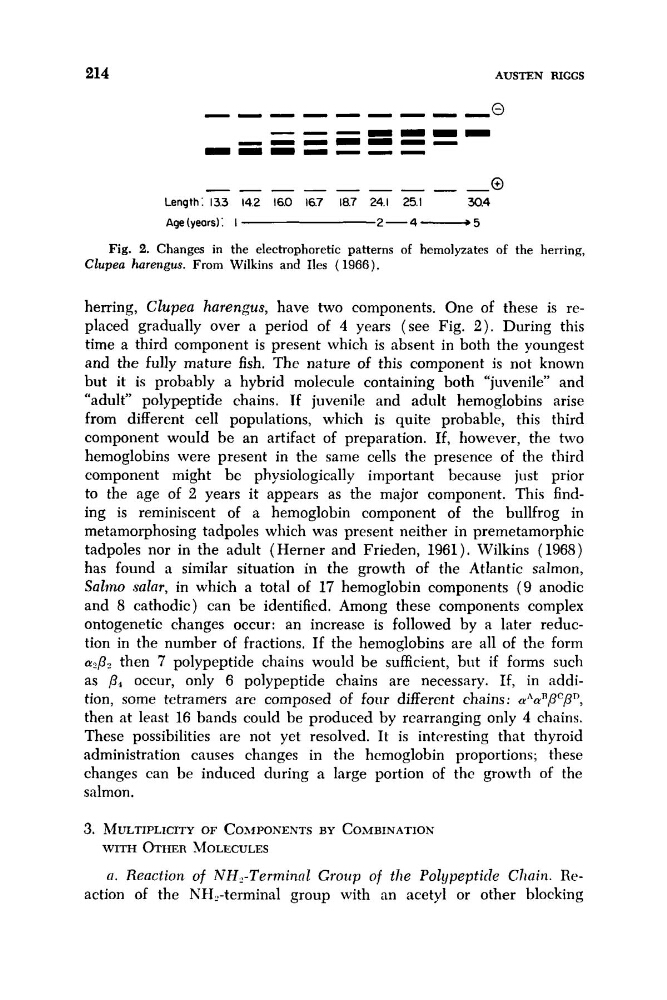
Fig. 2. Changes in the electrophoretic patterns of hemolyzates of the herring,
Clupea harengus. From Wilkins and Iles ( 1966).
herring, Clupea harengus, have two components. One of these is replaced gradually over a period of 4 years (see Fig. 2 ) . During this
time a third component is present which is absent in both the youngest
and the fully mature fish. The nature of this component is not known
but it is probably a hybrid molecule containing both “juvenile” and
“adult” polypeptide chains. If juvenile and adult hemoglobins arise
from different cell populations, which is quite probable, this third
component would be an artifact of preparation. If, however, the two
hemoglobins were present in the same cells the presence of the third
component might be physiologically important because just prior
to the age of 2 years it appears as the major component. This finding is reminiscent of a hemoglobin component of the bullfrog in
metamorphosing tadpoles which was present neither in premetamorphic
tadpoles nor in the adult (Herner and Frieden, 1961). Wilkins (1968)
has found a similar situation in the growth of the Atlantic salmon,
Salmo salar, in which a total of 17 hemoglobin components ( 9 anodic
and 8 cathodic) can be identified. Among these components complex
ontogenetic changes occur: an increase is followed by a later reduction in the number of fractions. If the hemoglobins are all of the form
a2p2 then 7 polypeptide chains would be sufficient, but if forms such
as p4 occur, only 6 polypeptide chains are necessary. If, in addition, some tetramers are composed of four different chains: ~ y * ~ y ~ p ~ , P ,
then at least 16 bands could be produced by rearranging only 4 chains.
These possibilities are not yet resolved. It is interesting that thyroid
administration causes changes in the hemoglobin proportions; these
changes can be induced during a large portion of thc growth of the
salmon.
3. MULTIPLICITY OF COMPONENTS BY COMBINATION
WITH OTHER MOLECULES
a . Reaction of NH,-Terminnl Group of the Polypeptide Chain. Reaction of the NH,-terminal group with an acetyl or other blocking
AUSTEN RIGGS
- - - - - - - - - 0
Length:13.3 14.2 16.0 1 6 . 7 18.7 24.1 25.1
30.4
Age (years): I
2-4-5
Fig. 2. Changes in the electrophoretic patterns of hemolyzates of the herring,
Clupea harengus. From Wilkins and Iles ( 1966).
herring, Clupea harengus, have two components. One of these is replaced gradually over a period of 4 years (see Fig. 2 ) . During this
time a third component is present which is absent in both the youngest
and the fully mature fish. The nature of this component is not known
but it is probably a hybrid molecule containing both “juvenile” and
“adult” polypeptide chains. If juvenile and adult hemoglobins arise
from different cell populations, which is quite probable, this third
component would be an artifact of preparation. If, however, the two
hemoglobins were present in the same cells the presence of the third
component might be physiologically important because just prior
to the age of 2 years it appears as the major component. This finding is reminiscent of a hemoglobin component of the bullfrog in
metamorphosing tadpoles which was present neither in premetamorphic
tadpoles nor in the adult (Herner and Frieden, 1961). Wilkins (1968)
has found a similar situation in the growth of the Atlantic salmon,
Salmo salar, in which a total of 17 hemoglobin components ( 9 anodic
and 8 cathodic) can be identified. Among these components complex
ontogenetic changes occur: an increase is followed by a later reduction in the number of fractions. If the hemoglobins are all of the form
a2p2 then 7 polypeptide chains would be sufficient, but if forms such
as p4 occur, only 6 polypeptide chains are necessary. If, in addition, some tetramers are composed of four different chains: ~ y * ~ y ~ p ~ , P ,
then at least 16 bands could be produced by rearranging only 4 chains.
These possibilities are not yet resolved. It is interesting that thyroid
administration causes changes in the hemoglobin proportions; these
changes can be induced during a large portion of thc growth of the
salmon.
3. MULTIPLICITY OF COMPONENTS BY COMBINATION
WITH OTHER MOLECULES
a . Reaction of NH,-Terminnl Group of the Polypeptide Chain. Reaction of the NH,-terminal group with an acetyl or other blocking