

5. ACID-BASE BALANCE
183
Sp=O.l
sp = 0.01
PH
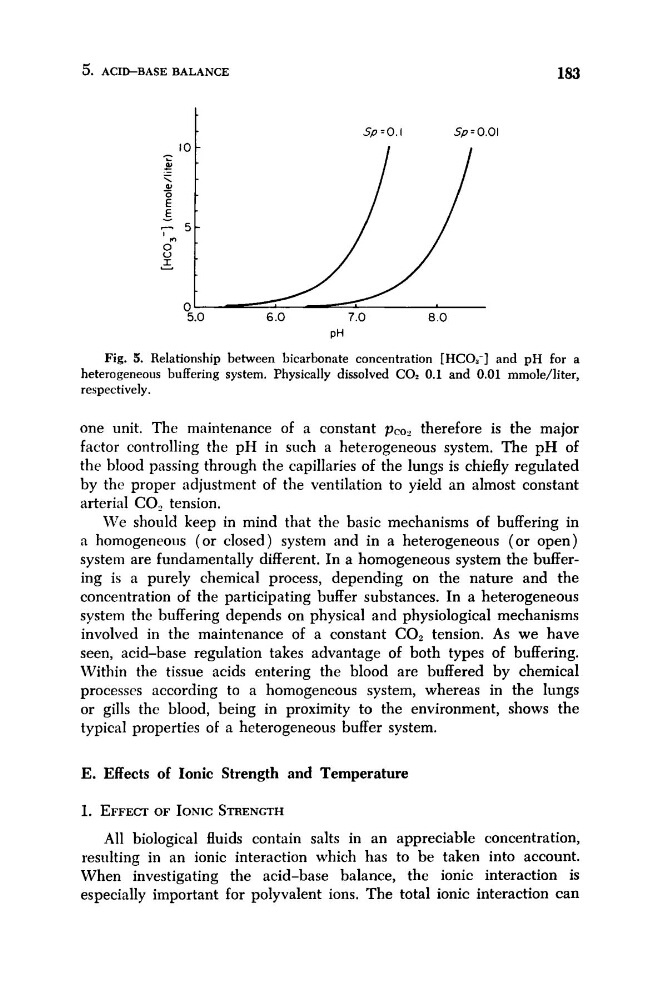
Fig. 5. Relationship between bicarbonate concentration [HCO1-] and pH for a
heterogeneous buffering system. Physically dissolved CO, 0.1 and 0.01 mmole/Iiter,
respectively.
one unit. The maintenance of a constant pco, therefore is the major
factor controlling the pH in such a heterogeneous system. The p H of
the blood passing through the capillaries of the lungs is chiefly regulated
by thc proper adjustment of the ventilation to yield an almost constant
arterial CO, tension.
We should keep in mind that the basic mechanisms of buffering in
a homogeneous (or closed) system and in a heterogeneous (or open)
system are fundamentally different. In a homogeneous system the buff ering is a purely chemical process, depending on the nature and the
concentration of the participating buffer substances. In a heterogeneous
system the buffering depends on physical and physiological mechanisms
involved in the maintenance of a constant CO, tension. As we have
seen, acid-base regulation takes advantage of both types of buffering.
Within the tissue acids entering the blood are buffered by chemical
processes according to a homogeneous system, whereas in the lungs
or gills the blood, being in proximity to the environment, shows the
typical properties of a hcterogeneous buffer system.
E. Effects of Ionic Strength and Temperature
1. EFFECT OF IONIC STRENGTH
All biological fluids contain salts in an appreciable concentration,
resulting in an ionic interaction which has to be taken into account.
When investigating the acid-base balance, the ionic interaction is
especially important for polyvalent ions, The total ionic interaction can
183
Sp=O.l
sp = 0.01
PH
Fig. 5. Relationship between bicarbonate concentration [HCO1-] and pH for a
heterogeneous buffering system. Physically dissolved CO, 0.1 and 0.01 mmole/Iiter,
respectively.
one unit. The maintenance of a constant pco, therefore is the major
factor controlling the pH in such a heterogeneous system. The p H of
the blood passing through the capillaries of the lungs is chiefly regulated
by thc proper adjustment of the ventilation to yield an almost constant
arterial CO, tension.
We should keep in mind that the basic mechanisms of buffering in
a homogeneous (or closed) system and in a heterogeneous (or open)
system are fundamentally different. In a homogeneous system the buff ering is a purely chemical process, depending on the nature and the
concentration of the participating buffer substances. In a heterogeneous
system the buffering depends on physical and physiological mechanisms
involved in the maintenance of a constant CO, tension. As we have
seen, acid-base regulation takes advantage of both types of buffering.
Within the tissue acids entering the blood are buffered by chemical
processes according to a homogeneous system, whereas in the lungs
or gills the blood, being in proximity to the environment, shows the
typical properties of a hcterogeneous buffer system.
E. Effects of Ionic Strength and Temperature
1. EFFECT OF IONIC STRENGTH
All biological fluids contain salts in an appreciable concentration,
resulting in an ionic interaction which has to be taken into account.
When investigating the acid-base balance, the ionic interaction is
especially important for polyvalent ions, The total ionic interaction can