

4. THE CIRCULATORY SYSTEM
161
through the gills and appeared in the visceral veins 20 sec after leaving
the heart. The observed circulation time is much more rapid than the
calculated value. The estimated time however is only an average value,
and the circulation time through different pathways must vary.
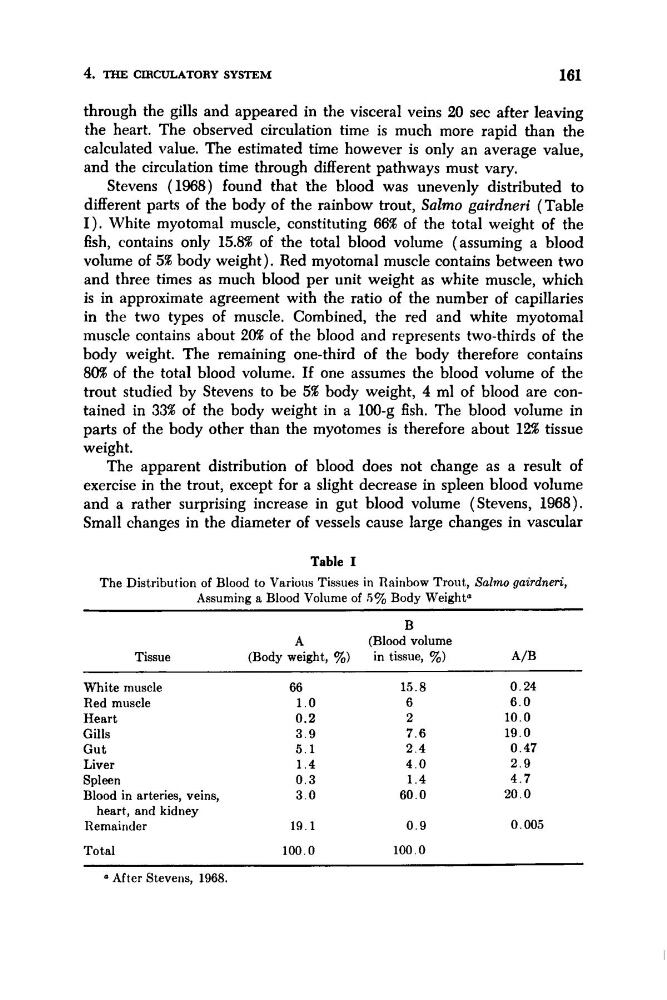
Stevens (1968) found that the blood was unevenly distributed to
different parts of the body of the rainbow trout, Salmo gairdneri (Table
I). White myotomal muscle, constituting 66% of the total weight of the
fish, contains only 15.8% of the total blood volume (assuming a blood
volume of 5% body weight). Red myotomal muscle contains between two
and three times as much blood per unit weight as white muscle, which
is in approximate agreement with the ratio of the number of capillaries
in the two types of muscle. Combined, the red and white myotomal
muscle contains about 20% of the blood and represents two-thirds of the
body weight. The remaining one-third of the body therefore contains
80% of the total blood volume. If one assumes the blood volume of the
trout studied by Stevens to be 5% body weight, 4 ml of blood are contained in 33% of the body weight in a 100-g fish. The blood volume in
parts of the body other than the myotomes is therefore about l!B tissue
weight.
The apparent distribution of blood does not change as a result of
exercise in the trout, except for a slight decrease in spleen blood volume
and a rather surprising increase in gut blood volume (Stevens, 1968).
Small changes in the diameter of vessels cause large changes in vascular
Table I
The Distribution of Blood to Various Tissues in Rainbow Trout, Salmo gairdneri,
Assuming a Blood Volume of 5% Body Weight"
B
A
(Blood volume
Tissue
(Body weight, %) in tissue, %)
A/B
White muscle
Red muscle
Heart
Gills
G u t
Liver
Spleen
Blood in arteries, veins,
heart, and kidney
Remainder
Total
66
1 . 0
0 . 2
3 . 9
5 . 1
1 . 4
0 . 3
3 . 0
19.1
100.0
15.8
6
2
7 . 6
2 . 4
4 . 0
1 . 4
60.0
0 . 9
100.0
0.24
6 . 0
10.0
19.0
0.47
2 . 9
4 . 7
20.0
0.005
a After Stevens, 1968.
161
through the gills and appeared in the visceral veins 20 sec after leaving
the heart. The observed circulation time is much more rapid than the
calculated value. The estimated time however is only an average value,
and the circulation time through different pathways must vary.
Stevens (1968) found that the blood was unevenly distributed to
different parts of the body of the rainbow trout, Salmo gairdneri (Table
I). White myotomal muscle, constituting 66% of the total weight of the
fish, contains only 15.8% of the total blood volume (assuming a blood
volume of 5% body weight). Red myotomal muscle contains between two
and three times as much blood per unit weight as white muscle, which
is in approximate agreement with the ratio of the number of capillaries
in the two types of muscle. Combined, the red and white myotomal
muscle contains about 20% of the blood and represents two-thirds of the
body weight. The remaining one-third of the body therefore contains
80% of the total blood volume. If one assumes the blood volume of the
trout studied by Stevens to be 5% body weight, 4 ml of blood are contained in 33% of the body weight in a 100-g fish. The blood volume in
parts of the body other than the myotomes is therefore about l!B tissue
weight.
The apparent distribution of blood does not change as a result of
exercise in the trout, except for a slight decrease in spleen blood volume
and a rather surprising increase in gut blood volume (Stevens, 1968).
Small changes in the diameter of vessels cause large changes in vascular
Table I
The Distribution of Blood to Various Tissues in Rainbow Trout, Salmo gairdneri,
Assuming a Blood Volume of 5% Body Weight"
B
A
(Blood volume
Tissue
(Body weight, %) in tissue, %)
A/B
White muscle
Red muscle
Heart
Gills
G u t
Liver
Spleen
Blood in arteries, veins,
heart, and kidney
Remainder
Total
66
1 . 0
0 . 2
3 . 9
5 . 1
1 . 4
0 . 3
3 . 0
19.1
100.0
15.8
6
2
7 . 6
2 . 4
4 . 0
1 . 4
60.0
0 . 9
100.0
0.24
6 . 0
10.0
19.0
0.47
2 . 9
4 . 7
20.0
0.005
a After Stevens, 1968.