

makes it clear that this interpretation is incorrect and that in fact it is a
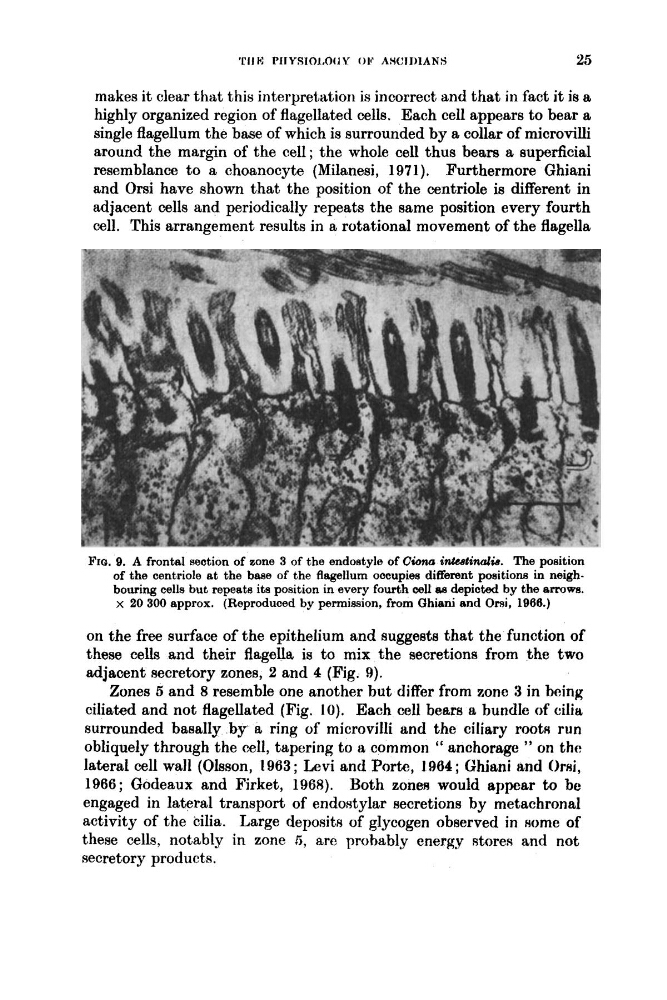
highly organized region of flagellated cells. Each cell appears to bear a
single flagellum the base of which is surrounded by a collar of microvilli
around the margin of the cell ; the whole cell thus bears a superficial
resemblance to a choanocyte (Milanesi, 1971). Furthermore Ghiani
and Orsi have shown that the position of the centriole is different in
adjacent cells and periodically repeats the same position every fourth
cell. This arrangement results in a rotational movement of the flagella
FIG. 9. A frontal section of zone 3 of the endostyle of Cionu iWtinizlie. The position
of the centriole at the base of the flagellum occupies different positions in neighbowing cells but repeats its position in every fourth oell aa depicted by the a m m .
x 20 300 approx. (Reproduced by permission, from Ohiani and Or& 1966.)
on the free surface of the epithelium and suggests that the function of
these cells and their flagella is to mix the secretions from the two
adjacent secretory zones, 2 and 4 (Fig. 9).
Zones 5 and 8 resemble one another but differ from zonc 3 in being
ciliated and not flagellated (Fig. 10). Each cell bears a bundle of cilia
surrounded basally by a ring of microvilli and the ciliary root8 run
obliquely through the cell, tapering to (t common " anchorage " on the
lateral cell wall (Olsson, 1963 ; Levi and Pork, I964 ; Ghiani and ( h i ,
1966; Godeaux and Firket, 1968). Both zone8 would appear to he
engaged in lateral transport of endostylar secretions by metachronal
activity of the cilia. Large deposit8 of glycogen observed in Home of
these cells, notably in zone A, are probably energy &ores and not
secretory products.
highly organized region of flagellated cells. Each cell appears to bear a
single flagellum the base of which is surrounded by a collar of microvilli
around the margin of the cell ; the whole cell thus bears a superficial
resemblance to a choanocyte (Milanesi, 1971). Furthermore Ghiani
and Orsi have shown that the position of the centriole is different in
adjacent cells and periodically repeats the same position every fourth
cell. This arrangement results in a rotational movement of the flagella
FIG. 9. A frontal section of zone 3 of the endostyle of Cionu iWtinizlie. The position
of the centriole at the base of the flagellum occupies different positions in neighbowing cells but repeats its position in every fourth oell aa depicted by the a m m .
x 20 300 approx. (Reproduced by permission, from Ohiani and Or& 1966.)
on the free surface of the epithelium and suggests that the function of
these cells and their flagella is to mix the secretions from the two
adjacent secretory zones, 2 and 4 (Fig. 9).
Zones 5 and 8 resemble one another but differ from zonc 3 in being
ciliated and not flagellated (Fig. 10). Each cell bears a bundle of cilia
surrounded basally by a ring of microvilli and the ciliary root8 run
obliquely through the cell, tapering to (t common " anchorage " on the
lateral cell wall (Olsson, 1963 ; Levi and Pork, I964 ; Ghiani and ( h i ,
1966; Godeaux and Firket, 1968). Both zone8 would appear to he
engaged in lateral transport of endostylar secretions by metachronal
activity of the cilia. Large deposit8 of glycogen observed in Home of
these cells, notably in zone A, are probably energy &ores and not
secretory products.