

348
.%LAIN SOURNIA
E1q)lr.y ilt~tl C:o;~t~wortlr, l!)(i(i; , ) O I * ~ ( ~ ~ ~ ~ C I I ,
1966; Eppley r:t al., 1967,
197 I ; LVult,her iuld Ecintunds, 1973 ; etc.).
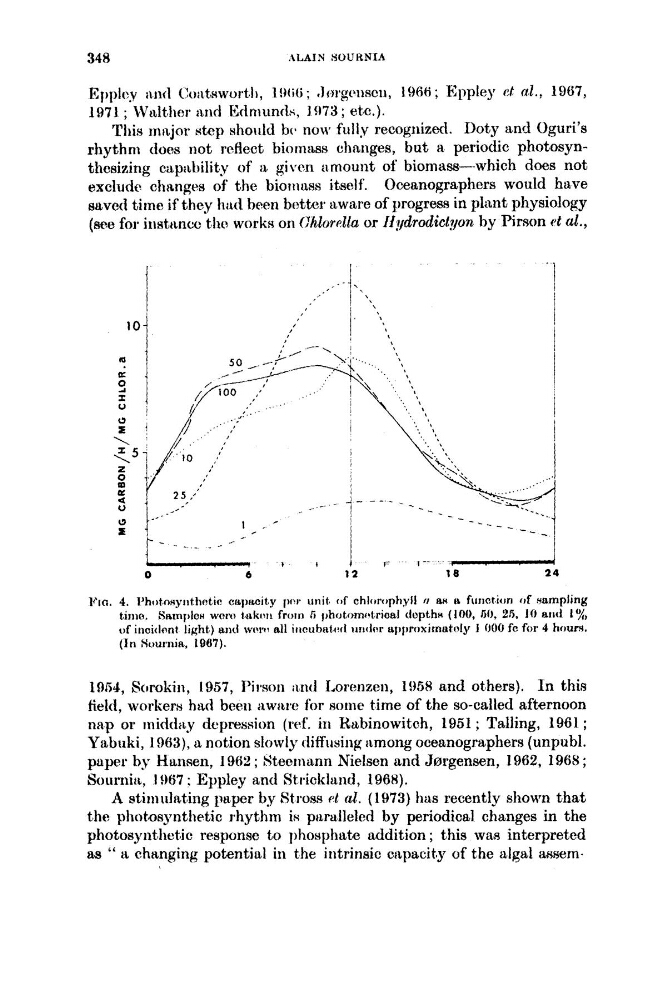
This lrlnjor step shot~ld b(1 now f~rlly recognized. Doty and Oguri's
rhythm does not reflect biomtzss changes, but u periodic photosynthesizing captt.l)ility of a. given amount of biomass--which does not
exclude chlrngc~s of the bio~ttass itself. Oceanographers would have
saved tirne if they 1.11d been botter aware of progress in pliznt physiology
(see for illtit,tt.ncc t,lu! works on (Jhlort~lla or lf?/drodict?/on by Pirson et al.,
1'10. 4. IJhc~t.nnyllthotic ccll,scit,y IIIV ttriit of chlctrophyll 11 a~ e fi~r~ct.iori of mmpling
t,illln. Seml)lou wort> t.ak131i fro111 fi photomc!t,rical tlupth~ (100, 60, 25, 10 HIIC! I(%,
of incitlont light,) anti wt*l.tr all it~ci~t)nt.(?~l ~cnclor ul~proxirnatctly 1 000 fc for 4 hours.
(In Sournis, 1907).
1954, fi<,rokin, 1957, I'il-son iirul Lorenzen, 1!)58 and ot,hers). In this
field, workern hitd beell awrL1.e for some time of the so-called afternoon
nap or rniddily depression (ref. ill Rubinowitch, 1961 ; Talling, 1961 ;
Yubuki, 1963), a notion slowly difising iLmong oceanographers (unpubl.
paper by Hunsen, 1962 ; Stee~nann Nielsen and J~rgensen, 1962, 1968 ;
sour nit^, 1967 : Eppley and Stricltlund, 1968).
A sti~nulnting paper by Stross tt al. (1973) has recently shown that
the pl~ot~osynthetic rhythm is parulleled by periodical changes in the
photosynthet~ic response to ~)hosghate addition ; this was interpreted
as " n changing potential in the intrinsic crtpacity of the algal assem.
.%LAIN SOURNIA
E1q)lr.y ilt~tl C:o;~t~wortlr, l!)(i(i; , ) O I * ~ ( ~ ~ ~ ~ C I I ,
1966; Eppley r:t al., 1967,
197 I ; LVult,her iuld Ecintunds, 1973 ; etc.).
This lrlnjor step shot~ld b(1 now f~rlly recognized. Doty and Oguri's
rhythm does not reflect biomtzss changes, but u periodic photosynthesizing captt.l)ility of a. given amount of biomass--which does not
exclude chlrngc~s of the bio~ttass itself. Oceanographers would have
saved tirne if they 1.11d been botter aware of progress in pliznt physiology
(see for illtit,tt.ncc t,lu! works on (Jhlort~lla or lf?/drodict?/on by Pirson et al.,
1'10. 4. IJhc~t.nnyllthotic ccll,scit,y IIIV ttriit of chlctrophyll 11 a~ e fi~r~ct.iori of mmpling
t,illln. Seml)lou wort> t.ak131i fro111 fi photomc!t,rical tlupth~ (100, 60, 25, 10 HIIC! I(%,
of incitlont light,) anti wt*l.tr all it~ci~t)nt.(?~l ~cnclor ul~proxirnatctly 1 000 fc for 4 hours.
(In Sournis, 1907).
1954, fi<,rokin, 1957, I'il-son iirul Lorenzen, 1!)58 and ot,hers). In this
field, workern hitd beell awrL1.e for some time of the so-called afternoon
nap or rniddily depression (ref. ill Rubinowitch, 1961 ; Talling, 1961 ;
Yubuki, 1963), a notion slowly difising iLmong oceanographers (unpubl.
paper by Hunsen, 1962 ; Stee~nann Nielsen and J~rgensen, 1962, 1968 ;
sour nit^, 1967 : Eppley and Stricltlund, 1968).
A sti~nulnting paper by Stross tt al. (1973) has recently shown that
the pl~ot~osynthetic rhythm is parulleled by periodical changes in the
photosynthet~ic response to ~)hosghate addition ; this was interpreted
as " n changing potential in the intrinsic crtpacity of the algal assem.