

342
ALAIN YOUHNIA
in the late afternoon. At thc 60 ni depth, the maximum was observed
during the tluy and the minimum a t night. Mechanisms were looked
for in the luboratory with Skclatonama cultures : a t high light intensities
(simnlnting the former conditions) maxima were nocturnal and minima
were diurnttl, while a t lower intsn~iticrs (sltcch as prevailing at 50 rn depth)
the periodicity W ~ L R rover~ed. Hlet~chi~lg was de~nonstratctl to be the
cause of tht? decline in the light ; or1 tho other hand, the decline during
darkness was dcluyed if some o g a ~ ~ i c
carbon source was provided.
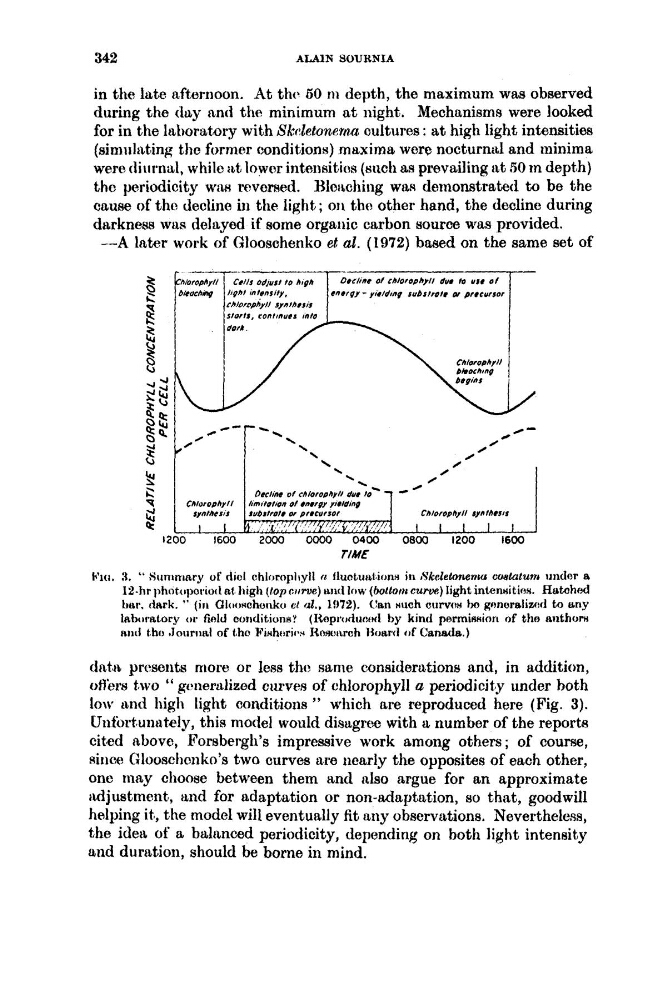
--A later work of Glooschenko et al. (1972) based on the same set of
fb/oropbyII synmrra
starts, conttnues Into
Z
h P
e
4 - - -
/
./\
\
,
0
'.
0
k
\
0
\
0
i=
~ e c t t w of c ~ ~ o r o o h y ~ t
due to- 7
/
P
Chtorophylt
hmrtot~on of energy y~eld~ng
syntherrs
substrate w precursor
ChlorophyN #ynthes~s
1200
1600
2000
0000 0400
0800
1200
1600
Y I ~ I .
3. " Sttn~n~nry of ti101 chloropl~yll rc ffuctuut~onn in ~fkclelonen~u cu8lalum under a
12-hl- photoportocl nt 111gl1 (top a~rrue) nntl low (botlotr, cum,) light inteneitios. Hatched
L~er, dark. " (111 Oloo~chunkc~ el czl., 1!J72). (!an ncmh cnrvtts tm g~oneralizc!d to any
labclratory or field co~iditionrr? (Iteproduatnl by kind permifinion of tho nilthorn
a1111 tho Jor~r~lnl of t.ho Ftnhorri.~ Itowc~rch tharcl of Canada.)
dnttb prcsents more or less tho same considera.tions and, in addition,
oflers two " gchnerulizod curvths of chlorophyll a periodicity under both
low und high light conditions " which are reproduced here (Fig. 3).
Unfi)rt,unately, this model would disagree with a number of the reports
cit,ed nbovs, Porsbergh's impressive work among others; of course,
since (:looschc~~ko's two curves are ~lcarly the opposites of each other,
onc rlltty choose between them and also argue for an approximate
rbdjustment, and for adaptation or non-adaptation, so that, goodwill
helping it*, the model will eventually fit any observations. Nevertheless,
the idea of a balanced periodicity, depending on both light intensity
and duration, shoulcl be borne in mind.
ALAIN YOUHNIA
in the late afternoon. At thc 60 ni depth, the maximum was observed
during the tluy and the minimum a t night. Mechanisms were looked
for in the luboratory with Skclatonama cultures : a t high light intensities
(simnlnting the former conditions) maxima were nocturnal and minima
were diurnttl, while a t lower intsn~iticrs (sltcch as prevailing at 50 rn depth)
the periodicity W ~ L R rover~ed. Hlet~chi~lg was de~nonstratctl to be the
cause of tht? decline in the light ; or1 tho other hand, the decline during
darkness was dcluyed if some o g a ~ ~ i c
carbon source was provided.
--A later work of Glooschenko et al. (1972) based on the same set of
fb/oropbyII synmrra
starts, conttnues Into
Z
h P
e
4 - - -
/
./\
\
,
0
'.
0
k
\
0
\
0
i=
~ e c t t w of c ~ ~ o r o o h y ~ t
due to- 7
/
P
Chtorophylt
hmrtot~on of energy y~eld~ng
syntherrs
substrate w precursor
ChlorophyN #ynthes~s
1200
1600
2000
0000 0400
0800
1200
1600
Y I ~ I .
3. " Sttn~n~nry of ti101 chloropl~yll rc ffuctuut~onn in ~fkclelonen~u cu8lalum under a
12-hl- photoportocl nt 111gl1 (top a~rrue) nntl low (botlotr, cum,) light inteneitios. Hatched
L~er, dark. " (111 Oloo~chunkc~ el czl., 1!J72). (!an ncmh cnrvtts tm g~oneralizc!d to any
labclratory or field co~iditionrr? (Iteproduatnl by kind permifinion of tho nilthorn
a1111 tho Jor~r~lnl of t.ho Ftnhorri.~ Itowc~rch tharcl of Canada.)
dnttb prcsents more or less tho same considera.tions and, in addition,
oflers two " gchnerulizod curvths of chlorophyll a periodicity under both
low und high light conditions " which are reproduced here (Fig. 3).
Unfi)rt,unately, this model would disagree with a number of the reports
cit,ed nbovs, Porsbergh's impressive work among others; of course,
since (:looschc~~ko's two curves are ~lcarly the opposites of each other,
onc rlltty choose between them and also argue for an approximate
rbdjustment, and for adaptation or non-adaptation, so that, goodwill
helping it*, the model will eventually fit any observations. Nevertheless,
the idea of a balanced periodicity, depending on both light intensity
and duration, shoulcl be borne in mind.