

CIRCADIAN PEBIODI(!ITIEX IN Plf YTOPLANKTON
337
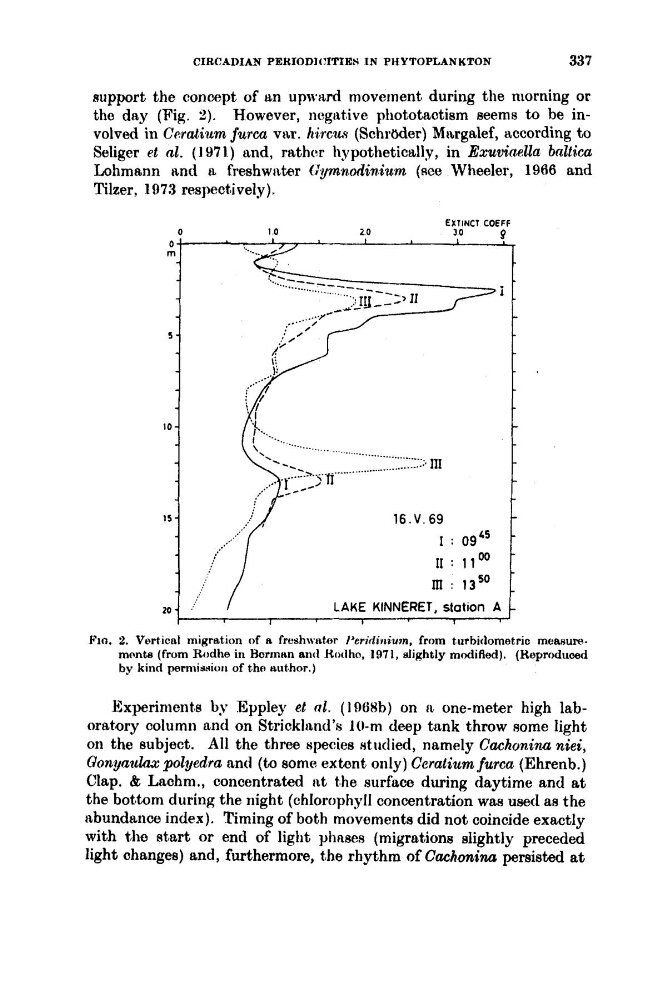
support the concept of un upwwd movement during the morning or
the day (Fig. 2). However, negative phototactism seems to be involved in Ccratium furca vw. hiscus (Schrbder) Mnrgalef, according to
Seliger et n2. (1 971) and, rather hypothetically, in Emviaella bnltica
Lohmann nnd u. freshwcttm CymnorEin,ium (see Wheeler, 1966 and
Tilzer, 1973 respectively).
S -
10 -
15 -
1 .o
2.0
EXTINCT CO
30
EFF
20
I
LAKE KINNERET, station A 1
I
I
1
FIG. 2. Vertical migration of n freshwater Peridhiwm, from tuthitlometric meanummonte (from Rodhe in Borman and Rodho, 1971, diphtly modifled). (Reproduced
by kind perniiaaioii of tho author.)
Experinicnts by Eppley et nl. (196sb) on IL one-meter high laboratory column and on Strickland’s 10-m deep tank throw Bome light
on the subject. All the three species ntiidied, namely Cachonina niei,
Qongauh polgedra and (to some extant’ only) Ceralium furca (Ehrenb.)
Clap. & Laohm., concentrated i k t t’he surface during daytime and at
the bottom during the night (chlorophyll concentration was used aB the
abundance index). Timing of both movements did not coincide exactly
with the start or end of light phases (migrations slightly preceded
light changes) and, furthermore, the rhythm of Cachonina persisted a t
337
support the concept of un upwwd movement during the morning or
the day (Fig. 2). However, negative phototactism seems to be involved in Ccratium furca vw. hiscus (Schrbder) Mnrgalef, according to
Seliger et n2. (1 971) and, rather hypothetically, in Emviaella bnltica
Lohmann nnd u. freshwcttm CymnorEin,ium (see Wheeler, 1966 and
Tilzer, 1973 respectively).
S -
10 -
15 -
1 .o
2.0
EXTINCT CO
30
EFF
20
I
LAKE KINNERET, station A 1
I
I
1
FIG. 2. Vertical migration of n freshwater Peridhiwm, from tuthitlometric meanummonte (from Rodhe in Borman and Rodho, 1971, diphtly modifled). (Reproduced
by kind perniiaaioii of tho author.)
Experinicnts by Eppley et nl. (196sb) on IL one-meter high laboratory column and on Strickland’s 10-m deep tank throw Bome light
on the subject. All the three species ntiidied, namely Cachonina niei,
Qongauh polgedra and (to some extant’ only) Ceralium furca (Ehrenb.)
Clap. & Laohm., concentrated i k t t’he surface during daytime and at
the bottom during the night (chlorophyll concentration was used aB the
abundance index). Timing of both movements did not coincide exactly
with the start or end of light phases (migrations slightly preceded
light changes) and, furthermore, the rhythm of Cachonina persisted a t