

304
MAUOTO DMORI
sulmon to prcvent discoloirrution of the fish body. Catches of Ezcphausia
from the coast of Miyagi Prefcctui*e amount to 2 000-8 000 tons
t i yew. E . pncijioa, rilthoirgh showing considerable individual variiition, contains carohnoid pigments on an average 118 pg/g wet
weight, of which 21 pg/g i R astaxanthin and its esters (Kayama and
Omori, unpublished). According to Fisher et al. (1957), carotenoids in
pcbnaeids include astaxanthin arid its esters, carotenes and xanthophylls, but only astaxanthin or its esters with occasional traces of
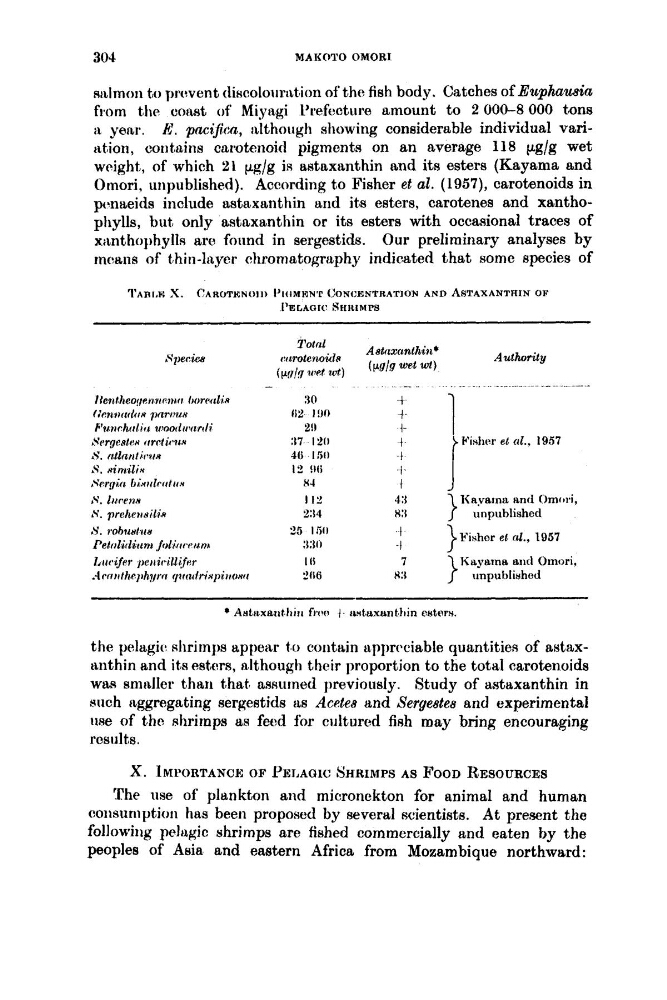
xibnthophylls are found in sergestids. Our preliminary analyses by
mc.tlns of thin-layer chromatography indicated that some species of
TARIA: X. CAROTKNOII) PI(IMRNT (:ONCENTRATION AND ASTAXANTHIN OF
I'E LAOlC s HHI MPS
30
fi4 I !!O
2!)
37 I PO
4ti 150
I:! !I(;
84
1 I : !
234
25 I50
330
Authority
- __
C'irhtv el ciE., 1957
1
i
i
ii
t
-I
t
43
} I
'
I
unpublished
} k'i\her et nl., 1967
the pelagic. slirirnps appear to contain apprwiable quantities of astexanthin and its esters, nlthough their proportion to the total carotenoids
was smdlcr than that asmrned previously. Study of astaxanthin in
such aggregating sergestids as Acolea and Sergestes and experimental
me of the dwirnps as feed for cultured fiah may bring encouraging
I' CslJlti3.
x. ~MPORTANCK OF I-'ELAC4IC SHRIMPS AS FOOD RESOURCES
The use of plankton and micronekton for animal and human
consuniption has been proposed by several ecientists. At present the
following pelagic shrimps are fished cornmcrcially and oaten by the
peoples of Asia and eastern Africa from Mozambique northward:
MAUOTO DMORI
sulmon to prcvent discoloirrution of the fish body. Catches of Ezcphausia
from the coast of Miyagi Prefcctui*e amount to 2 000-8 000 tons
t i yew. E . pncijioa, rilthoirgh showing considerable individual variiition, contains carohnoid pigments on an average 118 pg/g wet
weight, of which 21 pg/g i R astaxanthin and its esters (Kayama and
Omori, unpublished). According to Fisher et al. (1957), carotenoids in
pcbnaeids include astaxanthin arid its esters, carotenes and xanthophylls, but only astaxanthin or its esters with occasional traces of
xibnthophylls are found in sergestids. Our preliminary analyses by
mc.tlns of thin-layer chromatography indicated that some species of
TARIA: X. CAROTKNOII) PI(IMRNT (:ONCENTRATION AND ASTAXANTHIN OF
I'E LAOlC s HHI MPS
30
fi4 I !!O
2!)
37 I PO
4ti 150
I:! !I(;
84
1 I : !
234
25 I50
330
Authority
- __
C'irhtv el ciE., 1957
1
i
i
ii
t
-I
t
43
} I
'
I
unpublished
} k'i\her et nl., 1967
the pelagic. slirirnps appear to contain apprwiable quantities of astexanthin and its esters, nlthough their proportion to the total carotenoids
was smdlcr than that asmrned previously. Study of astaxanthin in
such aggregating sergestids as Acolea and Sergestes and experimental
me of the dwirnps as feed for cultured fiah may bring encouraging
I' CslJlti3.
x. ~MPORTANCK OF I-'ELAC4IC SHRIMPS AS FOOD RESOURCES
The use of plankton and micronekton for animal and human
consuniption has been proposed by several ecientists. At present the
following pelagic shrimps are fished cornmcrcially and oaten by the
peoples of Asia and eastern Africa from Mozambique northward: