

cilia aid in creating a water ourrent and in holding the mucus sheet
against the branchial wall. In t h o Htolidobranchs Croxall finds that
thero arc! t w o Heparat(! nhect>x of rnuciis crossing the pharynx. One of
thorn HhootR in fast, moving ant1 passe8 from crest to crest of the branchial
folds aided 1)y waves o f activit,,y in these folds which pass from the
endostyle towards the dorsal Lmiua. The other is a slow moving sheet
which passns aroiind both folds aiid troughs. These two systems effectively form a double fi1t)ration system of coarse and fine filters; the
fast moving sheot from crest, to crest is suittrble for high densities of
particles while the slow moving Hhwt is mow efficient in low particle
densitie8.
A . internhptcs
4 0
Phallusia mamniillata ’I.!)
P. mammilkrtu
148
Molyula sp.
...
P . mammillata
‘ I Full sizod ”
-
80
230
-72
I20
210
24
117
27
I04
400
640
1
16 I!)
27
2 i
27
2 i
Id
Id
I G - l ! )
11--14
Author
- .
Goldbt:rg et al. (1951)
Jergenson (1949, 1955)
Hecht (1916)
.
Hecht (1916)
Goodbody (Unpublished
Goodbody (Unpublished
Coodbody (Unpublished
Good body (Unpublishod
C‘arlislo (1 966)
Carlisle (1966)
.Jctrgensen (1 94!), 1955)
Hoylo ( 1953)
data)
data)
data)
data)
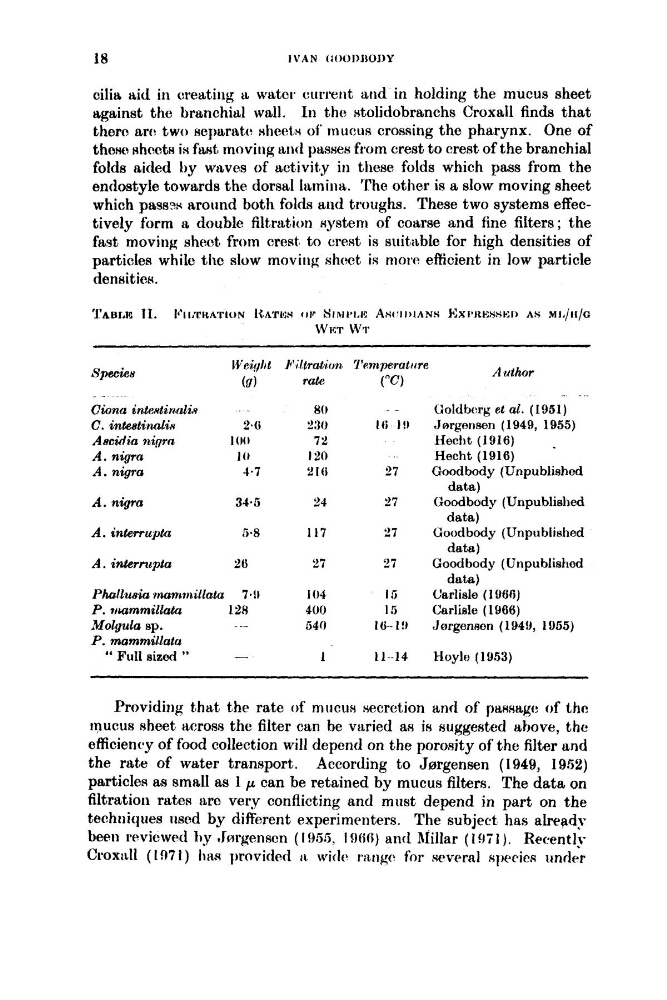
Providing t h a t the rate of mticus necrotion and of pawage of the
mucus sheet across the filter can be varied au i~ suggested above, the
efficiency of food collection will depend on the porosity of’ the filter and
the rate of water transport. According to Jsrgensen (1949, 1952)
particles as small as 1 p can be retained by mucus filters. The data on
filtration rates arc very conflicting and must depend in part on the
techniques tisod by different experimenters. The subject has alregdy
been reviewed 1)y Jorgenscn (1958, 1966) and Millar (1971). Recently
Croxidl ( 197 1 ) ha8 provided it witlr ri~t~fic’ for several speries ttnrler
against the branchial wall. In t h o Htolidobranchs Croxall finds that
thero arc! t w o Heparat(! nhect>x of rnuciis crossing the pharynx. One of
thorn HhootR in fast, moving ant1 passe8 from crest to crest of the branchial
folds aided 1)y waves o f activit,,y in these folds which pass from the
endostyle towards the dorsal Lmiua. The other is a slow moving sheet
which passns aroiind both folds aiid troughs. These two systems effectively form a double fi1t)ration system of coarse and fine filters; the
fast moving sheot from crest, to crest is suittrble for high densities of
particles while the slow moving Hhwt is mow efficient in low particle
densitie8.
A . internhptcs
4 0
Phallusia mamniillata ’I.!)
P. mammilkrtu
148
Molyula sp.
...
P . mammillata
‘ I Full sizod ”
-
80
230
-72
I20
210
24
117
27
I04
400
640
1
16 I!)
27
2 i
27
2 i
Id
Id
I G - l ! )
11--14
Author
- .
Goldbt:rg et al. (1951)
Jergenson (1949, 1955)
Hecht (1916)
.
Hecht (1916)
Goodbody (Unpublished
Goodbody (Unpublished
Coodbody (Unpublished
Good body (Unpublishod
C‘arlislo (1 966)
Carlisle (1966)
.Jctrgensen (1 94!), 1955)
Hoylo ( 1953)
data)
data)
data)
data)
Providing t h a t the rate of mticus necrotion and of pawage of the
mucus sheet across the filter can be varied au i~ suggested above, the
efficiency of food collection will depend on the porosity of’ the filter and
the rate of water transport. According to Jsrgensen (1949, 1952)
particles as small as 1 p can be retained by mucus filters. The data on
filtration rates arc very conflicting and must depend in part on the
techniques tisod by different experimenters. The subject has alregdy
been reviewed 1)y Jorgenscn (1958, 1966) and Millar (1971). Recently
Croxidl ( 197 1 ) ha8 provided it witlr ri~t~fic’ for several speries ttnrler