

242
MAKOTO OMORI
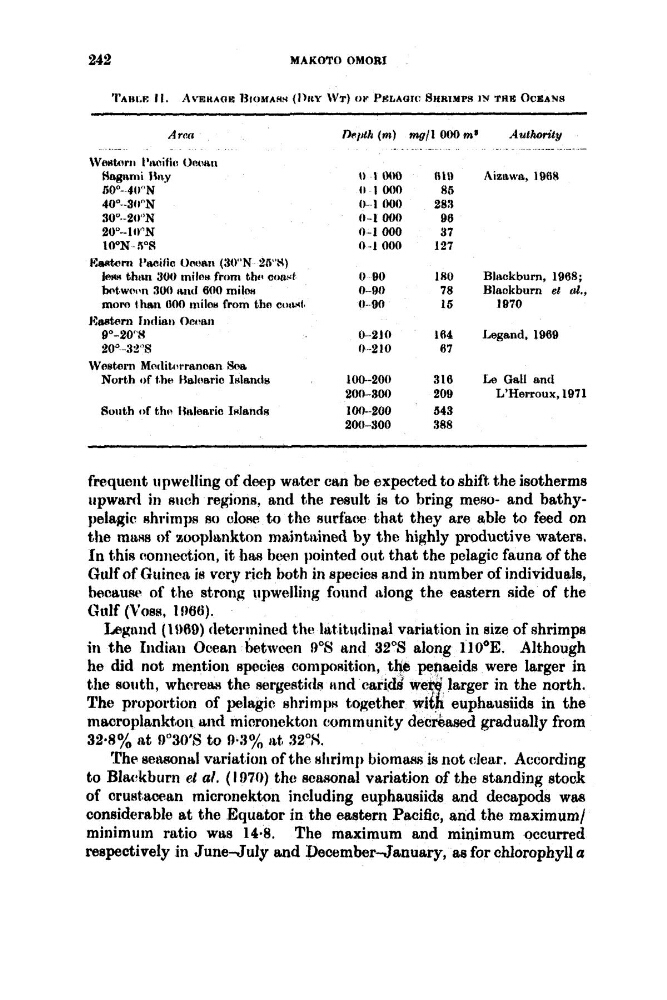
0 90
180
Bhckburn, 1968;
0-90
78
Hlackburn et a!,,
0-0
16
I970
0-210
164
Legand, 1969
0-210
(17
100-200
316
Le Gall and
200-300
209
L'Herroux, 1971
100-200
543
200-300
388
frequent upwelling of deep wnfor can be expected to shift the isotherms
iipwnrd in eitch regions, and the result iR to bring meso- and bathypelagic ~hrimps so clow to thc aurfaoc that they are able to feed on
the muss of xoopltmkton maintained by the highly productive waters.
In this oonnection, it h a bcan pointed out that the pelagic fauna of the
Gulf of Guinea is very rich both in species rtnd in number of individuals,
beoltuw of tho strong upwelling found dong the eastern side of the
L e p i d (IH6O) determined the latitudinal varicltjion in size of shrimps
in the Iiidian Ocean htivecn 9 ' 8 and 32'8 along llOOE, Although
he did not mention spooios composition, th
ids were larger in
the south, whcreas the sorgestitl~ rind caride
The proportion of pelagic ehrimp together
macroplankton ltitd micronektoii community
32.8% at W'3O'S to 9.3% ttt, 32%
&tlf (Voss, 1!)6(5).
The seasonal vuricttioii of the nlirimp biommrcs is not clear. According
to Blaclkburn el al. ( 1070) tho seusonal variation of the standing stook
of crustmean micronekton including euphausiids and decapods ww
considerable at the Equator in the eastern Pacific, and the maximum/
minimuin ratio was 14.8. The maximum and minimum occurred
respectively in June-July and December-January, as for chlorophyll a
MAKOTO OMORI
0 90
180
Bhckburn, 1968;
0-90
78
Hlackburn et a!,,
0-0
16
I970
0-210
164
Legand, 1969
0-210
(17
100-200
316
Le Gall and
200-300
209
L'Herroux, 1971
100-200
543
200-300
388
frequent upwelling of deep wnfor can be expected to shift the isotherms
iipwnrd in eitch regions, and the result iR to bring meso- and bathypelagic ~hrimps so clow to thc aurfaoc that they are able to feed on
the muss of xoopltmkton maintained by the highly productive waters.
In this oonnection, it h a bcan pointed out that the pelagic fauna of the
Gulf of Guinea is very rich both in species rtnd in number of individuals,
beoltuw of tho strong upwelling found dong the eastern side of the
L e p i d (IH6O) determined the latitudinal varicltjion in size of shrimps
in the Iiidian Ocean htivecn 9 ' 8 and 32'8 along llOOE, Although
he did not mention spooios composition, th
ids were larger in
the south, whcreas the sorgestitl~ rind caride
The proportion of pelagic ehrimp together
macroplankton ltitd micronektoii community
32.8% at W'3O'S to 9.3% ttt, 32%
&tlf (Voss, 1!)6(5).
The seasonal vuricttioii of the nlirimp biommrcs is not clear. According
to Blaclkburn el al. ( 1070) tho seusonal variation of the standing stook
of crustmean micronekton including euphausiids and decapods ww
considerable at the Equator in the eastern Pacific, and the maximum/
minimuin ratio was 14.8. The maximum and minimum occurred
respectively in June-July and December-January, as for chlorophyll a