

r l
I hc tni~ligrtctnt letrliac~rnic~ Iy111l)lionictt2t described by Griner (1971)
wc.rcS S C ( ~ I I it1 f wo tl~ikle sct~ls I'horrc vilz~lina gc~ronimensis Linnaeus, 1758
t~g(h(l I ) c ~ t I ~ ~ ~ c ~ ~ t
I . I ! R I I ~ 24 .ytba~s ('l'i~blt: IV). Neither animal showed
i~bnot.ttii~l sigtis : on(. it1 facrt was fi)lllid dertd, and the other died after
failing to ftbc.rl fbr two days (li'igs 22 to 24).
Two similar cases of generalized lymphatic leukaemia occurring in
one areit, u.ci~ld suggest ~t probably common aetiology and in this case a
virrtl agcbnt wi~s considered to be the most likely. Limited experiments
wclre p~~*forntcd in which other seals wcm injected with 5 ml macerated
rnaterit~l froni the spleen and lymph notles, but with negative results.
An elephant seial Mirounqa Z~koninu (Linnaeus, 1758) also in the pool did
not show tan-v signs of external disease.
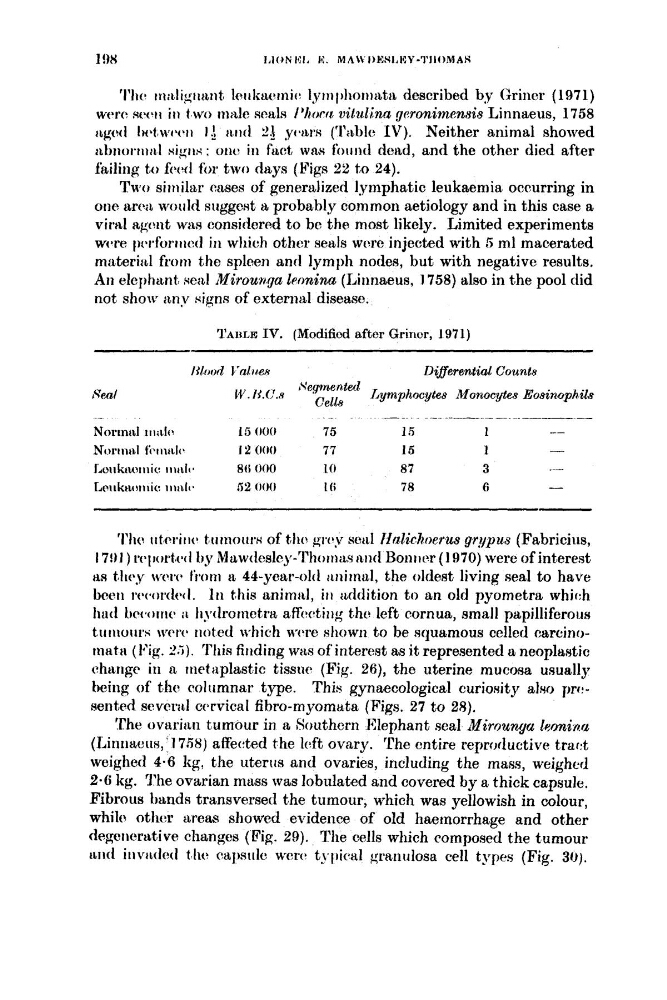
TABI,E IV. (Modifiod aftor Grinor, 1971)
Ijlood I 'al~rex
Diflerential Countx
Seyvnented
Seal
W . H.C.8
Cellx
Lymphocytes Monocytes Eoainophils
' I ' h c b
t t tcri~ic* trc~rnoluvs of tlic. gt.cby sc?ltl H'inlicltnerus grgpzcs (Fabricius,
17!)1) rc.t~)rtcbcl by Mawdcslc~~-Thottii~~ land. Bont~csr ( 1 970) were of interest
as bllt*y tc.chl.cl Vt boni a 44-year-oltl i~rlirnal, the oldest living seal to have
been ~.c~c+or,tlt*tl. 111 this animd, i l l c~ddition to an old pyometrtt which
llucl bct,ornc~ ;I h~.tlrornetra aff(betitig thc left cornua, small pttpilliferoux
tutuot~ra \rrcarcl ~loted which wtlre sl~own to be squttmous celled cctrcinomtitn (Fig. 2'5). l'llis finding was of' interest as it represented a neoplastic
c'hartgc iri a ttiet-lplast~ic tissu~ (Fig. 26), the uterine mucosa usually
1)cing of tkc coltimnar type. This gynaecological curiosity also prc:sent,cd sevcri~l cervical fibro-myomata (Figs. 27 to 28).
'rhr ovarii~n tumour in tt Southern Elephant seal Mirounga bonina
(I,innueux, 1758) affechted the l ~ f t
ovary. The entire repro(1uctive trar-t
weighed 4-6 kg, the uterus and ovaries, including the mass, weighed
2.6 kg. l'he ovarian mass was lobnlated and covered by a thick capsule.
Fibrous bands transvcrsetl the tumour, which was yellowish in colour,
while ot1ic.r areas showed evidence of old haemorrhage and other
dege~ic~rut~ive changes (Pig. 29). The cells which composed the tumour
I L I I ( ~ irtvat(I~(1 th(> CLL~SIIIC wercB t?,l)ic.al gra~ittlosa cell types (Fig. 30).
I hc tni~ligrtctnt letrliac~rnic~ Iy111l)lionictt2t described by Griner (1971)
wc.rcS S C ( ~ I I it1 f wo tl~ikle sct~ls I'horrc vilz~lina gc~ronimensis Linnaeus, 1758
t~g(h(l I ) c ~ t I ~ ~ ~ c ~ ~ t
I . I ! R I I ~ 24 .ytba~s ('l'i~blt: IV). Neither animal showed
i~bnot.ttii~l sigtis : on(. it1 facrt was fi)lllid dertd, and the other died after
failing to ftbc.rl fbr two days (li'igs 22 to 24).
Two similar cases of generalized lymphatic leukaemia occurring in
one areit, u.ci~ld suggest ~t probably common aetiology and in this case a
virrtl agcbnt wi~s considered to be the most likely. Limited experiments
wclre p~~*forntcd in which other seals wcm injected with 5 ml macerated
rnaterit~l froni the spleen and lymph notles, but with negative results.
An elephant seial Mirounqa Z~koninu (Linnaeus, 1758) also in the pool did
not show tan-v signs of external disease.
TABI,E IV. (Modifiod aftor Grinor, 1971)
Ijlood I 'al~rex
Diflerential Countx
Seyvnented
Seal
W . H.C.8
Cellx
Lymphocytes Monocytes Eoainophils
' I ' h c b
t t tcri~ic* trc~rnoluvs of tlic. gt.cby sc?ltl H'inlicltnerus grgpzcs (Fabricius,
17!)1) rc.t~)rtcbcl by Mawdcslc~~-Thottii~~ land. Bont~csr ( 1 970) were of interest
as bllt*y tc.chl.cl Vt boni a 44-year-oltl i~rlirnal, the oldest living seal to have
been ~.c~c+or,tlt*tl. 111 this animd, i l l c~ddition to an old pyometrtt which
llucl bct,ornc~ ;I h~.tlrornetra aff(betitig thc left cornua, small pttpilliferoux
tutuot~ra \rrcarcl ~loted which wtlre sl~own to be squttmous celled cctrcinomtitn (Fig. 2'5). l'llis finding was of' interest as it represented a neoplastic
c'hartgc iri a ttiet-lplast~ic tissu~ (Fig. 26), the uterine mucosa usually
1)cing of tkc coltimnar type. This gynaecological curiosity also prc:sent,cd sevcri~l cervical fibro-myomata (Figs. 27 to 28).
'rhr ovarii~n tumour in tt Southern Elephant seal Mirounga bonina
(I,innueux, 1758) affechted the l ~ f t
ovary. The entire repro(1uctive trar-t
weighed 4-6 kg, the uterus and ovaries, including the mass, weighed
2.6 kg. l'he ovarian mass was lobnlated and covered by a thick capsule.
Fibrous bands transvcrsetl the tumour, which was yellowish in colour,
while ot1ic.r areas showed evidence of old haemorrhage and other
dege~ic~rut~ive changes (Pig. 29). The cells which composed the tumour
I L I I ( ~ irtvat(I~(1 th(> CLL~SIIIC wercB t?,l)ic.al gra~ittlosa cell types (Fig. 30).