

(lor~iII”l.iLt,iV(’ pithlogy is rcnliwtcd a s , and of, its own right. Relevant
work i i i thc United States of America was catulyzed initially by Schlumberger, whose untimcly death delayed it by several years. Fortunately,
under the wspices of thci Nut ional C”uncer Institute and the Smithsonian
Institute, the Registry of Tumours of Lower Animals has been established i n the work of its Director, I h tJ. C. Harshbargcr, backed up by
Dr C. Ilawc, uiid him made great) stride8 over the past 4 to 6 years. The
early history of fish disease has already been documented (Wellings,
1969; Mawdvsley-Thomas, 1970; 1971a, 1972) and it may be concluded
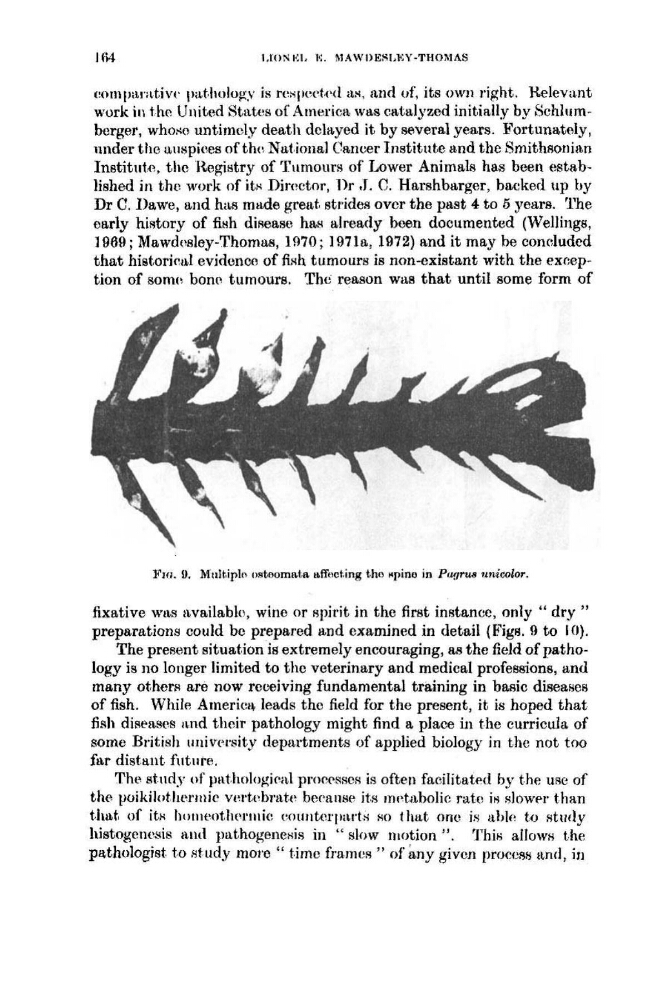
that historicid evidence of fish turnours is non-cxistant with the exception of somv borir turnours. The reason wus that until some form of
fixative wus svailablc, wine or spirit in the first instancc, only “ dry ”
preparations could be prepared and examined in detail (Figs. 9 to 10).
The prewnt situation is extremely encouraging, as the field of pathology is no longer limited to thc veterinary and medical professions, and
many others are now receiving fundamental training in basic diseases
of fish. While Americu, leads the field for the present, it is hoped that
fish diseases ibnd t,heir pathology might find a place in the curricula of
some British rinivc.rsity departments of applied biology in the not too
fur distant fiit tire.
The study of‘ pafliologirid processes is ofteri facilitated by the use of
the poikilotlierttiic vwtc4~rate because its Irwtiholic rate in slower than
tjliutj of its Iioiiieotlic\l.i~iic couiittq)iwts so that onc is itble to ~tucly
histogenesis niid pat8hogencsis iii “ d o w motion ”. This allows the
pathologist to study more “ time franiw ” of any givcn promss wrl, in
work i i i thc United States of America was catulyzed initially by Schlumberger, whose untimcly death delayed it by several years. Fortunately,
under the wspices of thci Nut ional C”uncer Institute and the Smithsonian
Institute, the Registry of Tumours of Lower Animals has been established i n the work of its Director, I h tJ. C. Harshbargcr, backed up by
Dr C. Ilawc, uiid him made great) stride8 over the past 4 to 6 years. The
early history of fish disease has already been documented (Wellings,
1969; Mawdvsley-Thomas, 1970; 1971a, 1972) and it may be concluded
that historicid evidence of fish turnours is non-cxistant with the exception of somv borir turnours. The reason wus that until some form of
fixative wus svailablc, wine or spirit in the first instancc, only “ dry ”
preparations could be prepared and examined in detail (Figs. 9 to 10).
The prewnt situation is extremely encouraging, as the field of pathology is no longer limited to thc veterinary and medical professions, and
many others are now receiving fundamental training in basic diseases
of fish. While Americu, leads the field for the present, it is hoped that
fish diseases ibnd t,heir pathology might find a place in the curricula of
some British rinivc.rsity departments of applied biology in the not too
fur distant fiit tire.
The study of‘ pafliologirid processes is ofteri facilitated by the use of
the poikilotlierttiic vwtc4~rate because its Irwtiholic rate in slower than
tjliutj of its Iioiiieotlic\l.i~iic couiittq)iwts so that onc is itble to ~tucly
histogenesis niid pat8hogencsis iii “ d o w motion ”. This allows the
pathologist to study more “ time franiw ” of any givcn promss wrl, in