

THE PliYSIOLOQY OF ASCIDIANS
97
light receptors in the branchial region and sensitivity must rest in
unspecialized dermal light receptors (Steven, 1963). A phototropic
response of this sort has not been reported from any other species, but
this is not sm.prising a8 tjhe majority of species have pigmented tests
which must prevent the light penet,rat!ing to the body wall.
C i ~ m also responds to uuddcn changes in illumination by a sharp
retraction of t h body. Ascidin nigra, however, only responds in this
way if the source of illumination is directed into the branchial siphon.
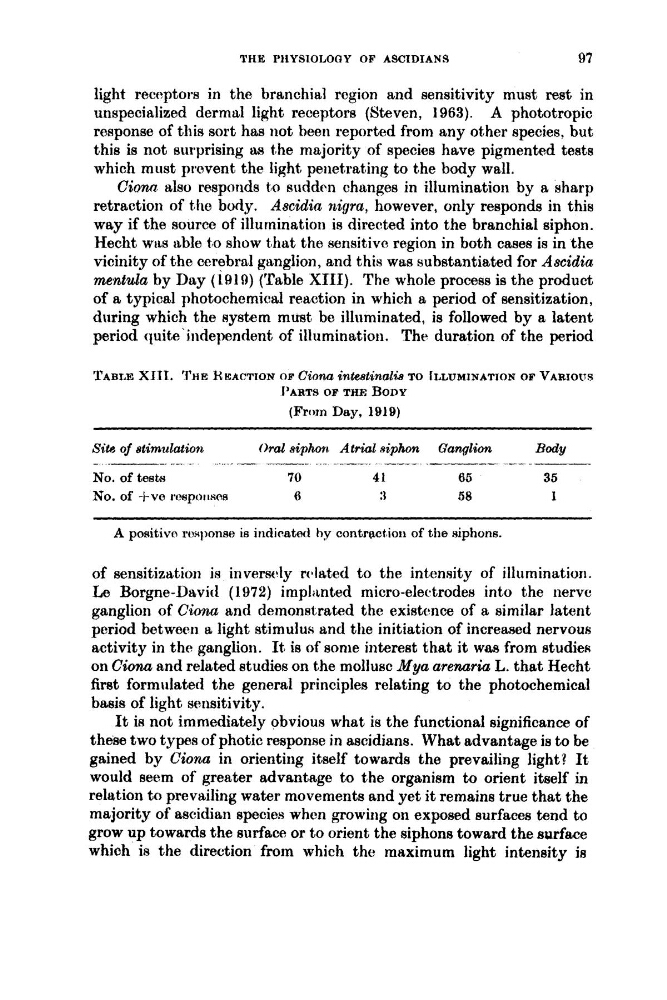
Hecht WILS able t,o show t,hat the sensitive region in both cases is in the
vicinity of the cerebral ganglion, and this was substantiated for Ascidia
mentula by Day (191 9) (Table XIII). The whole process is the product
of a typical photochemical reaction in which a period of sensitization,
during which the Rystem must be illuminated, is followed by a latent
period quite’iiidependent of illumination. The duration of the period
TABLE XTTT. THE HEACTION OF Ciona intestinalia TO CLLUMINATION
OF VARIOUS
PARTS OF THE BODY
(From Day, 1919)
Site of stimulation
Oral siphon Atrial siphon Canglwn
BdY
NO. of +VO I W S ~ O I I S O S
0
3
58
1
- ____
- . .
- _____ . __
-_____ ___
No. of testti
70
41
65
35
A positivo rt~spon~e is indicated hy contr&ct ion of the siphons.
of sensitization is inversely rcllatcd to the intensity of illuminatiori.
Le Borgne-David (I 972) implanted micro-electrodes into the nerve
ganglion of Ciona and demonstrated the existence of a similar latent
period between a light stimulus and the initiation of increased nervoug
activity in the ganglion. It is of some interest that it was from studiers
on Ciona and related studies on the mollusc Mya arenaria L. that Hecht
first formulated the general principles relating to the photochemical
basis of light sensitivity.
It i
R not immediately obvious what is the functional significance of
these two types of photic response in ascidians. What advantage is to be
gained by Ciona in orienting itself towards the prevailing light? It
would seem of greater advantage to the organism to orient itself in
relation to prevailing water movements and yet it remains true that the
majority of ascidian species when growing on exposed surfaces tend to
grow up towards the surface or to orient the siphons toward the surface
which is the direction from which the maximum light intensity is
97
light receptors in the branchial region and sensitivity must rest in
unspecialized dermal light receptors (Steven, 1963). A phototropic
response of this sort has not been reported from any other species, but
this is not sm.prising a8 tjhe majority of species have pigmented tests
which must prevent the light penet,rat!ing to the body wall.
C i ~ m also responds to uuddcn changes in illumination by a sharp
retraction of t h body. Ascidin nigra, however, only responds in this
way if the source of illumination is directed into the branchial siphon.
Hecht WILS able t,o show t,hat the sensitive region in both cases is in the
vicinity of the cerebral ganglion, and this was substantiated for Ascidia
mentula by Day (191 9) (Table XIII). The whole process is the product
of a typical photochemical reaction in which a period of sensitization,
during which the Rystem must be illuminated, is followed by a latent
period quite’iiidependent of illumination. The duration of the period
TABLE XTTT. THE HEACTION OF Ciona intestinalia TO CLLUMINATION
OF VARIOUS
PARTS OF THE BODY
(From Day, 1919)
Site of stimulation
Oral siphon Atrial siphon Canglwn
BdY
NO. of +VO I W S ~ O I I S O S
0
3
58
1
- ____
- . .
- _____ . __
-_____ ___
No. of testti
70
41
65
35
A positivo rt~spon~e is indicated hy contr&ct ion of the siphons.
of sensitization is inversely rcllatcd to the intensity of illuminatiori.
Le Borgne-David (I 972) implanted micro-electrodes into the nerve
ganglion of Ciona and demonstrated the existence of a similar latent
period between a light stimulus and the initiation of increased nervoug
activity in the ganglion. It is of some interest that it was from studiers
on Ciona and related studies on the mollusc Mya arenaria L. that Hecht
first formulated the general principles relating to the photochemical
basis of light sensitivity.
It i
R not immediately obvious what is the functional significance of
these two types of photic response in ascidians. What advantage is to be
gained by Ciona in orienting itself towards the prevailing light? It
would seem of greater advantage to the organism to orient itself in
relation to prevailing water movements and yet it remains true that the
majority of ascidian species when growing on exposed surfaces tend to
grow up towards the surface or to orient the siphons toward the surface
which is the direction from which the maximum light intensity is