

ANTARCTIC BENTHOS
71
Sea forms. Skogsberg (1928, 1939) has written two papers on species
from South Georgia. Neale’s (1967) contribution based upon 1 020
specimens belonging to 26 species from Halley Bay, Coats Land is
important in that it is based upon a reasonably sized sample. This is
brought properly in perspective when it is realized that in terms of the
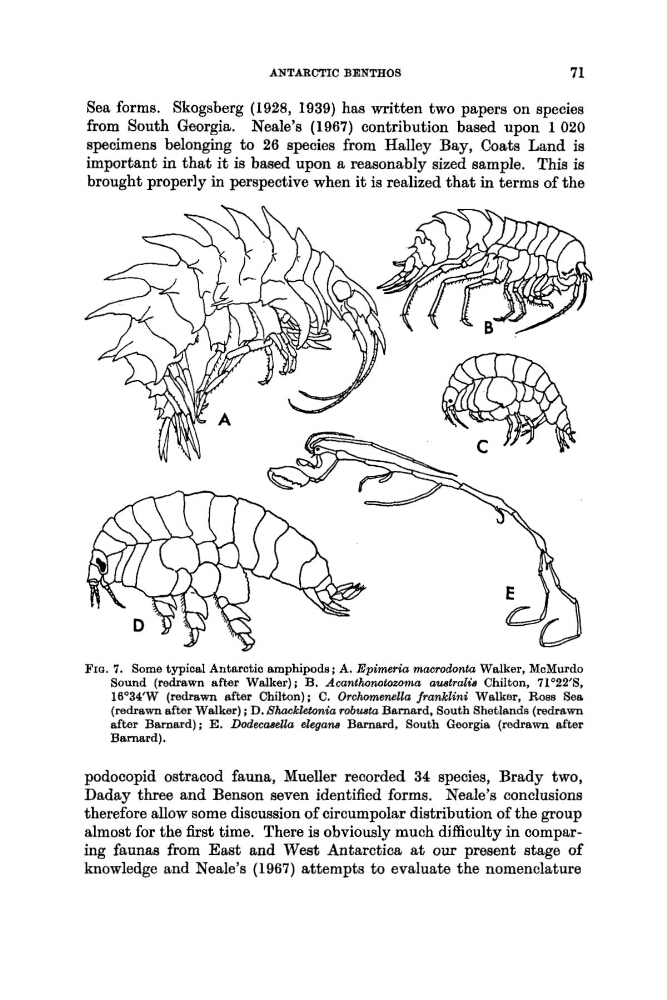
FIG. 7. Some typical Antarctic amphipods; A. Epimeria maorodonta Walker, McMurdo
Sound (redrawn after Walker) ; B. Acanthonotozoma australke Chilton, 7I022’S,
16’34‘W (redrawn after Chilton) ; C. Orchomenella franklini Walker, Ross Sea,
(redrawn after Walker) ; D, Shackletonia robusta Barnard, South Shetlands (redrawn
after Barnard) ; E. Dodecasella elegana Barnard, South Georgia (redrawn after
Barnard).
podocopid ostracod fauna, Mueller recorded 34 species, Brady two,
Daday three and Benson seven identified forms. Neale’s conclusions
therefore allow some discussion of circumpolar distribution of the group
almost for the f i s t time. There is obviously much difficulty in comparing faunas from East and West Antarctica at our present stage of
knowledge and Neale’s (1967) attempts to evaluate the nomenclature
71
Sea forms. Skogsberg (1928, 1939) has written two papers on species
from South Georgia. Neale’s (1967) contribution based upon 1 020
specimens belonging to 26 species from Halley Bay, Coats Land is
important in that it is based upon a reasonably sized sample. This is
brought properly in perspective when it is realized that in terms of the
FIG. 7. Some typical Antarctic amphipods; A. Epimeria maorodonta Walker, McMurdo
Sound (redrawn after Walker) ; B. Acanthonotozoma australke Chilton, 7I022’S,
16’34‘W (redrawn after Chilton) ; C. Orchomenella franklini Walker, Ross Sea,
(redrawn after Walker) ; D, Shackletonia robusta Barnard, South Shetlands (redrawn
after Barnard) ; E. Dodecasella elegana Barnard, South Georgia (redrawn after
Barnard).
podocopid ostracod fauna, Mueller recorded 34 species, Brady two,
Daday three and Benson seven identified forms. Neale’s conclusions
therefore allow some discussion of circumpolar distribution of the group
almost for the f i s t time. There is obviously much difficulty in comparing faunas from East and West Antarctica at our present stage of
knowledge and Neale’s (1967) attempts to evaluate the nomenclature