

64
R. K. DELL
146-170 fm). Hedgpeth supposes that the dispersal of pycnogonids is
probably easier than that of the shelled gastropod concerned.
0. Crustacea
1. Cirripedia
The continent of Antarctica would hardly seem an ideal, or even a
possible habitat for barnacles. It does in fact support a varied fauna of
benthic forms, some of the genera presenting a wealth of varied aspects.
n
-
E
G
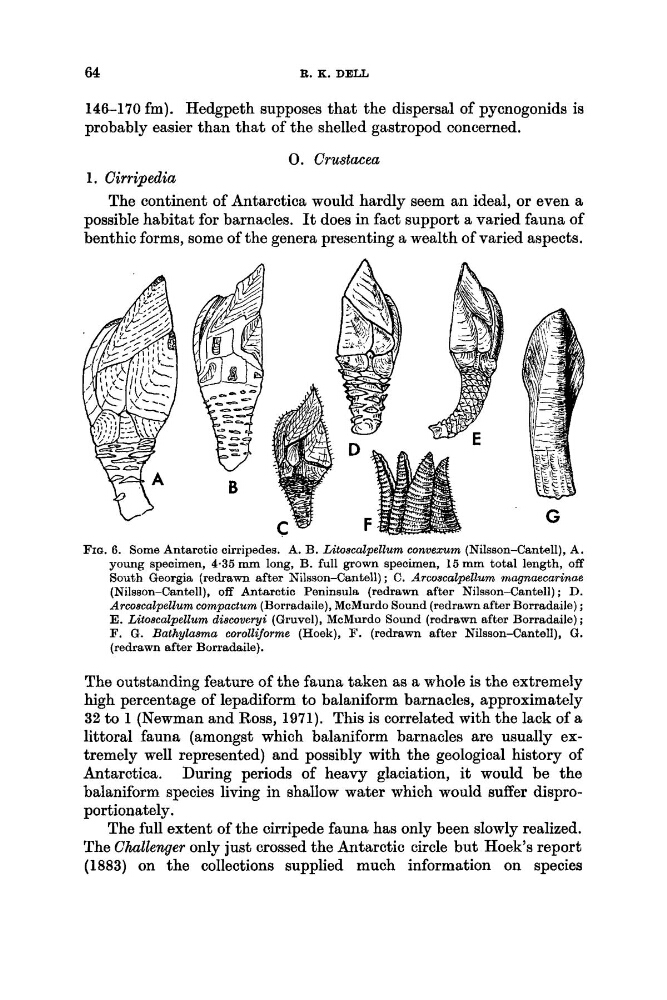
FIQ. 6. Some Antarctic cirripedes. A. B. Litoscalpellurn convexum (Nilsson-Cantell), A ,
young specimen, 4.35 mm long, B. full grown specimen, 15 mm total length, off
South Georgia (redrawn after Nilsson-Cantell) ; C. Arcoscalpellum magnaecarinae
(Nilsson-Cantell), off Antarctic Peninsula (redrawn after Nilsson-Cantell) ; D.
Arcoscalpellurn compacturn (Borradaile), McMurdo Sound (redrawn after Borradaile) ;
E. Litoacalpellurn discoveryi (Gruvel), McMurdo Sound (redrawn after Borradaile) ;
F. G. Balhylama corolliforme (Hoek), F. (redrawn after Nilsson-Cantell), G.
(redrawn after Borradaile).
The outstanding feature of the fauna taken as a whole is the extremely
high percentage of lepadiform to balaniform barnacles, approximately
32 to 1 (Newman and Ross, 1971). This is correlated with the lack of a
littoral fauna (amongst which balaniform barnacles are usually extremely well represented) and possibly with the geological history of
Antarctica. During periods of heavy glaciation, it would be the
balaniform species living in shallow water which would suffer disproportionately.
The full extent of the cirripede fauna has only been slowly realized.
The Challenger only just crossed the Antarctic circle but Hoek’s report
(1883) on the collections supplied much information on species
R. K. DELL
146-170 fm). Hedgpeth supposes that the dispersal of pycnogonids is
probably easier than that of the shelled gastropod concerned.
0. Crustacea
1. Cirripedia
The continent of Antarctica would hardly seem an ideal, or even a
possible habitat for barnacles. It does in fact support a varied fauna of
benthic forms, some of the genera presenting a wealth of varied aspects.
n
-
E
G
FIQ. 6. Some Antarctic cirripedes. A. B. Litoscalpellurn convexum (Nilsson-Cantell), A ,
young specimen, 4.35 mm long, B. full grown specimen, 15 mm total length, off
South Georgia (redrawn after Nilsson-Cantell) ; C. Arcoscalpellum magnaecarinae
(Nilsson-Cantell), off Antarctic Peninsula (redrawn after Nilsson-Cantell) ; D.
Arcoscalpellurn compacturn (Borradaile), McMurdo Sound (redrawn after Borradaile) ;
E. Litoacalpellurn discoveryi (Gruvel), McMurdo Sound (redrawn after Borradaile) ;
F. G. Balhylama corolliforme (Hoek), F. (redrawn after Nilsson-Cantell), G.
(redrawn after Borradaile).
The outstanding feature of the fauna taken as a whole is the extremely
high percentage of lepadiform to balaniform barnacles, approximately
32 to 1 (Newman and Ross, 1971). This is correlated with the lack of a
littoral fauna (amongst which balaniform barnacles are usually extremely well represented) and possibly with the geological history of
Antarctica. During periods of heavy glaciation, it would be the
balaniform species living in shallow water which would suffer disproportionately.
The full extent of the cirripede fauna has only been slowly realized.
The Challenger only just crossed the Antarctic circle but Hoek’s report
(1883) on the collections supplied much information on species