

470
0. B. COWEY AND J. R. SARGENT
those enzymes for which the vitamin serves (possibly in a modified
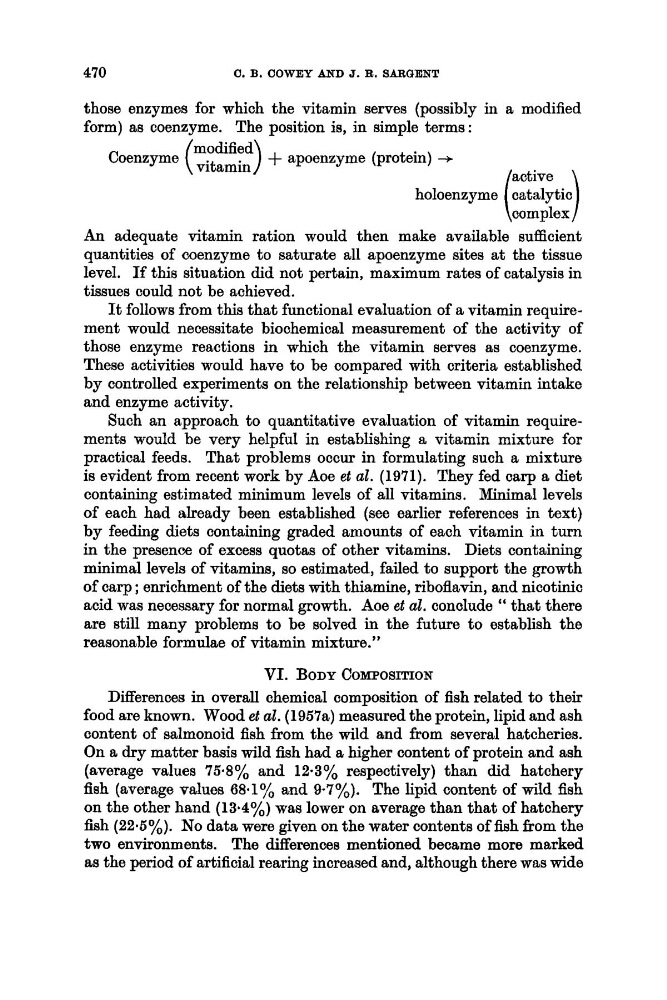
form) as coenzyme. The position is, in simple terms:
Coenzyme (modi fi ed) + apoenzyme (protein) +
vitamin
holoenzyme catalytic
(
:
:
e
x
)
An adequate vitamin ration would then make available sufficient
quantities of coenzyme to saturate all apoenzyme sites at the tissue
level. If this situation did not pertain, maximum rates of catalysis in
tissues could not be achieved.
It follows from this that functional evaluation of a vitamin requirement would necessitate biochemical measurement of the activity of
those enzyme reactions in which the vitamin serves as coenzyme.
These activities would have to be compared with criteria established
by controlled experiments on the relationship between vitamin intake
and enzyme activity.
Such an approach to quantitative evaluation of vitamin requirements wouId be very helpful in establishing a vitamin mixture for
practical feeds. That problems occur in formulating such a mixture
is evident from recent work by Aoe et al. (1971). They fed carp a diet
containing estimated minimum levels of all vitamins. Minimal levels
of each had already been established (see earlier references in text)
by feeding diets containing graded amounts of each vitamin in turn
in the presence of excess quotas of other vitamins. Diets containing
minimal levels of vitamins, so estimated, failed to support the growth
of carp ; enrichment of the diets with thiamine, riboflavin, and nicotinic
acid was necessary for normal growth. Aoe et al. conclude “ that there
are still many problems to be solved in the future to establish the
reasonable formulae of vitamin mixture.”
VI. BODY COMPOSITION
Differences in overall chemical composition of fish related to their
food are known. Wood et al. (1957a) measured the protein, lipid and ash
content of salmonoid fish from the wild and from several hatcheries.
On a dry matter basis wild fish had a higher content of protein and ash
(average values 7543% and 12.3% respectively) than did hatchery
fish (average values 6S.1y0 and 9.7%). The lipid content of wild fish
on the other hand (13.4%) was lower on average than that of hatchery
fish (22.5%). No data were given on the water contents of fish from the
two environments. The differences mentioned became more marked
as the period of artificial rearing increased and, although there was wide
0. B. COWEY AND J. R. SARGENT
those enzymes for which the vitamin serves (possibly in a modified
form) as coenzyme. The position is, in simple terms:
Coenzyme (modi fi ed) + apoenzyme (protein) +
vitamin
holoenzyme catalytic
(
:
:
e
x
)
An adequate vitamin ration would then make available sufficient
quantities of coenzyme to saturate all apoenzyme sites at the tissue
level. If this situation did not pertain, maximum rates of catalysis in
tissues could not be achieved.
It follows from this that functional evaluation of a vitamin requirement would necessitate biochemical measurement of the activity of
those enzyme reactions in which the vitamin serves as coenzyme.
These activities would have to be compared with criteria established
by controlled experiments on the relationship between vitamin intake
and enzyme activity.
Such an approach to quantitative evaluation of vitamin requirements wouId be very helpful in establishing a vitamin mixture for
practical feeds. That problems occur in formulating such a mixture
is evident from recent work by Aoe et al. (1971). They fed carp a diet
containing estimated minimum levels of all vitamins. Minimal levels
of each had already been established (see earlier references in text)
by feeding diets containing graded amounts of each vitamin in turn
in the presence of excess quotas of other vitamins. Diets containing
minimal levels of vitamins, so estimated, failed to support the growth
of carp ; enrichment of the diets with thiamine, riboflavin, and nicotinic
acid was necessary for normal growth. Aoe et al. conclude “ that there
are still many problems to be solved in the future to establish the
reasonable formulae of vitamin mixture.”
VI. BODY COMPOSITION
Differences in overall chemical composition of fish related to their
food are known. Wood et al. (1957a) measured the protein, lipid and ash
content of salmonoid fish from the wild and from several hatcheries.
On a dry matter basis wild fish had a higher content of protein and ash
(average values 7543% and 12.3% respectively) than did hatchery
fish (average values 6S.1y0 and 9.7%). The lipid content of wild fish
on the other hand (13.4%) was lower on average than that of hatchery
fish (22.5%). No data were given on the water contents of fish from the
two environments. The differences mentioned became more marked
as the period of artificial rearing increased and, although there was wide