

FISH NUTRITION
467
malonyl coenzyme A to succinyl coenzyme A, (ii) in the catabolism of
propionate, (iii) in the methylation of homocysteine to methionine.
In view of the profound effects of vitamin B,, deficiency on the
growth of domestic animals (pigs, chicks) the effects of feeding vitamin
B,, deficient diets to fish are surprisingly small. Halver (1957) found no
effect of such treatment on the growth of chinook salmon although
fragmentation of erythrocytes was evident. Kitamura et al. (1967a)
found no effects at all in rainbow trout, whereas Dupree (1966) found
that weight gain of channel catfish was reduced after about four months
on such a diet. Data on the vitamin BIZ content of the tissues of these
fish would have been of considerable interest.
High concentrations of vitamin B,, occur in the tissues of fish
(Tarr et al., 1950), the kidney (18 pg/g dry matter) being especially
rich. It may serve as a reserve of the vitamin prior to egg maturation.
During the spawning of Atlantic salmon (Salmo salar) the vitamin B,,
in the kidney falls from 24 pg/g dry matter to 5 pg/g dry matter
(Cowey et al., 1962). The distribution of the vitamin between the
different organs of marine fish is of interest (Braekkan, 1958). High
concentrations are encountered in the heart of certain species,
particulady in " undernourished " fish where the concentration in the
heart exceeded that in the liver. These high levels of vitamin B,, in
marine fish may be fortuitous (plaice, which inhabit shallow coastal
water where high vitamin B,, concentrations might be expected to
occur and to be taken up through the food chain, had the highest
average liver concentration of vitamin B,,) and comparative data
relating to cultured fish receiving diets free of the vitamin would again
be of interest.
11. Ascorbic acid
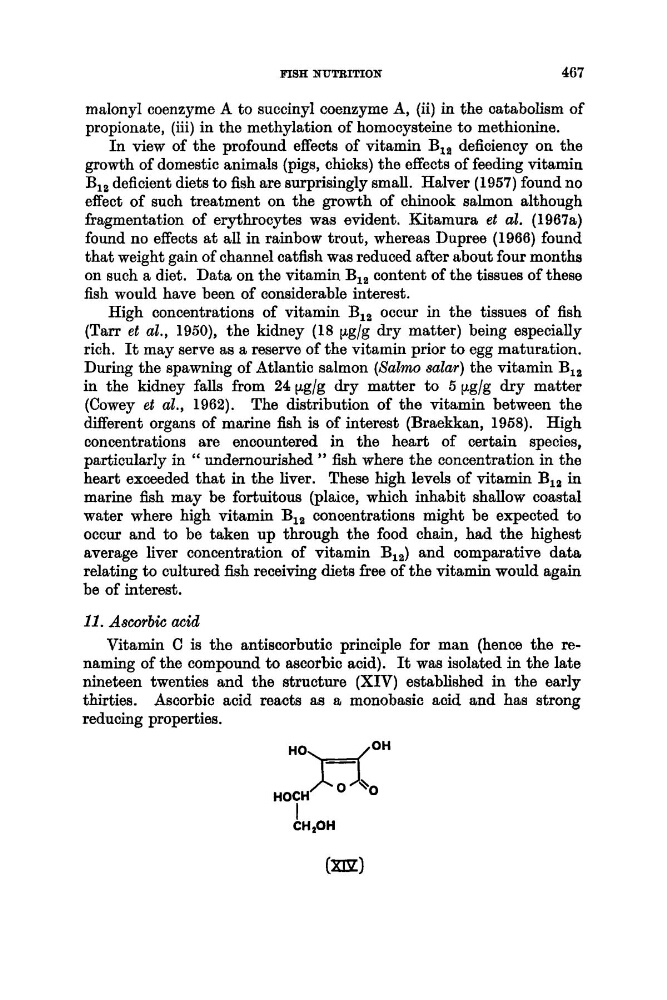
Vitamin C is the antiscorbutic principle for man (hence the renaming of the compound to ascorbic acid). It was isolated in the late
nineteen twenties and the structure (XIV) established in the early
thirties. Ascorbic acid reacts as a monobasic acid and has strong
reducing properties.
HOCH " O S :
I
467
malonyl coenzyme A to succinyl coenzyme A, (ii) in the catabolism of
propionate, (iii) in the methylation of homocysteine to methionine.
In view of the profound effects of vitamin B,, deficiency on the
growth of domestic animals (pigs, chicks) the effects of feeding vitamin
B,, deficient diets to fish are surprisingly small. Halver (1957) found no
effect of such treatment on the growth of chinook salmon although
fragmentation of erythrocytes was evident. Kitamura et al. (1967a)
found no effects at all in rainbow trout, whereas Dupree (1966) found
that weight gain of channel catfish was reduced after about four months
on such a diet. Data on the vitamin BIZ content of the tissues of these
fish would have been of considerable interest.
High concentrations of vitamin B,, occur in the tissues of fish
(Tarr et al., 1950), the kidney (18 pg/g dry matter) being especially
rich. It may serve as a reserve of the vitamin prior to egg maturation.
During the spawning of Atlantic salmon (Salmo salar) the vitamin B,,
in the kidney falls from 24 pg/g dry matter to 5 pg/g dry matter
(Cowey et al., 1962). The distribution of the vitamin between the
different organs of marine fish is of interest (Braekkan, 1958). High
concentrations are encountered in the heart of certain species,
particulady in " undernourished " fish where the concentration in the
heart exceeded that in the liver. These high levels of vitamin B,, in
marine fish may be fortuitous (plaice, which inhabit shallow coastal
water where high vitamin B,, concentrations might be expected to
occur and to be taken up through the food chain, had the highest
average liver concentration of vitamin B,,) and comparative data
relating to cultured fish receiving diets free of the vitamin would again
be of interest.
11. Ascorbic acid
Vitamin C is the antiscorbutic principle for man (hence the renaming of the compound to ascorbic acid). It was isolated in the late
nineteen twenties and the structure (XIV) established in the early
thirties. Ascorbic acid reacts as a monobasic acid and has strong
reducing properties.
HOCH " O S :
I