

458
CY. B. COWEY AND J. B. SABUENT
0
ll,OH
OH
CH 2O P\
I
HO-C-H
I
HO- C -H
I
HO-C-H
I
CH2
I
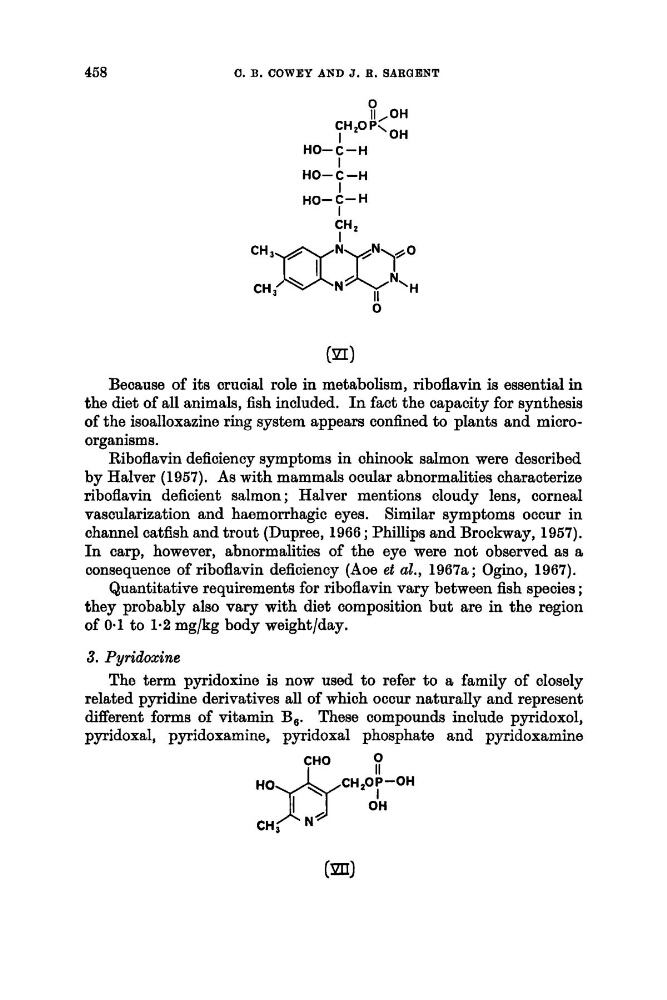
Because of its crucial role in metabolism, riboflavin is essential in
the diet of all animals, fish included. I n fact the capacity for synthesis
of the isoalloxazine ring system appears confined to plants and microorganisms.
Riboflavin deficiency symptoms in chinook salmon were described
by Halver (1957). As with mammals ocular abnormalities characterize
riboflavin deficient salmon ; Halver mentions cloudy lens, corneal
vascularization and haemorrhagic eyes. Similar symptoms occur in
channel catfish and trout (Dupree, 1966 ; Phillips and Brockway, 1957).
In carp, however, abnormalities of the eye were not observed as a
consequence of riboflavin deficiency (Aoe et al., 1967a; Ogino, 1967).
Quantitative requirements for riboflavin vary between fish species ;
they probably also vary with diet composition but are in the region
of 0.1 to 1.2 mg/kg body weightlday.
3. Pyridoxine
The term pyridoxine is now used to refer to a family of closely
related pyridine derivatives all of which occur naturally and represent
different forms of vitamin B,. These compounds include pyridoxol,
pyridoxal, pyridoxamine, pyridoxal phosphate and pyridoxamine
0
OH
CY. B. COWEY AND J. B. SABUENT
0
ll,OH
OH
CH 2O P\
I
HO-C-H
I
HO- C -H
I
HO-C-H
I
CH2
I
Because of its crucial role in metabolism, riboflavin is essential in
the diet of all animals, fish included. I n fact the capacity for synthesis
of the isoalloxazine ring system appears confined to plants and microorganisms.
Riboflavin deficiency symptoms in chinook salmon were described
by Halver (1957). As with mammals ocular abnormalities characterize
riboflavin deficient salmon ; Halver mentions cloudy lens, corneal
vascularization and haemorrhagic eyes. Similar symptoms occur in
channel catfish and trout (Dupree, 1966 ; Phillips and Brockway, 1957).
In carp, however, abnormalities of the eye were not observed as a
consequence of riboflavin deficiency (Aoe et al., 1967a; Ogino, 1967).
Quantitative requirements for riboflavin vary between fish species ;
they probably also vary with diet composition but are in the region
of 0.1 to 1.2 mg/kg body weightlday.
3. Pyridoxine
The term pyridoxine is now used to refer to a family of closely
related pyridine derivatives all of which occur naturally and represent
different forms of vitamin B,. These compounds include pyridoxol,
pyridoxal, pyridoxamine, pyridoxal phosphate and pyridoxamine
0
OH